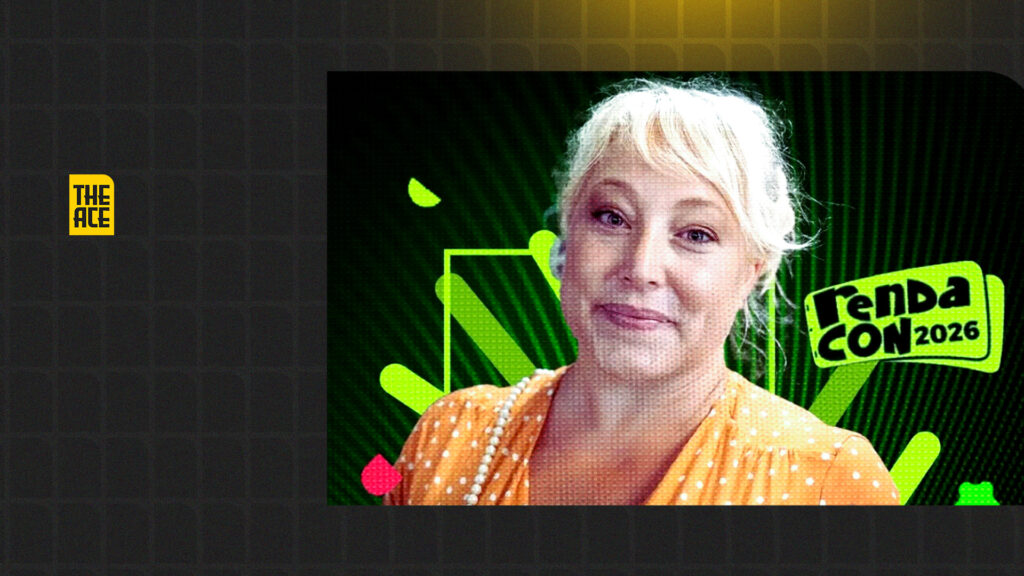
Before Vanessa Sinden ever stepped onto the RendaCon stage, her work had already travelled across borders, not as export, but as quiet insistence. Projects like Kizazi Moto, Super Team 4, and Generation Fire, each attempting, in different ways, to answer the same underlying question: what does it mean to tell an African story for the world without losing its centre?
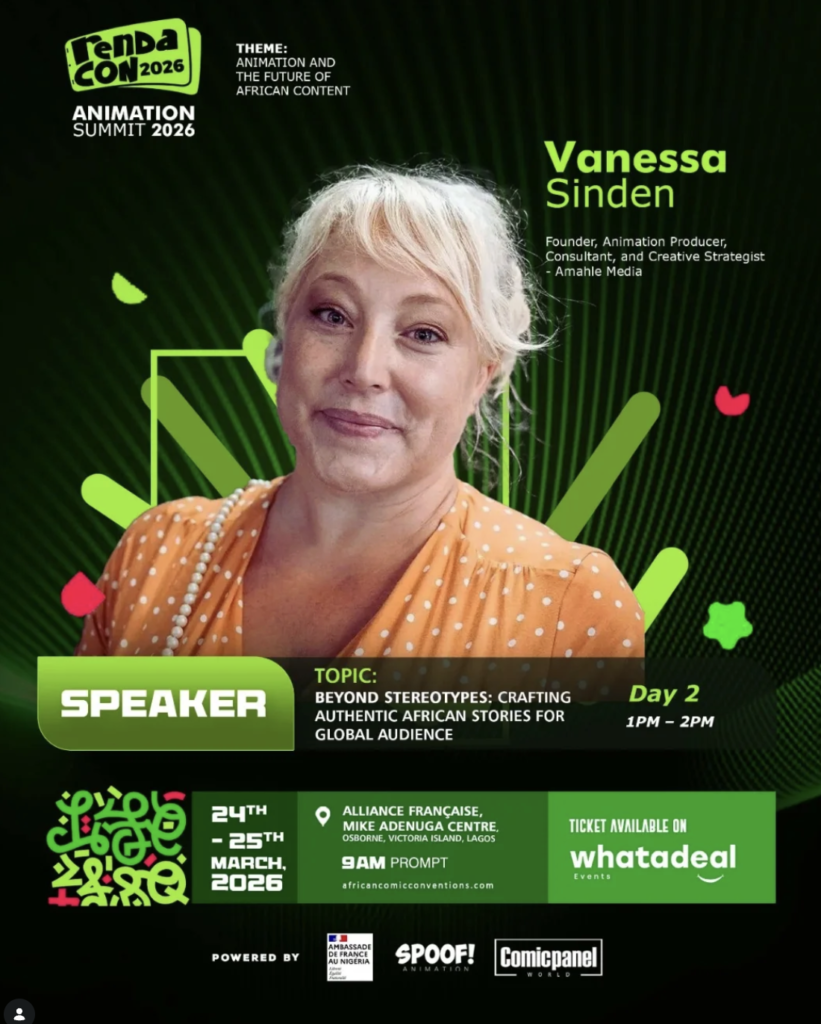
It is a question that has followed the industry for years, often answered through aesthetics; accent, setting, costume, all surface signifiers that risked flattening depth into decoration, while something more fundamental slips through the cracks. At RendaCon 2026, in her session “Beyond Stereotypes: Crafting Authentic African Stories for a Global Audience,” Sinden shifted the lens entirely. The conversation moved away from what African stories look like to how they are built.
What she offers is not a checklist, but a compass, a set of principles shaped by experience working across continents, navigating co-productions, and confronting the quiet trade-offs between visibility and control. Here are five things that, in her framing, make an African story truly authentic.
1. Authorship Is Not Optional
At the heart of Sinden’s argument is a quiet but radical insistence: authenticity is not added later like subtitles or a local soundtrack. It is embedded in the very first frame. So, African stories must be authored from within. “It’s really about a point of view. It’s about authorship and specificity,” she explains. “Who is telling the story is key to the story that’s being told to global audiences.”
This goes beyond representation on screen. It speaks to control at the level of creation, who writes, who directs, who shapes the world from its earliest conceptual stages. According to her, writers, directors, and producers who are rooted in the cultural context of the story carry an internal logic no research trip can replicate. They bring lived nuance, unspoken grammar, the weight of history in a glance or silence. “You can’t reverse-engineer that,” she insists. And she’s right. Because when authorship resides elsewhere, what follows isn’t adaptation, it’s approximation.
Thus, the integrity of a story is determined long before production begins. Authenticity, in this sense, is not a layer. It is a foundation.
2. Specificity Is the Gateway to Universality
One of the most persistent myths about African storytelling is that it must generalise to travel. Sinden dismantles this completely. “It’s not about aesthetic markers… or accents. It’s not just about that,” she notes.
Global audiences, she argues, are not looking for a singular African voice. They are drawn to stories that are rooted deeply and unapologetically in place.” A Lagos street market at 6 a.m., the rhythm of Zulu idioms in dialogue, the quiet tension between tradition and TikTok, these are not barriers to connection. They are invitations. “They’re looking for hyper-local settings… localised voice in vernacular… content that’s driven by social realities.
Paradoxically, it is this level of precision that allows stories to resonate beyond their origin. “When a story is vague, it’s really hard for an audience to engage,” she observes. But when it’s clear and precise, anchored in place, language, and lived reality, it really does travel well, not despite its specificity, but because of it.
3. Cultural Detail Must Not Be Negotiated Away
There is a quiet pressure in pitch decks, funding applications, and distribution talks to soften edges, simplify textures, “globalise” the vernacular. Sinden calls it what it is: surrender disguised as strategy. This recurring anxiety among creators working within global systems on the need to dilute to make stories more “accessible” Sinden rejects outright. “Do we pull back on the African-ness or the richness of our story…? I honestly don’t believe that.”
The richness of African storytelling, its proverbs layered with irony, its music carrying memory, its visual grammar rooted in pattern and symbolism, is not a hurdle nor is it a liability. It is the heart rate of the story. It is the very thing that gives it weight. To strip it is to amputate meaning. “I think keeping cultural detail is essential,” she insists.
The real work lies elsewhere: in strengthening the narrative engine like character, consequence, stakes and so on. This ensures that the story itself is compelling enough to carry that detail across borders.
4. Collaboration Should Not Mean Surrender
Sinden is neither isolationist nor idealist, but pragmatic about the realities of the industry. African productions thrive on partnerships for funding, distribution, and scale. Collaboration, therefore, is inevitable. But she draws a line where many blur it: collaboration must never be code for cession. “You don’t want to exclude collaboration,” she says, “but you don’t want to give away creative control or have a meaningful influence on the content.”
She cites a sobering truth: “As soon as outside of Africa invest in our IP… the IP does flatten. It does become more generic.” Not because outsiders lack talent, but because systems rarely accommodate worldview as infrastructure. Creative control is not ego. It is the safeguard against erasure. When that balance is lost, the consequences are predictable.
True collaboration begins with parity, shared vision, transparent deal structures, and IP ownership held firmly, collectively, by those who birthed the idea. Authenticity cannot survive without control.
5. Perspective Is the True Marker of Identity
This is the quiet pivot, the principle that binds the others. What makes a story African is not its geography, but its gravity. Its moral architecture. Its understanding of time, kinship, justice, not as tropes, but as lived frameworks.
The most subtle, and most important, point is this: what makes a story African is its point of view. “It’s really about a point of view,” she reiterates, returning to the idea that anchors her entire session. This perspective is shaped by lived reality, by how stories understand community, conflict, history, and possibility.
Sinden reminds us: African creators are not merely entering global storytelling. They are redefining it, sourcing stories differently, structuring them beyond three-act rigidity, and owning them beyond licensing windows. “We’re not just participating in global media,” she says. “We can redefine how stories are sourced, structured, and owned.” This is where authenticity becomes harder to imitate. It is not in costume or accent, but in worldview.
Beyond Visibility
What makes Sinden’s message resonate is its refusal of hollow metrics. She shifts the conversation away from visibility, a metric that has dominated discussions about African storytelling for years. The question is no longer simply whether African stories are being seen. The more urgent question is: under what conditions are they being told?
Because visibility without control is just performance without power. Representation without authorship risks becoming spectacle. Inclusion without infrastructure becomes tokenism. The real work now is not just getting stories seen, but ensuring they remain intact: narratively coherent, culturally whole, economically sovereign.
That is the quiet revolution unfolding, not in grand declarations, but in writers’ rooms, in pitch decks with firm terms, in studios insisting on co-ownership, in vernacular spoken unapologetically on screen. That is how stereotypes fall, not with a shout, but with a story told, wholly and held, from the inside out. If African storytelling is to define its place in the global industry, it will not be by fitting into existing systems. It will be by insisting at every stage of creation, collaboration, and distribution that its stories are not just present, but intact. That is the real work of moving beyond stereotypes
--------------------------------------------------------
--------------------------------------------------------
AI Use at TheACE
TheACE uses artificial intelligence tools to support research, drafting and analysis across Africa’s creative industries. All content is verified, edited and approved by our human editorial team to ensure accuracy, clarity and responsible storytelling. AI assists our work; it does not replace human judgment.