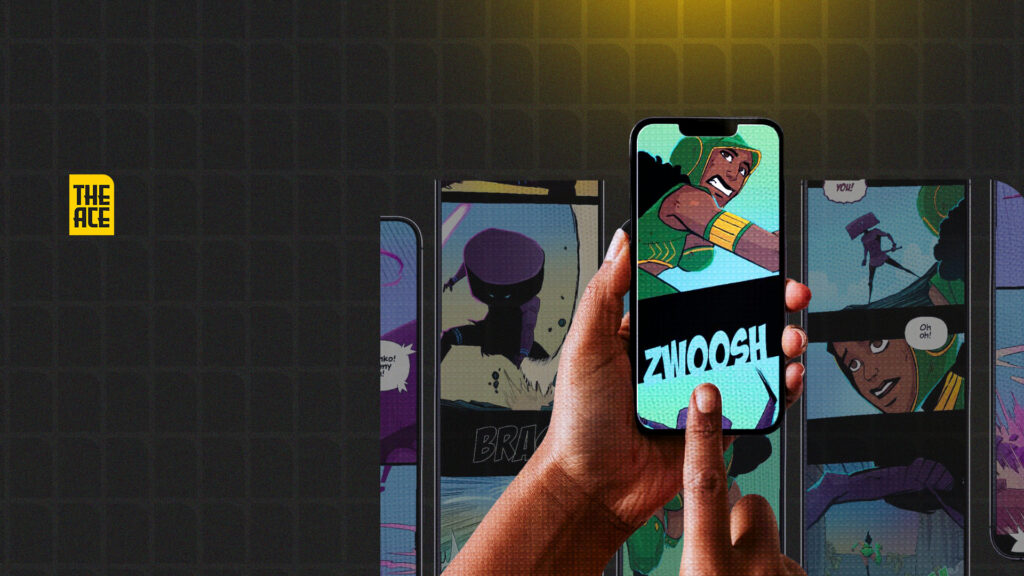
There is a particular kind of patience that page-turn comics demand of a reader. A tap, a pause while the next page loads, the small ritual of arriving at a full spread and letting the eye travel across it the way a print reader would, left to right, top to bottom. It is a format built to mimic the object it replaced. The vertical scroll asks for something else entirely. There is no page to turn, only a thumb moving down a single continuous strip, a panel bleeding into a panel, white space doing the work a page break used to do, and a story unspooling at exactly the speed the reader’s hand allows. It is a small mechanical difference. It is also, increasingly, the difference between a platform that survives the next five years and one that does not.
That distinction reaches further into the production room than it first appears. A page-turn comic is composed as a surface: an artist can stage several beats at once, bury information in a corner, or use a full-page reveal to make the reader absorb several elements simultaneously. A vertical episode is composed as a sequence. The phone exposes only a narrow portion of the story at any one moment, so order, distance and pause have to be engineered linearly. Lettering must remain legible without pinching the screen. Panel width, image compression and episode length become product decisions as much as artistic ones. Once those decisions begin shaping scripts, deadlines and release schedules, the format is no longer a container placed around the comic after it is made. It has become part of how the comic is conceived.
Three of the platforms that have shaped African digital comics over the past decade are now converging on that second format, on timelines close enough to suggest something more than coincidence. Comic Republic put its content behind a paywall in 2025 and began rolling out vertical webtoon-format titles through 2026. VORTEX247.COM, the Lagos platform Somto Ajuluchukwu built into a 400-comic catalogue over six years, is closing its page-turn site entirely by the end of 2026, folding its archive into SKROL, an AI-native storytelling platform from Vortex’s GENER8 Labs, with VX Comics continuing digital publishing in webtoon format exclusively from that point on. And this week, Ejob Nathanael Ejob, founder of Cameroon’s Zebra Comics and now a three-time DC anthology illustrator, used two LinkedIn posts to lay out the clearest public case yet for why vertical webtoon is not just a format choice but a business model.
The convergence is especially notable because the three companies did not arrive here from identical positions. Zebra has described itself as a studio, distributor, technology platform and data company, having adopted the webtoon strategy close to a decade ago. Comic Republic has spent years building recognisable superhero properties around its own publishing identity. Vortex operated as a broad digital shelf for work drawn from a much wider creator network. At its height, that network included more than 400 comics by over 60 creators across 23 countries, according to TheACE’s account of the platform’s closure. Their agreement on format does not mean that their businesses have become interchangeable. It suggests, instead, that a phone-native episode is becoming the common unit around which several different African comics businesses now expect to organise publishing, audience development and licensing.
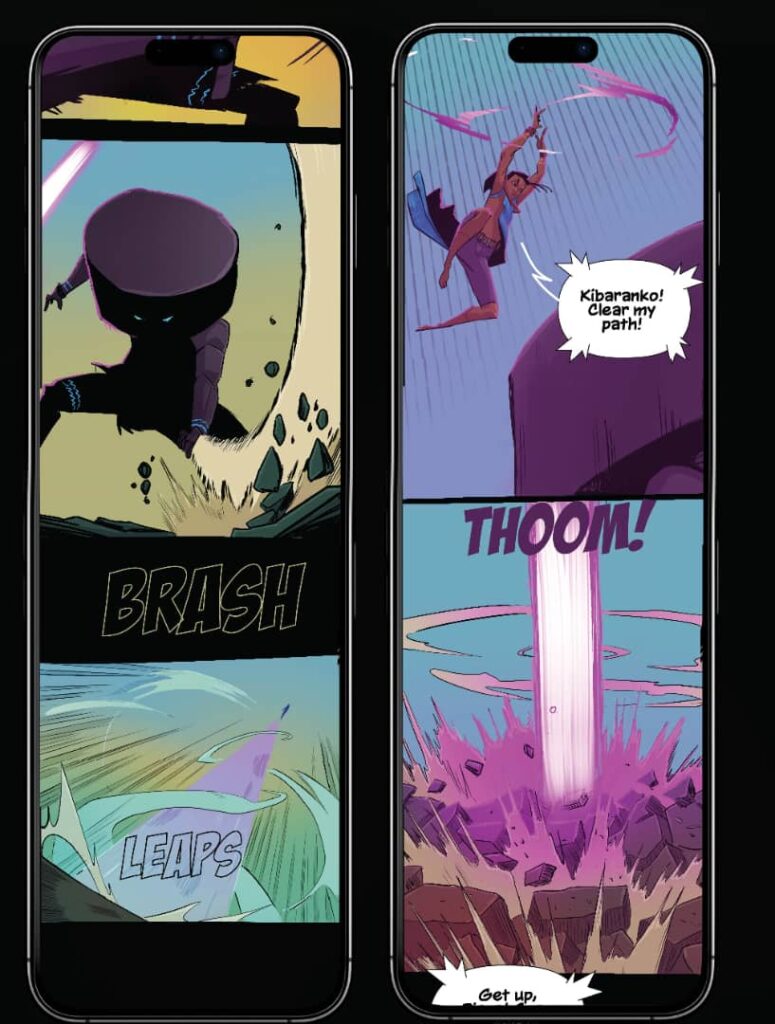
Ejob’s argument, made through stills from Zebra’s fantasy title Beasts of Tazeti, is a technical one before it is a commercial one. The space between panels controls suspense in a way a printed page cannot. A single moment can occupy the entire screen. Action reads faster because the reader is physically swiping through it rather than scanning it. And every episode can be built to end on a cliffhanger, which he frames as central to monetisation rather than incidental to it. Beasts of Tazeti is already live in English, French and Brazilian Portuguese, which lets Zebra test one story across several markets before any decision is made about expanding it into animation, games, print or merchandise. In a second post, Ejob extended the argument further, describing Zebra not as a comic studio but as what he called an IP factory: original stories created, published as webcomics, measured against real reader data, and then pitched to licensing partners on the strength of that data, positioning the studio’s newest universe, Godlevel Academy, alongside the audience Demon Slayer, My Hero Academia, Jujutsu Kaisen and Avatar: The Last Airbender have built.
The commercial logic has several layers. Free episodes can attract a reader; scheduled releases and notifications can bring that reader back; advertising, subscriptions, early-access chapters or small episode payments can convert some part of that attention into revenue. The resulting record of completion rates, repeat reading and willingness to pay can then reduce uncertainty for a film, animation, game or publishing partner. Ejob has described that pipeline in similar terms elsewhere: creation leads to distribution, distribution generates data, and data is used to identify intellectual property with expansion potential. But an IP factory only works as a factory if its chain of ownership is clear. Creator contracts must establish who controls translation, territory, print, screen, game and merchandise rights; how revenue is shared; what happens when a title is withdrawn; and whether rights return to the creator if development stops. Audience evidence can make a property easier to pitch, but it cannot repair uncertain ownership after the audience has already arrived.
It is a compelling pitch, and it drew a compelling question in the comments beneath it. Reader Michael Oscar Esio asked, reasonably, whether there is proper user feedback behind the format shift that Zebra and others can actually point to, or whether this is founder conviction being presented as market data. It is the right question to ask of any company making a public case for its own strategy, and it deserves a more careful answer than a comments thread can hold.
The careful answer would require more than a total view count. The useful comparison is how the same or closely matched stories perform in page-turn and vertical formats under similar promotional conditions. Platforms would need to compare episode-completion rates, movement from one episode to the next, seven-day and thirty-day return rates, subscription or paid-chapter conversion, cancellation, average revenue per paying reader and the amount of mobile data consumed per completed episode. Those figures would also need to be separated by country, language, device and acquisition source. A short episode can produce many starts while retaining few readers; a large catalogue can produce impressive cumulative views while generating little repeat use. Even if companies cannot release commercially sensitive totals, anonymised percentages, indexed comparisons or independently reviewed case studies would provide a firmer answer to Esio’s question than headline audience numbers alone.
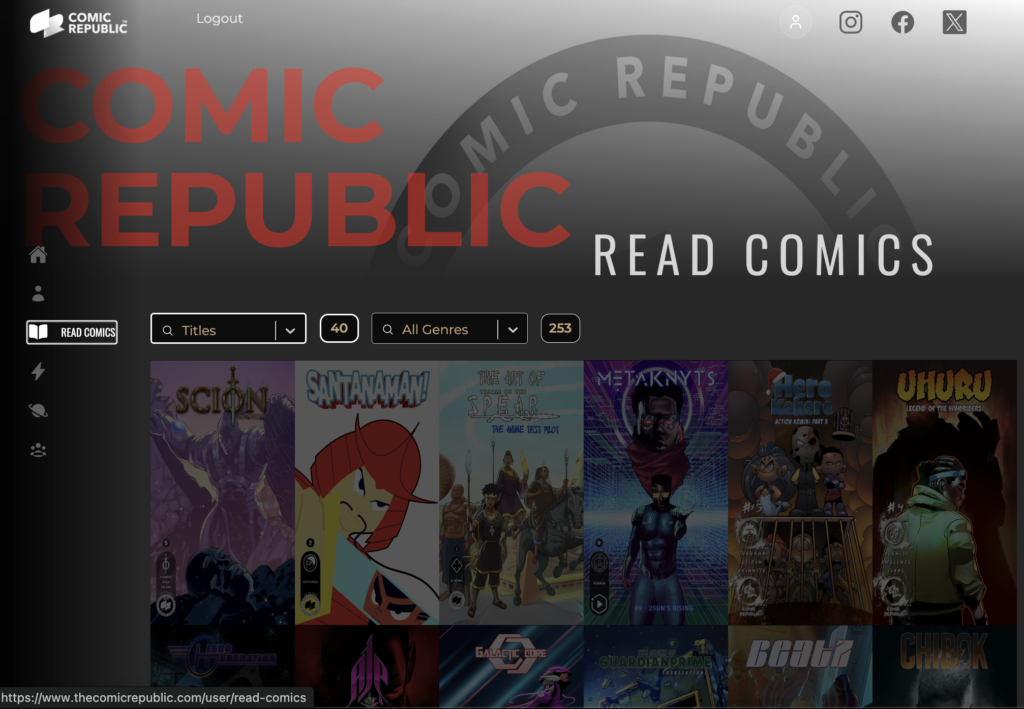
What can be said with more certainty is that Zebra is not making this argument alone. VORTEX247.COM’s migration to SKROL, confirmed on record to TheACE, is not simply Somto Ajuluchukwu retiring a platform. It is a deliberate move away from the page-turn format that defined Vortex’s identity for six years. VX Comics will continue publishing digitally in webtoon format exclusively going forward, even as print editions of its classic titles continue unaffected, a distinction that matters: this is not a company abandoning print; it is a company drawing a firm line between what belongs on a page and what belongs on a scroll. Comic Republic’s own trajectory tracks closely alongside Zebra’s and Vortex’s, moving from a 2025 paywall into a 2026 rollout of vertical-format titles, part of a broader repositioning of one of Nigeria’s longest-running digital comics platforms. Taken together, three platforms with three different founders, with different countries of origin and different business pressures, moved in the same trajectory within the past eighteen months. That is closer to a market signal than a marketing line. (NB: Zebra Comics adopted the webtoon strategy close to a decade ago)
There is, however, a substantial cost hidden inside the word migration. A finished page cannot always be cut into separate panels and stacked without damage. Speech balloons may need to be moved, backgrounds extended, transitions redrawn, and new pause panels added. A surprise designed for the turn of a printed page may become visible too early on a scroll; an action sequence designed for a tall strip may feel cramped when repacked into print. That is why Vortex’s conversion of more than 19,000 existing panels is not merely a file-transfer exercise. It is an editorial and preservation project, one that must retain credits, metadata, reading order and the visual intentions of dozens of creators while changing the work’s rhythm.
The reverse journey matters too. A successful webtoon does not arrive in bookshops simply by being exported as a PDF. It must be redesigned for fixed pages, and the expense is justified only when publishers believe a digital audience will follow the title into another format. The fourteen-title agreement between WEBTOON Entertainment and Random House is evidence that this reverse pipeline can carry commercial value: mobile readership can help select titles for print, while a printed edition can turn an impermanent stream of episodes into a collectable and distributable object.
SKROL’s description as AI-native introduces another question that should be kept separate from the case for vertical reading. Artificial intelligence could be used for recommendations, search, catalogue tagging, translation, reformatting, production assistance or the generation of new assets, and those uses do not carry the same implications. Readers and creators will need clarity about where it enters the pipeline, what material any system was trained on, whether creators consented to that use, how human authorship is credited and whether the migrated editions remain faithful to the originals. A platform can make a persuasive case for the scroll without that case automatically answering the more difficult questions raised by AI-assisted production.
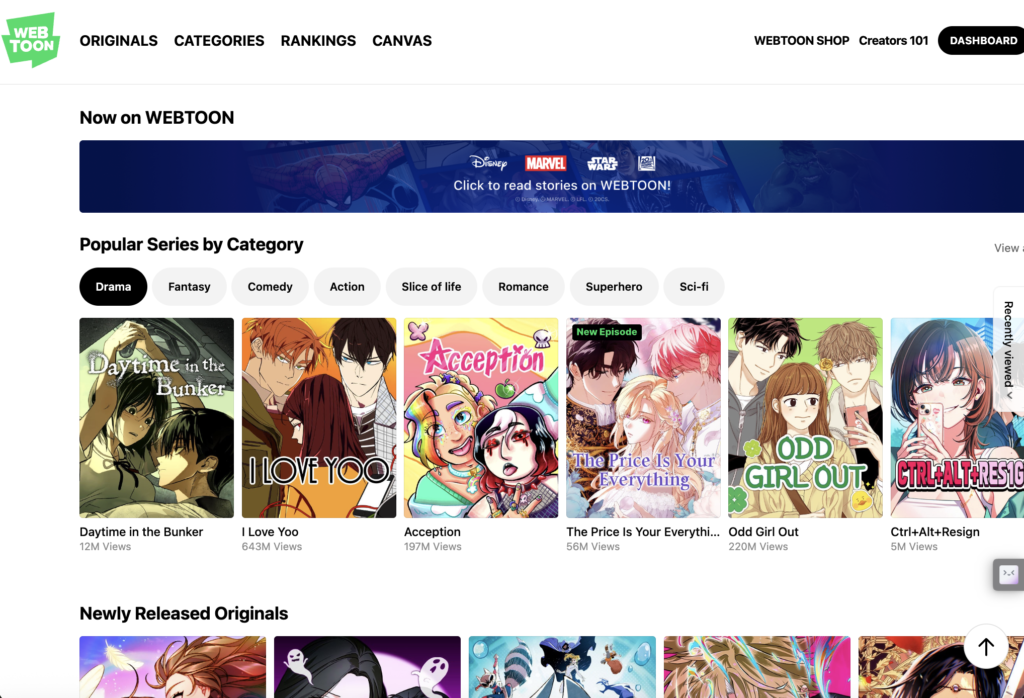
It also is not a decision being made in a vacuum. The format itself has a well-documented history elsewhere, and the shape of that history is instructive. Naver Webtoon launched in South Korea in 2004 and was spun off as a standalone subsidiary in 2017, the year its global platforms counted roughly 46 million monthly active users. By 2022, that figure had grown to 180 million, a near-quadrupling driven largely by localisation into ten languages across markets in North America, Europe, Southeast Asia and Japan. In March 2024, Naver Webtoon partnered with DC Comics to release six exclusive superhero series in webtoon format, folding major Western IP directly into a mobile-first platform, the same instinct Zebra is now applying in reverse, using its own DC anthology credits to build credibility for original African IP. Kakao’s Piccoma and platforms such as Tapas occupy similar ground in the same ecosystem, and the broader webtoon market, valued at an estimated USD 6.58 billion in 2025, is projected by industry analysts to grow at a compound annual rate above 18 per cent through the next decade, driven in large part by exactly the kind of adaptation pipeline, comic to animation, game or screen, that Ejob describes as Zebra’s core strategy.
Those global forecasts are best read as directional rather than definitive. Research firms do not always place the same things in the category: some measure webtoons alone, others combine them with webcomics, digitised manga or web novels, and their projections diverge accordingly. A more concrete picture comes from WEBTOON Entertainment’s 2024 public filing. The company reported approximately 170 million monthly active users, eight million monthly paying users and 24 million creators across more than 150 countries as of the periods covered by the filing. It also said that 117 stories generated more than USD 1 million each in paid-content transaction value during 2023. Those are powerful indicators of scale, but they carry an equally important warning: only a small share of active users pay, and the platform said that its primary monetisation markets remained Korea, Japan and North America despite its global reach.
The timeline is instructive as well. WEBTOON says it spent years building content and engagement before introducing paid content in 2012. Its current model combines paid episodes with advertising and intellectual-property adaptations rather than depending on one revenue stream. For African publishers, the lesson is not simply to copy coins, subscriptions or cliffhangers. It is that a mobile format becomes a viable business only when audience habit, reliable payments, a sufficiently deep release calendar and patient financing develop together. A technically elegant scroll cannot compensate for a catalogue that updates irregularly, a payment process readers cannot use or a creator pipeline that cannot sustain the promised schedule.
What none of that global data can tell you is how many African readers are actually part of it. It is a genuine gap, not a rhetorical one. The market research available on Naver, Kakao and their peers reports global and regional user figures for Korea, North America, Europe and Southeast Asia in granular detail, but no comparable figure exists for Africa specifically, on those platforms or in the aggregate. What is documented, instead, is what has been built locally: Zebra Comics’ own app and website, carrying titles across Afrofuturism, mythology, superhero and slice-of-life genres in multiple languages; Comic Republic’s catalogue, now moving into the same format; and Vortex’s forthcoming SKROL platform, inheriting more than 20,000 panels of existing work. The infrastructure a Korean or American reader takes for granted – cheap high-speed data, card and app-store payment rails, near-universal smartphone penetration – cannot simply be assumed onto an African rollout of the same format. Data costs remain a genuine constraint on daily scroll-heavy reading in several of the continent’s largest markets, and mobile money, not card payment, is the rail most African platforms will need to build monetisation around if the subscription and micro-payment models that fund Naver’s top creators are going to translate at all. Zebra’s own multi-market testing approach, publishing one story in three languages and watching which audience responds before committing further resources, is arguably the more exportable part of the global model here, better suited to a continent where reader behaviour still needs to be discovered market by market rather than assumed.

That infrastructure gap has direct design consequences. The GSMA’s 2024 assessment of Sub-Saharan Africa placed the region’s mobile-internet usage gap at 60 per cent, the highest in the world, and identified the affordability of smartphones and mobile service among the central barriers to adoption. For a comics platform, low-data mode, aggressive but visually responsible image compression, episode downloads, offline reading, transparent file-size information and testing on inexpensive Android devices are therefore not secondary accessibility features. They are part of the business model. So are local-currency pricing, mobile-money integration and a payment flow that does not turn a small chapter purchase into a disproportionate transaction cost.
Language also involves more than translating dialogue. Sound effects, lettering density, reading level, cultural notes, release times, marketing channels and even the price a reader sees all affect whether a translated episode feels native to its market. English, French and Brazilian Portuguese give Beasts of Tazeti access to large language communities and diasporic audiences, but the commercially useful question is not only which version draws the most first clicks. It is which audience finishes, returns, recommends, pays and remains interested long enough to support a second season or another format. The same discipline should apply to genre. A strong response to an African superhero title in one country cannot automatically be treated as proof of equal demand for fantasy, romance or slice-of-life stories elsewhere.
There is a labour question beneath the platform question as well. Regular episodic publishing requires a production line of scripts, thumbnails, finished art, colour, lettering, quality control, translation and upload, often with several episodes completed before the first is released. The cliffhanger cadence that helps retain readers can also create punishing deadlines if a platform does not fund enough lead time or enough people. A durable African webtoon model will therefore have to show not only that readers return, but that creators are paid predictably, credited visibly, given transparent royalty statements and able to produce without the schedule exhausting the teams on which the catalogue depends.
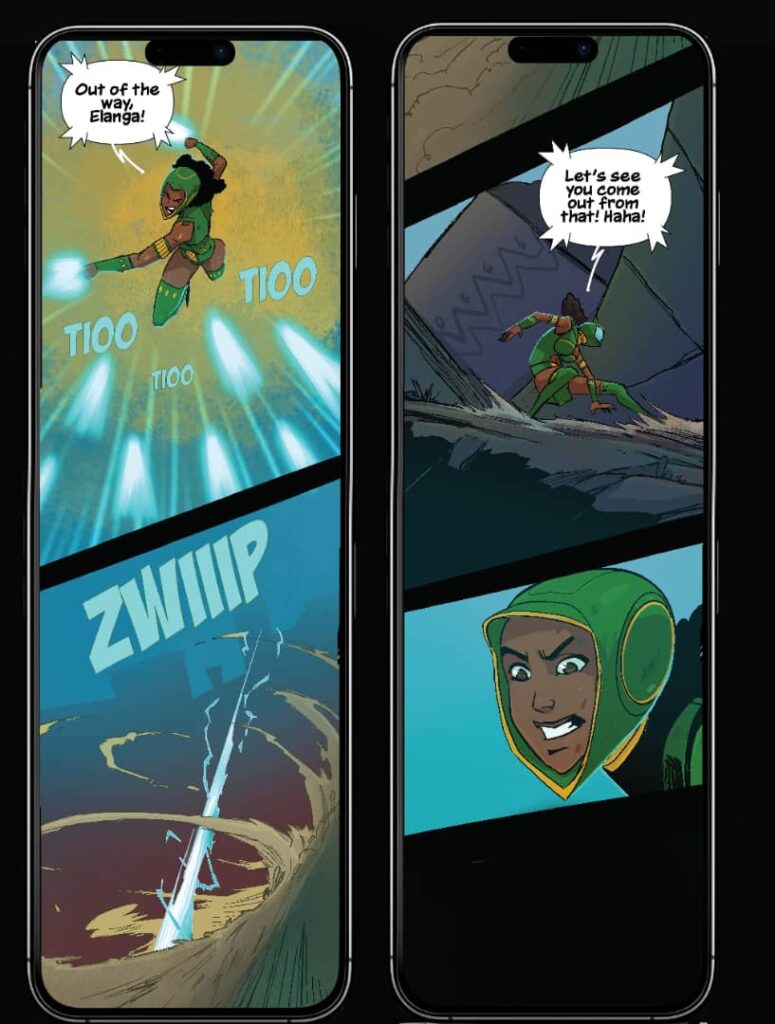
Phone-first and print-first need not be treated as mutually exclusive endpoints. Print can serve readers with unreliable connectivity, enter schools and libraries, circulate at conventions, preserve work beyond the life of an app and provide a premium object for an audience first assembled online. The more useful strategic distinction may be between using print to discover demand and using print after demand has been measured. In the second model, the phone handles serial release, discovery and feedback; selected print editions deepen the relationship with proven readers; and licensing carries the strongest properties into larger media. That sequence is coherent, but it will only be commercially persuasive when platforms disclose enough evidence to show where readers enter it, where they leave it and where they begin to pay.
None of this settles the question Ejob put to his own audience at the end of his first post: should African comics companies build primarily for print or for the phone, printing only what has already proven its audience online? It is not a question with an obvious answer, and it is worth treating as still open. What the last eighteen months make clear is that three of the platforms best positioned to answer it, Zebra, Comic Republic and Vortex, have each independently decided that the phone comes first. Whether the audience data backing that decision is as solid as its founders suggest is a question TheACE will be putting directly to the wider community in the days ahead.
References
- Ejob Nathanael Ejob, LinkedIn posts on vertical webtoon format and Zebra Comics’ IP strategy (accessed August 2026)
- TheACE, “VORTEX247.COM Is Shutting Down After 6 Years: Somto Ajuluchukwu Confirms,” 13 July 2026, theafricancomicsempire.com
- ActuaBD, “Le Webtoon en Afrique (2): comment le Camerounais Zebra Comics…,” actuabd.com
- ComicPanelWorld, “Ejob Nathanael Ejob Makes History with DC, Illustrates Supergirl: The World Through Zebra Comics,” comicpanelworld.com
- KED Global, “Naver Webtoon’s global users quadruple in 5 years on localization,” kedglobal.com
- Business Research Insights, “Webtoons Market Size & Share Trends, 2035,” businessresearchinsights.com (Naver Webtoon MAU figures, market sizing)
- Expert Market Research, “Webtoons Market Size, Share and Growth Analysis Report,” expertmarketresearch.com
- Market Growth Reports, “Webtoons Market Size & Share Trends, 2035” (Naver–DC Comics partnership, March 2024), marketgrowthreports.com
- Zebra Comics Blog, “What African Comics Companies Should Learn from Webtoon,” blog.zebra-comics.com
- Zebra Comics Blog, “The Growth of the Webtoon Market in Africa,” blog.zebra-comics.com
Note: figures on Comic Republic’s 2025 paywall and 2026 vertical-format rollout reflect TheACE’s own editorial tracking of the platform, not a third-party published source.
Written by Seyi Adedokun and Mujeeb Jummah
--------------------------------------------------------
--------------------------------------------------------
AI Use at TheACE
TheACE uses artificial intelligence tools to support research, drafting and analysis across Africa’s creative industries. All content is verified, edited and approved by our human editorial team to ensure accuracy, clarity and responsible storytelling. AI assists our work; it does not replace human judgment.