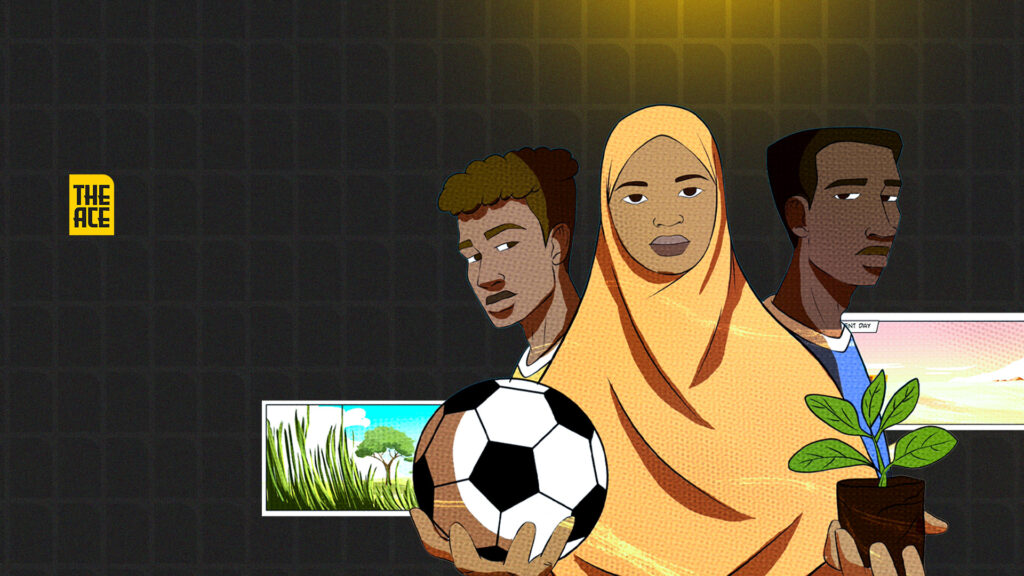
The comic book is often celebrated for its entertainment value, but its utility extends far beyond the superhero trope. In the right hands, sequential art becomes a vehicle for education and a megaphone for advocacy. This is the precise space occupied by “Youth: Rise for a Greener Future”, an 18-page narrative that leverages the “beautiful game” of football to tackle the existential crisis of climate change and the social friction of displacement in Somalia.
Produced by Freehand Studios and supported by a coalition of international partners, this work is a sophisticated example of “graphic diplomacy.” It humanises geopolitical and environmental data, transforming abstract statistics into a tangible struggle for survival and reconciliation.
A Tale of Two Captains
The story introduces us to a present-day reality where the “blazing sun” and sweeping sands have turned once-fertile fields into dust. At the heart of this landscape are two young men: Liban, a reserved and determined striker, and Burhan, a confident, charismatic defender.
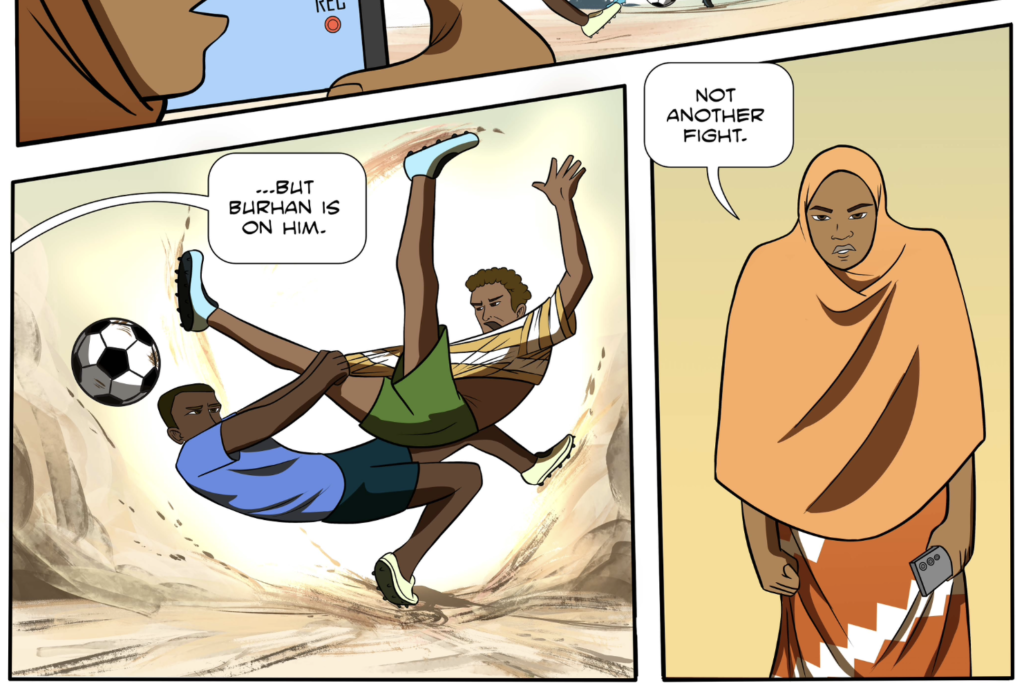
What begins as a high-stakes football match (Pages 3–8) quickly devolves into a physical altercation. Their rivalry mirrors a growing social divide in the region. Liban leads a team from an IDP (Internally Displaced Persons) camp; people forced from their ancestral homes by environmental collapse. Burhan, representing the settled town community, views these newcomers with a mixture of arrogance and hostility, dismissing them as “homeless nobodies”.
The tension reaches a breaking point during a heated match when a rough tackle by Burhan leads to a foul and a subsequent confrontation. This moment of athletic aggression serves as a metaphor for the broader “tense atmosphere” between displaced populations and host communities. As Burhan storms off the field, his disdain for the “small clan” of the IDP team highlights the tribal and social barriers that prevent collective action.
The Ghost of a Greener Past
The narrative’s emotional weight is anchored in its use of memory. Through a series of flashbacks, the comic contrasts the arid present with a vibrant past. Twenty years ago (Page 13), the land was protected by “trees and grass,” providing shade from the harsh winds and sustenance for livestock. There was a borehole with “plentiful water” for all communities.
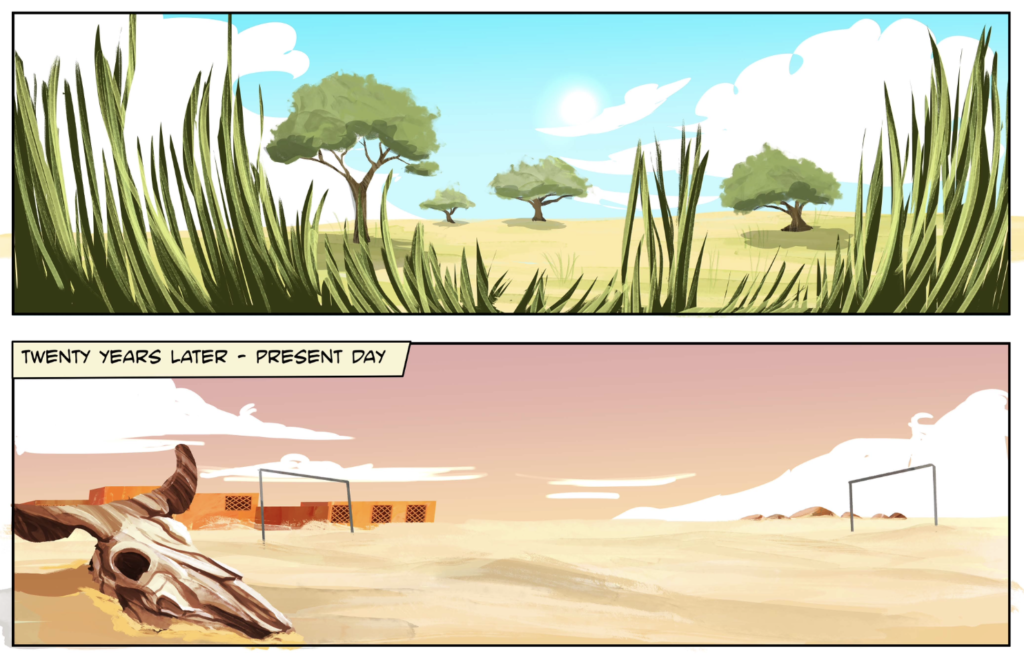
The transition from this lush imagery to the sight of a bleached cattle skull resting in the sand is a stark visual representation of “climate change”. As the characters reflect on what has been lost, the comic makes it clear that the sand “took over all the land,” forcing families to flee and leading to the very displacement that created the friction between Liban and Burhan.
From Conflict to Collaboration
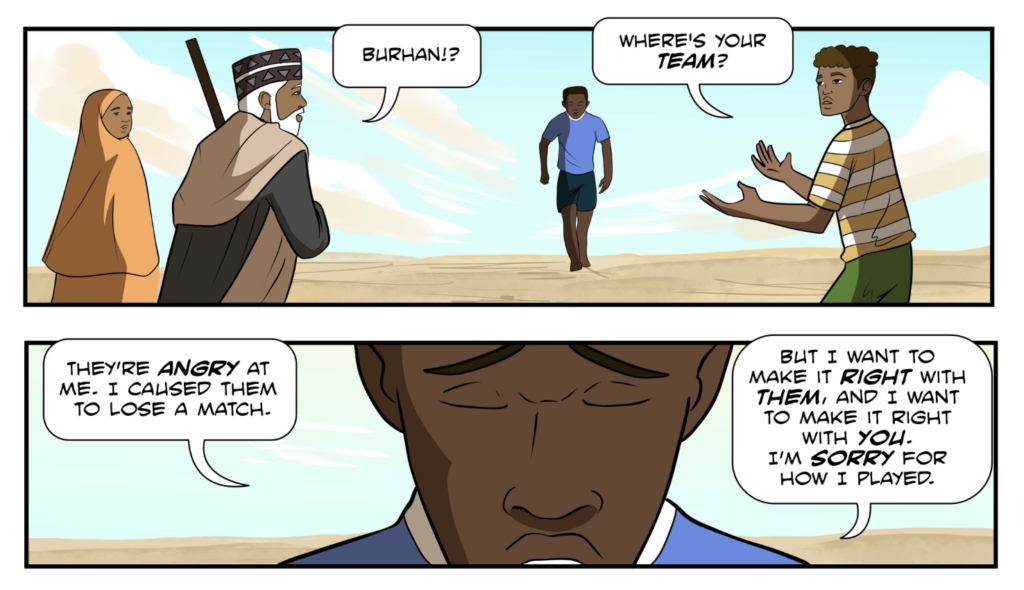
The narrative shifts started when another unsportsmanlike tackle (Page 8 – 9) led to social isolation for Burhan’s team. The intervention of an elder, Haji Warsame, and a young woman named Amina provided the wisdom needed to bridge the gap. Along with the shared memory of a once-verdant homeland, recalled through a flashback, the protagonists realise that their internal conflict is a luxury they can no longer afford. It is only a distraction from their true enemy: the desertification of their land. The fundamental Somali philosophy was introduced through the proverb: “Far keliya fool ma dhaqdo”—one finger cannot wash a face.
This call for unity prompts a transformation in Burhan. Recognising that his “rough” play and arrogance have left his team isolated, he approaches Liban with a humble apology. “Maybe we can learn to play with, and not against each other,” he suggests, signalling a shift from competitive athletics to cooperative survival.
The Blueprint for Restoration
The second half of the comic shifts from social drama to a practical guide for environmental healing. It outlines a multi-generational approach to “restore land impacted by climate change”. This strategy relies on three distinct pillars of the community: the wisdom of elders, the knowledge of women, and the creativity of the youth.
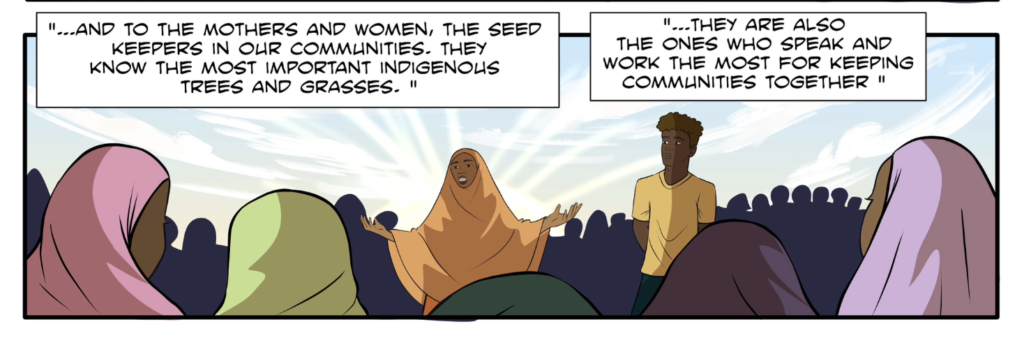
Recognising the “tracks of the leading camel,” the community looks to its elders for leadership and historical perspective. The mothers and women are hailed as “seed keepers”. They possess the indigenous knowledge required to identify the best trees and grasses for the local ecosystem and act as the glue “keeping communities together”. And as the “leaders” of tomorrow, the young men and women provide the manual labour and innovative energy to implement new methods.
The community begins to implement “clever ideas” adapted from global successes. They plant “indigenous trees” and protect them with “soil bunds”, earthen barriers designed to capture precious rainwater. They pair this with grass planting to bind the soil and prevent further erosion. Furthermore, they create “windbreak panels” from old fabric to shield the saplings from the desiccating power of the desert winds.
The Weight of the Words: Our Literal Analysis
The script by Njogu Macharia anchors itself deeply in Somali oral tradition. The dialogue is elevated by the strategic use of proverbs, such as “The restless foot comes across trouble” (Page 10) and “One finger cannot wash a face.” These linguistic choices bridge the gap between impulsive youth energy and the grounded wisdom of the elders, providing a cultural authenticity that a standard script might lack.
However, a seasoned reader will notice a distinct tonal shift in the latter half of the book. While the opening sequences are sharp and punchy, famously describing Liban’s strike as a “warrior’s spear” (Page 4), the concluding dialogue adopts a more didactic, “NGO-report” style.
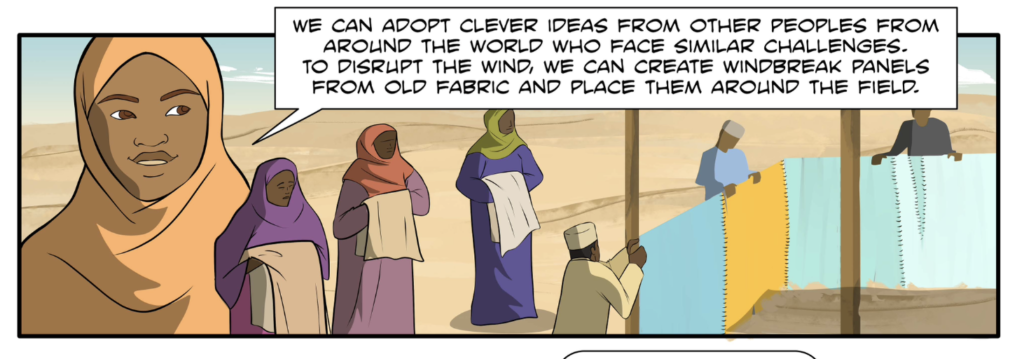
As the story moves toward the “Forging a Greener Peace” initiative, the characters’ voices lose some of their organic motivation, leaning instead into “show-and-tell” project milestones. The narrative became increasingly instructional, and emotional continuity was sacrificed.
Furthermore, the reader is no longer experiencing the story through the character’s perspective, but through guided explanation. This transition subtly repositions the reader, from participant to observer, and ultimately, to recipient of information. For future iterations, maintaining the character-driven momentum of the first act through to the resolution would ensure a more immersive experience.
Visual Discipline and the Palette of Despair
Visually, the collaboration between Movin Were (Layout/Lettering), Steven Muchiri (Scamping), and Fridah Maina Muyu (Line Work) creates a disciplined aesthetic. However, it is Michelle Zadia Pike’s colour palette that acts as the narrative’s most effective non-verbal communicator.
Utilising oppressive ochres and dusty oranges, Pike renders the “blazing sun” of the present with visceral heat. This “palette of desperation” stands in contrast to the lush, cool greens of the 20-year flashback (Page 13). This visual juxtaposition explains the stakes of climate change, the loss of the “green” in their future, more powerfully than any dialogue bubble could.
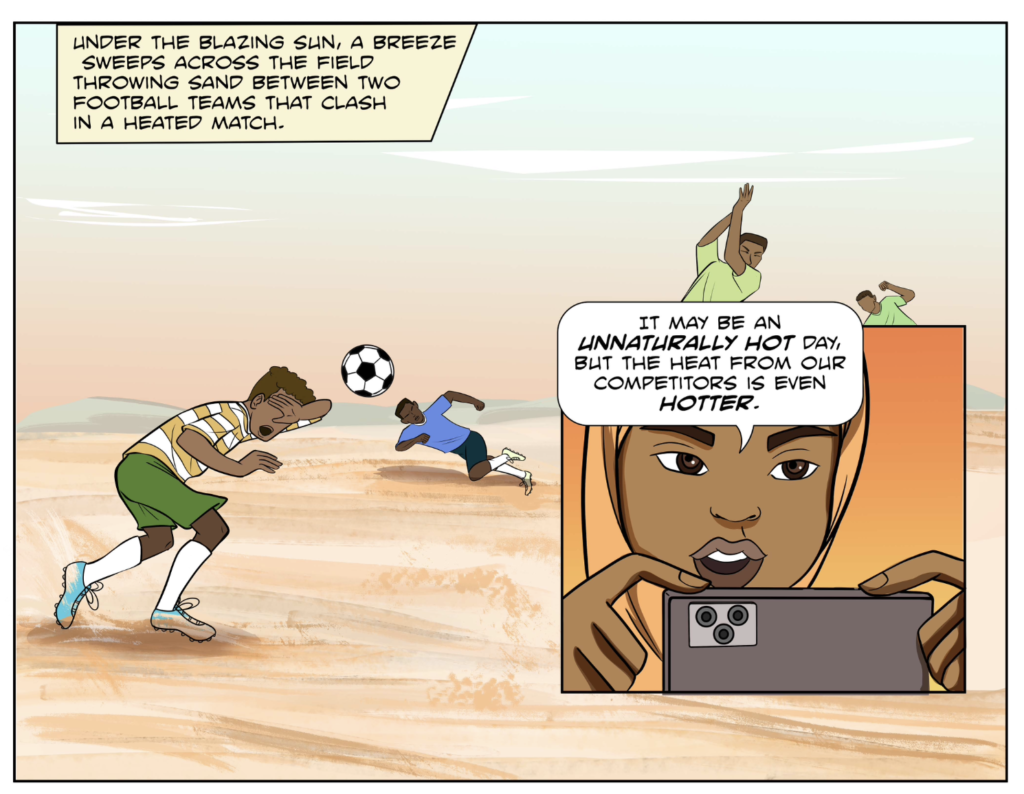
The panel dynamics further enhance this energy. The use of “slanted” gutters and “Dutch angles” (tilted frames) during the physical altercation on Page 9 successfully communicates a breakdown of social order. The layout guides the reader’s eye through the chaos, ensuring the kinetic energy of the fight is felt as much as it is seen.
Technical Considerations for Sequential Art
Despite these triumphs, the work occasionally struggles with “text-heavy syndrome” in its final act. On Page 15, large word balloons dominate the frames, at times obscuring character expressions and disrupting the immersion. This dominance of word balloons suppressed the visual grammar of the medium. Sequential art thrives on implication, gesture, and spatial storytelling, yet here, those elements are subordinated to explicit instruction. In high-level comic book production, maintaining a balanced art-to-text ratio is vital to ensure the visual storytelling is not stifled by its own message.
Additionally, Burhan’s redemption arc feels slightly rushed. His transformation from a hostile captain to a cooperative peacebuilder occurs almost instantaneously between the match and the restoration efforts. The absence of sustained ideological resistance within Burhan’s arc simplifies what is, in reality, a deeply complex social tension. Conflict is introduced with weight but resolved with efficiency, suggesting a preference for cohesion over confrontation. The inclusion of a silent “beat”, a panel dedicated to internal reflection or a moment of shared eye contact would have made this pivotal character shift feel more earned.
Our Verdict and Recommendations
This is a strategically constructed work whose strengths and limitations are inseparable from its institutional purpose. While serving as a vital piece of “edutainment, it successfully humanises the statistics of climate displacement by grounding them in the universal language of football.
At its core, it raised an important question about the role of storytelling within development frameworks: can narrative retain its complexity when tasked with delivering clear, actionable messages? “Youth: Rise for a Greener Future” offers a compelling case study, demonstrating both the reach of such storytelling and the constraints it imposes on narrative depth.
It is noteworthy to mention that the comic’s structural decisions cannot be separated from its institutional context. Its narrative compression, accelerated character arcs, and expository dialogue are not merely creative shortcomings but indicators of a work designed with predefined communicative outcomes. In this sense, the story does not unfold organically; it is guided toward alignment.
Ergo, unlike character-driven comics that prioritise ambiguity and internal conflict, this work adopts a clarity-first approach, ensuring its messaging remains accessible across audiences.
Nonetheless, for future iterations or similar projects, we recommend a subtler exposition, where the environment is allowed to speak, allowing visual cues to carry thematic weight rather than reiterating them through dialogue. Instead of an elder explaining that the land is dry and maybe showing a panel of a character trying to plant a tree in cracked earth that refuses to take the seed.
The character arcs can also be improved. Burhan’s transition from a hothead to a peacebuilder (Pages 14-16) can be excellently executed with a silent panel showing a moment of internal reflection. Introducing moments of visual pause, particularly during key character transitions, would allow emotional shifts to register more convincingly. It would make his redemption feel more earned.
And as regards lettering, the flow needs to be better adjusted. Word balloons should guide the eye in a “Z” pattern. On Page 12, the placement of the bubbles occasionally forces the reader to double-back, slightly breaking the narrative flow.
Beyond the story of Liban, Burhan, and our critique, the comic book proves the power of African sequential art in tackling complex geopolitical issues. It successfully serves as a vehicle for international diplomacy and climate advocacy. It highlights the “Forging a Greener Peace” project in the Hirshabelle State of Somalia, an initiative aimed at fostering both “social and infrastructural change”.
Digital copies of the comic book can be found here. Download, read, and let us know what you think.
AI Use at TheACE
TheACE uses artificial intelligence tools to support research, drafting and analysis across Africa’s creative industries. All content is verified, edited and approved by our human editorial team to ensure accuracy, clarity and responsible storytelling. AI assists our work; it does not replace human judgment.