In 2024, a single independent creative industry generated over 100 million US dollars (The Bookause report 2025). It wasn’t Afrobeats, it wasn’t Nollywood, and it certainly wasn’t the heavily funded tech sector. While global venture capitalists were busy flooding fintech startups with cash, an independent, highly creative underground movement was capturing the attention and wallets of over 40 million young people. They were not waiting for permission or asking for international funding; they just kept drawing.
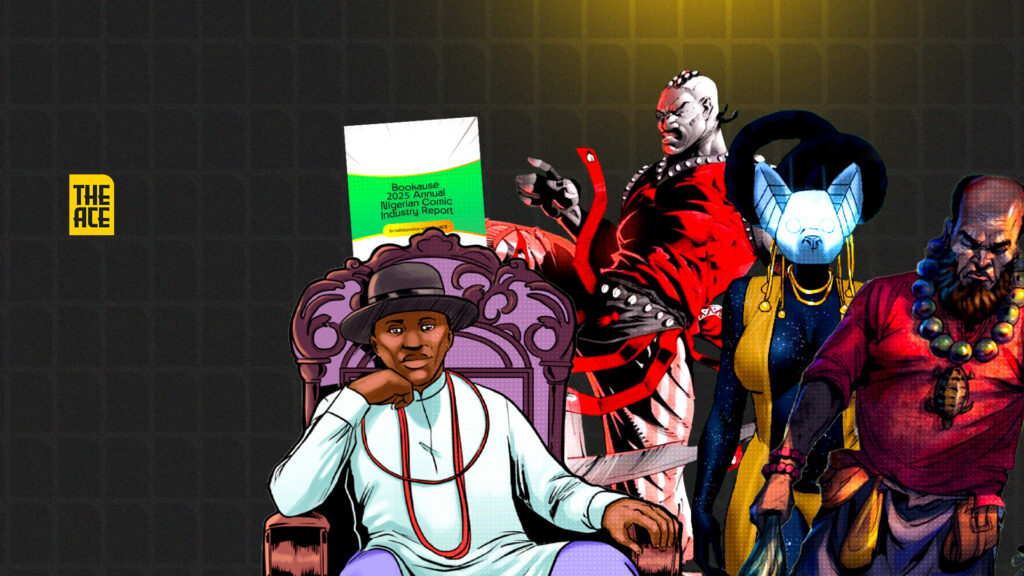
Welcome to the hidden world of Nigerian comics. For decades, mainstream media has treated comic books as a fringe hobby—a juvenile distraction relegated to the back of school classrooms. But the data tells a completely different, almost dangerous story. Co-published by TheACE and Bookause, the 2025 Annual Nigerian Comic Industry Report didn’t just map out an ecosystem; it exposed a massive economic blind spot. Whether you are a die-hard fan or an investor looking for the next cultural gold rush, the reality is simple: you are either paying attention to this sector, or you are getting left behind. From 1980s government decolonisation to secret corporate empires hiding inside product boxes, here are 10 things you probably didn’t know—or completely forgot—about the true power of this creative frontier.
1. The 1980s Decolonisation: Captain Africa
Long before modern cinematic universes took over digital screens across the globe, local pioneers were actively trying to decolonise sequential art on the continent. In 1987, visionary creator Andy Akman, alongside the ambitious publisher African Comics Ltd., introduced the legendary character Captain Africa to the world. Far from the Western ‘white saviour’ tropes that completely dominated the era, Captain Africa was birthed specifically to battle contemporary continental issues and systemic corruption. This groundbreaking narrative move cemented him as one of Nigeria’s very first homegrown superheroes, showing that local creators could build a self-contained mythos of entirely in African realities.
2. The Satirical Legacy of Ikebe Super
Before television sketch shows and internet memes dominated the landscape of modern Nigerian humour, there was Wale Adenuga’s groundbreaking magazine, Ikebe Super. Operating as a nationwide cultural phenomenon in the 1980s, this iconic humour comic used sharp visual satire and a stellar cast of clowning characters such as Papa Ajasco, Boy Alinco, and Miss Pepeiye to make light of everyday societal situations and economic hardships without causing offense. It laid the absolute structural foundation for modern Nigerian comedy print culture and proved that illustrated media could achieve massive commercial distribution before the characters eventually transitioned onto national television screens in the mid-1990s.
3. The Catalyst of the Lagos New Wave: Comic Republic (2013)
The modern era of the graphic novel ecosystem owes an incredible debt to the class of 2013. It was in this pivotal year that Jide Martin founded Comic Republic, a multimedia publisher that would spend over a decade completely reshaping global perceptions of African narratives. By pioneering a highly ambitious digital-first, freemium model that offered beautifully illustrated stories for free online for years, they successfully built a massive, loyal community. This strategic move proved the profound domestic and international appetite for original Nigerian intellectual property, paving the way for the premium, corporate-backed landscape we see today.
4. The Blockbuster Corporate Marketing Shift: The Indomitables
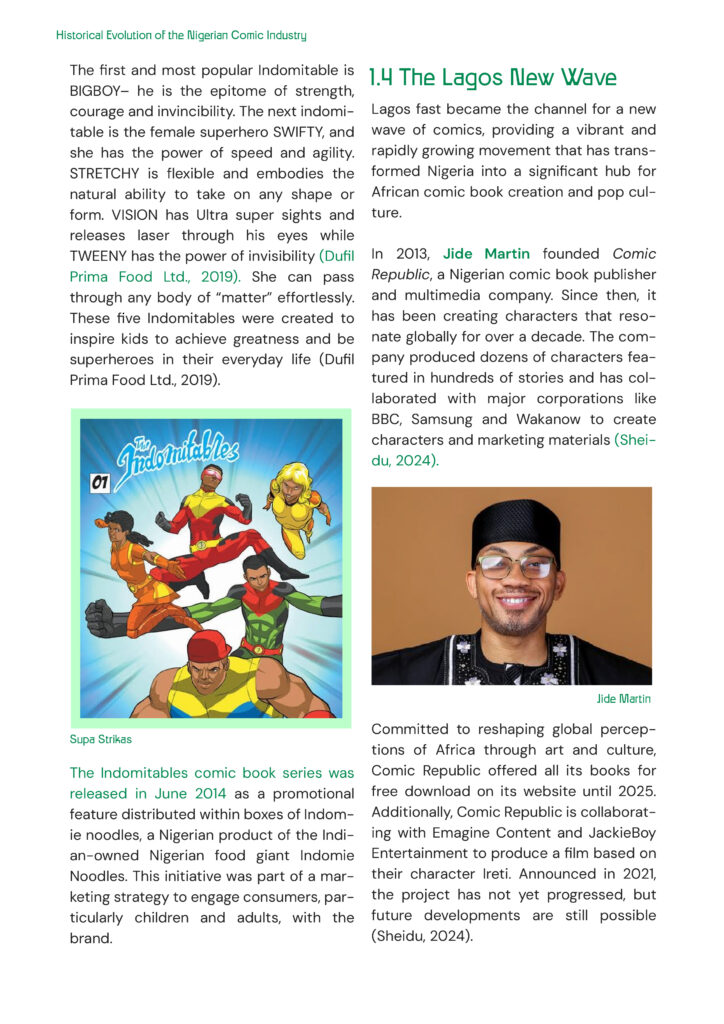
Comics in Nigeria have long proven to be a masterclass in direct-to-consumer corporate marketing, bypassing traditional media channels entirely. In June 2014, the household food giant Indomie capitalised on this unique cultural capture by launching The Indomitables. This special promotional superhero team comprising characters like Bigboy, Swifty, Stretchy, Vision, and Tweeny saw millions of physical comic books distributed directly inside instant noodle product boxes. The campaign engaged children and adults alike across the country, triggering an unprecedented wave of brand loyalty whilst simultaneously boosting youthful literacy in households that lacked traditional books.
5. Comics as Official Classroom Education: Panaramic Comics
Who says comic books are merely a distraction from serious schoolwork? In a historic move for national educational integration, Panaramic Comics became one of the very first independent publishers to be formally endorsed by the Lagos State Government. Their beautifully crafted, culturally rich materials were approved to serve as supplementary literature in classrooms, bringing a fresh, visually stimulating methodology into local public-school systems. This milestone proved that comics could be leveraged as serious tools for literacy and historical preservation rather than just simple entertainment.
6. The Literary Journey of Okiojo’s Chronicles
Speaking of educational power, the highly acclaimed historical series Okiojo’s Chronicles, distributed directly through Lagos public schools, became a massive domestic success by teaching history through sequential storytelling. However, the impact of this specific series travels much farther than Nigerian borders. In a brilliant twist of international academic recognition, this educational comic was officially adopted by Grand Valley State University in the United States to teach African history, proving the pedagogical power and global standard of Nigerian sequential art on an international stage.
7. Breaking Content Norms: Erivic Adedayo and the ‘Afroblot’ Movement
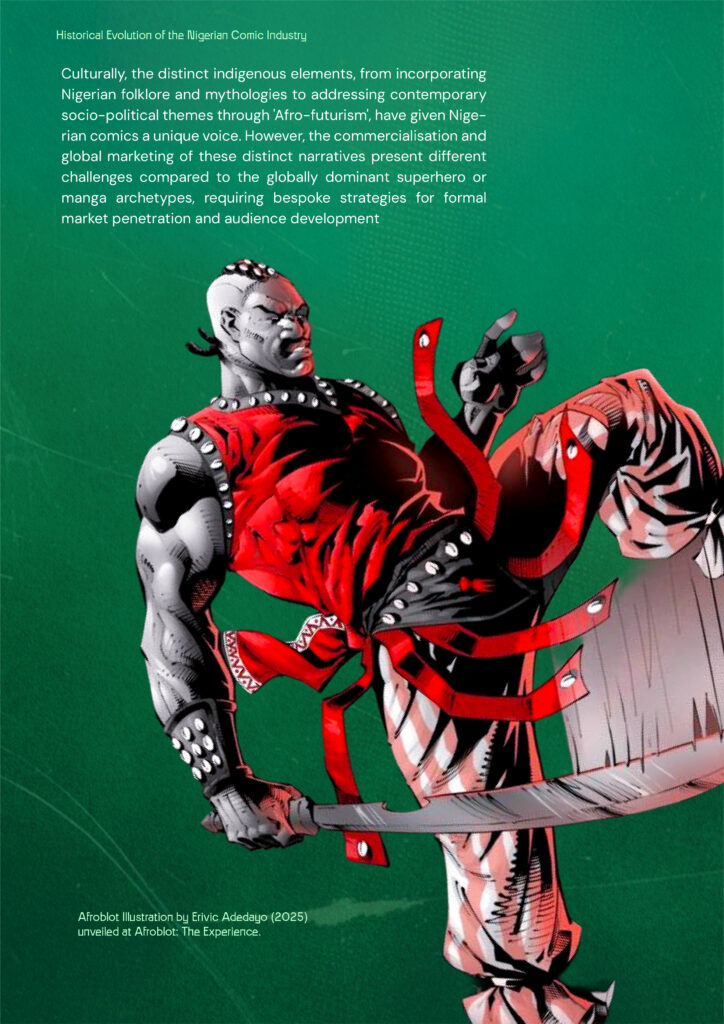
As the ecosystem matures, a new generation of creators is boldly breaking away from traditional, Western-influenced comic aesthetics. Prominent creator Erivic Adedayo single-handedly shook up the Southwestern creative region by launching the influential Afroblot movement. Characterised as a striking black-red-grey art style explicitly optimised to beat local printing constraints and lower production costs, the Afroblot movement has successfully kept the physical print culture alive through immersive, exhibition-style distribution events that treat comics as high art.
8. Historic State Governance Backing: Comic Con Ibadan
The year 2025 will go down in history as the exact moment local convention culture truly secured its institutional legitimacy within the country. For years, mainstream media erroneously dismissed comic conventions as mere children’s gatherings or niche copycat subcultures. That narrative was completely shattered when Comic Con Ibadan: Synergy 2025 officially received the formal endorsement and backing of the state government, paving a structured pathway for creative tourism, youth employment, and official regional policy integration.
9. The True Financial Scale: A Multimillion-Dollar Market
For the longest time, the distinct lack of centralised retail tracking infrastructure made the true economic value of local comics virtually invisible to international venture capital. Thanks to the rigorous primary research, studio surveys, and financial auditing in the new industry report, we finally have the real numbers out in the open. In 2024, the total estimated value of Nigeria’s comic-book market sat at a staggering USD 106.74 million, proving beyond a shadow of a doubt that the sector is a genuine economic powerhouse capable of yielding massive returns.
10. The Global Frontier: 0.67% and Rising
When placed side-by-side with international publishing giants like the United States and Japan, Nigeria currently accounts for exactly 0.67% of the global USD 17.62 billion comic market. While that decimal point might seem humble at first glance, industry analysts view it as an astronomical, high-growth frontier waiting to explode. Driven by an urban youth population of over 40 million and a rapid transition to digital mobile storefronts, local publishers are structurally positioned to capture a massive slice of the global creative market over the next decade.
The Next Billion-Dollar Gatekeepers
Here is the uncomfortable truth that mainstream media handles with kid gloves: Nigeria currently controls less than one percent of the global 17-billion-dollar comic market. To an outsider, that decimal point looks insignificant, but to anyone who understands market mechanics, it looks like a coiled spring. Every major cultural export the country has ever produced, from the global domination of Afrobeats titans like Burna Boy and Wizkid to the streaming wars fighting over Nollywood licensing rights, started exactly like this. They began in the shadows, driven by an obsessive youth demographic, fuelled by digital disruption, and completely underestimated by institutional gatekeepers until it was far too late to buy in cheap.
The question is not if this local comic industry will scale to match its international counterparts, but rather who will own the infrastructure and intellectual property when it does. The data is out, and the blueprint has been laid bare for everyone to see. If this brief look into the numbers has piqued your interest, you can deep-dive into the full structural mapping, five-year forecasts, and raw survey data by reading the complete 2025 Annual Nigerian Comic Industry Report. The infrastructure is being built right now, and the only thing left to decide is where you fit into the picture.
--------------------------------------------------------
--------------------------------------------------------
AI Use at TheACE
TheACE uses artificial intelligence tools to support research, drafting and analysis across Africa’s creative industries. All content is verified, edited and approved by our human editorial team to ensure accuracy, clarity and responsible storytelling. AI assists our work; it does not replace human judgment.