Aiku, Aje, Isegun… The first three words of a Yoruba hymn a primary school pupil would have learnt to sing during school sessions in the southwestern states, sometime from the 1990s to the early 2000s. It is used to learn the days of the week, and simply translates to “Sunday, Monday, Tuesday…” in the English language.
Perhaps that was part of what inspired AIKU: The Dead That Never Dies, the new Afroblot-themed comic book Adedayo Erivic announced a few weeks after the conclusion of Comic Con Ibadan 4.0. The ambition behind it is large; a nationwide tour, an exhibition, and more still to come. Behind that plan sits a long-time friend turned logistics manager, and now, project manager. Someone who calls it a fun day to be somewhere between a fraud investigation and a comic book tour itinerary; Eniola Ebenezer.
By profession, Ebenezer is a compliance officer at a Nigerian bank, spending his working hours monitoring transactions, enforcing regulatory policy, and liaising with bodies such as the EFCC and the police whenever fraud needs to be traced, queried or shut down. It is, by his own account, demanding, dynamic work that keeps him moving across departments rather than confined to a desk. By night, and by every spare hour in between, he is the man steering the machinery behind AIKU and the tour built around it.
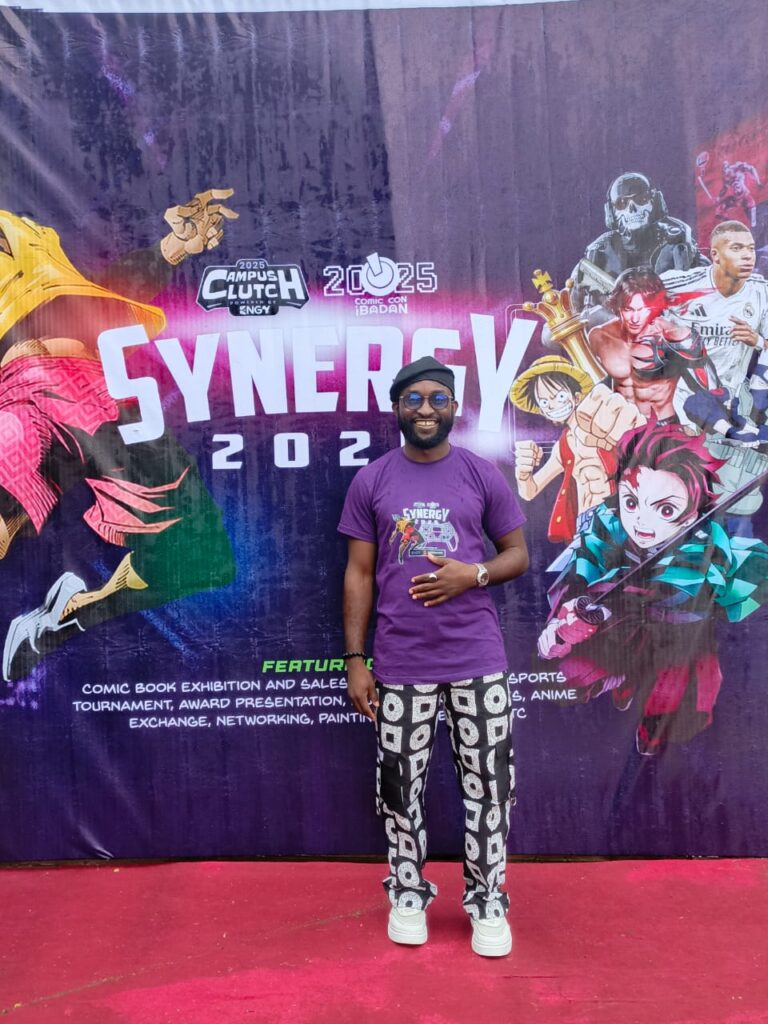
He does not see these as two separate lives. “I never really saw the two worlds differently. Never,” he says. A background in philosophy taught him that everything is connected, cause feeding into effect. Money touches everything, so understanding it is never wasted. Culture shapes how a comic book campaign should feel. For Ebenezer, banking and building a comic book movement are not opposites; they are the same instinct, pointed in two directions.
That instinct is also how he explains the actual work. People hear “logistics” and picture trucks and timetables. He sees something else entirely. “Logistics for me is like wireframing,” he says, the structure underneath a project that nobody notices until it is missing. Marketing, partners, vendors, the tour itself: all of it needs someone holding the shape together. “You’re like the vein, the nerves of the body,” he says. “You remove them from the body, and every other thing ceases to flow.” It is why “logistics manager” has become too small a title for what he does. He is managing a movement, not a schedule.
That role found him early. He and a small circle of university friends, Erivic among them, spent their student years drawn to art, fashion and culture, though comics themselves were not yet part of the picture; Ebenezer’s early exposure ran through diaspora cartoons, like most Nigerians his age. Erivic changed that, pulling him properly into the African comic space. Not long after, a conversation following an African philosophy class turned into an idea: run a comic convention, on campus, funded out of their own pockets. Neither of them really knew what they were doing at the time. They sold tickets for practically nothing and asked their friends what they needed as they went. It worked anyway. People showed up. “It was funny how it was very successful,” he remembers. “It was a blast.” They ran it again, then took it beyond the university altogether, until it grew into what is now Comic Con Ibadan.
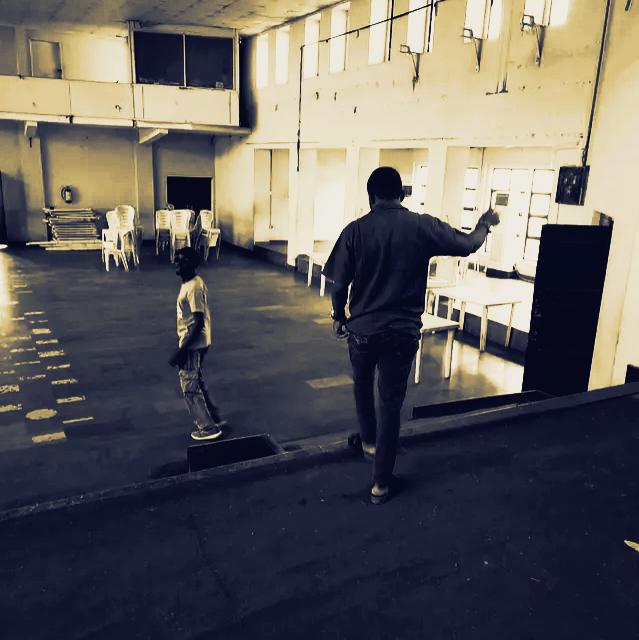
Logistics found him the same way; through years of organising faculty dinners, press events, student union activities, and watching his mother run events as a caterer when he was growing up. When the team eventually needed someone to hold it all together properly, it landed on him. “It’s been cool,” he says. “Really, really cool.”
Ebenezer experienced Afroblot’s beginnings as something almost casual, the kind of idea that comes up in conversation between friends and could easily have gone nowhere. To Erivic, it was never that loose; by his own account, it was intentional from the very first sketch, built with a long-term goal already in mind, and shared with Ebenezer with that seriousness attached. What Ebenezer remembers as an idea taking shape in real time, Erivic remembers as a plan he had already committed to. Either way, the moment Ebenezer heard it, something in him decided: this must happen, and it must happen properly. That decision is what turned a friend into a project manager.
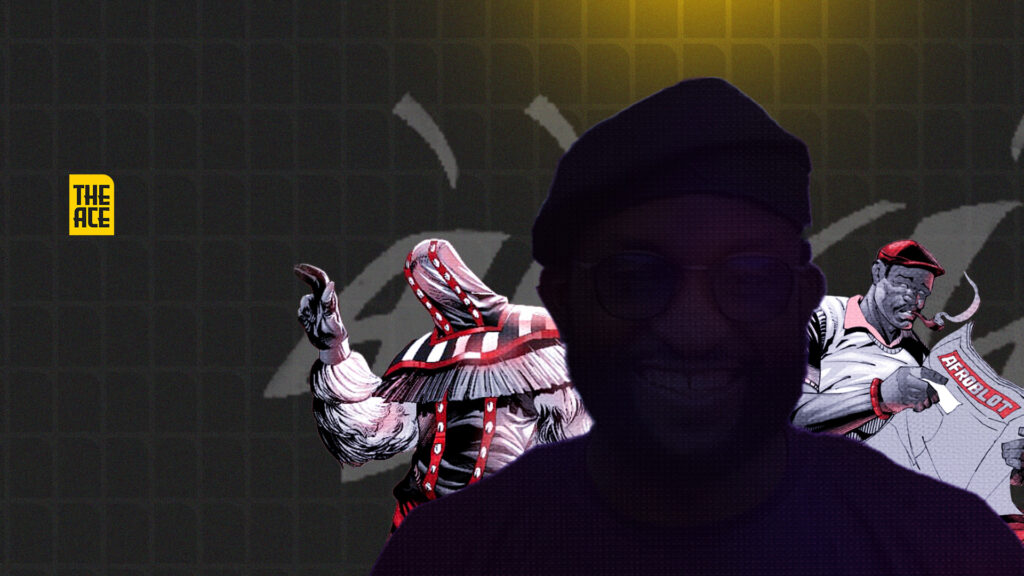
The reception once Afroblot went public surprised even its creators. Its black, red, white and ash palette was no accident. “It’s a colour scheme to tell an African story, an African reality,” Ebenezer says. “Afroblot is literally giving you a colour scheme, without dilution.” It was chosen for what it costs to print, and for how it reads: a colour language pulled from indigenous African dye traditions, not borrowed from anywhere else. Some people mistook the restraint for a limitation. For Ebenezer, that restraint is the entire point; an African story told fully in an African visual language, without softening it to travel further.
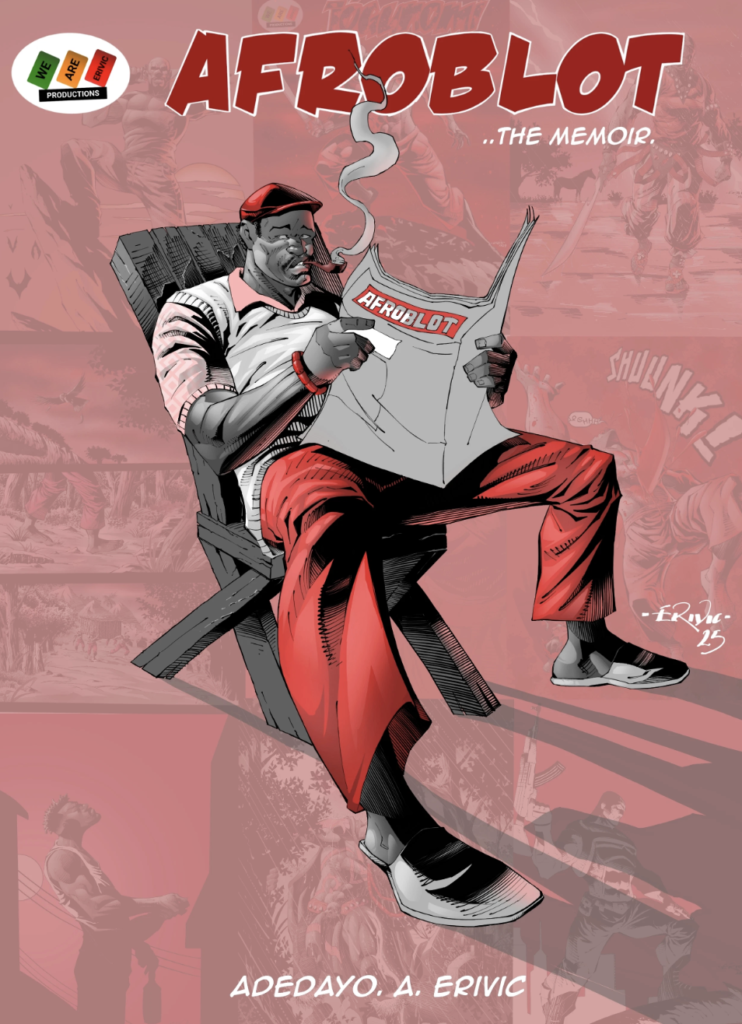
That project is now being built as its own thing, deliberately apart from the convention that gave Ebenezer his start. We Are Erivic Production is becoming a company, standing next to Comic Con Ibadan rather than folded into it, even though the same people sit behind both. He is careful about the distinction: Comic Con Ibadan is an event. We Are Erivic Production is a business, walking into the market to challenge the studios already there to do better. The two will keep getting mentioned in the same breath, he knows that. But he is running them as two separate engines, at two separate intensities.
Underneath that separation sits an answer to one of Nigerian comics’ oldest problems: the cost of making and moving a book. Rather than carrying that cost alone, Ebenezer says they are building revenue-share partnerships with studios and media houses, arrangements where both sides win when the book performs. It is less a favour, and more of a bet they are making together.
He is more direct about what frustrates him in the wider industry: too little collaboration, and too much gatekeeping among Nigeria’s comic and animation creators. “I think it should be an open market,” he says. “Regulated, yes, but an open market.” His issue is not with ambition. It is with a pattern he sees as self-defeating; creators softening their own work to chase approval from outside, instead of trusting that a strong, rooted story will travel on its own. He points to Japanese manga as proof this works: an industry that stayed close to its own folklore and let the rest of the world come to it. What he wants is not less structure, but better structure; an industry open enough to let new voices in, with clear standards for how African stories get researched, sourced and told.
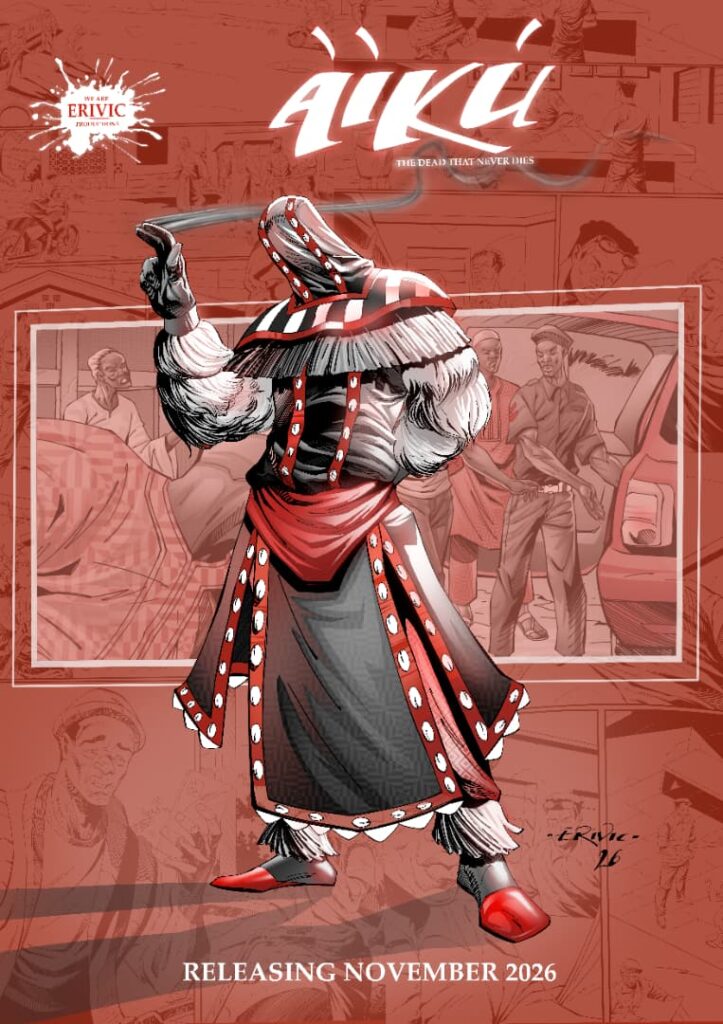
He is still careful about naming names. Conversations are underway with studios, corporations, distributors and publishers, across print and digital, and with press ahead of the tour. But the details, he says, are not ready to leave the room yet. What he will say clearly is the timeline: AIKU is landing in November 2026. The tour itself, named “We Are Erivic”, is planned for 2027, nothing more specific than that for now. The name, Ebenezer explains, carries a second meaning; strip away the wordplay, and We Are Erivic simply means We Are Eternal, a line he returns to more than once when describing what the whole project is actually for.
On numbers, he is candid about where the bar sits and where he wants it to go. Erivic’s target for AIKU is ten thousand digital copies. Ebenezer’s own goal sits further out than that. He wants it translated across the continent, into languages like Yoruba and Zulu, reaching readers in places like Togo and Rwanda, the same story landing differently in each one. Ten thousand, to him, is a starting line, not a finish.
His working relationship with Erivic, a friendship stretching back to university, runs on a kind of useful friction. Erivic thinks like a comic creator first, close to the craft. Ebenezer pulls the conversation wider; comics meeting film, music, education, even finance, reaching people who have never picked up a comic book before. They disagree often, he says, but rarely badly. Both think things through before bringing an idea to the table, and often they end up walking towards the same point from different directions. He calls it finding the spot where one decision, placed correctly, sends the effect through everything else. It is, in Erivic’s own framing of what he needs from this partnership, someone capable of taking his idea and carrying it further than he first imagined it; a river being pushed, deliberately, from where it starts to where it is meant to end up.
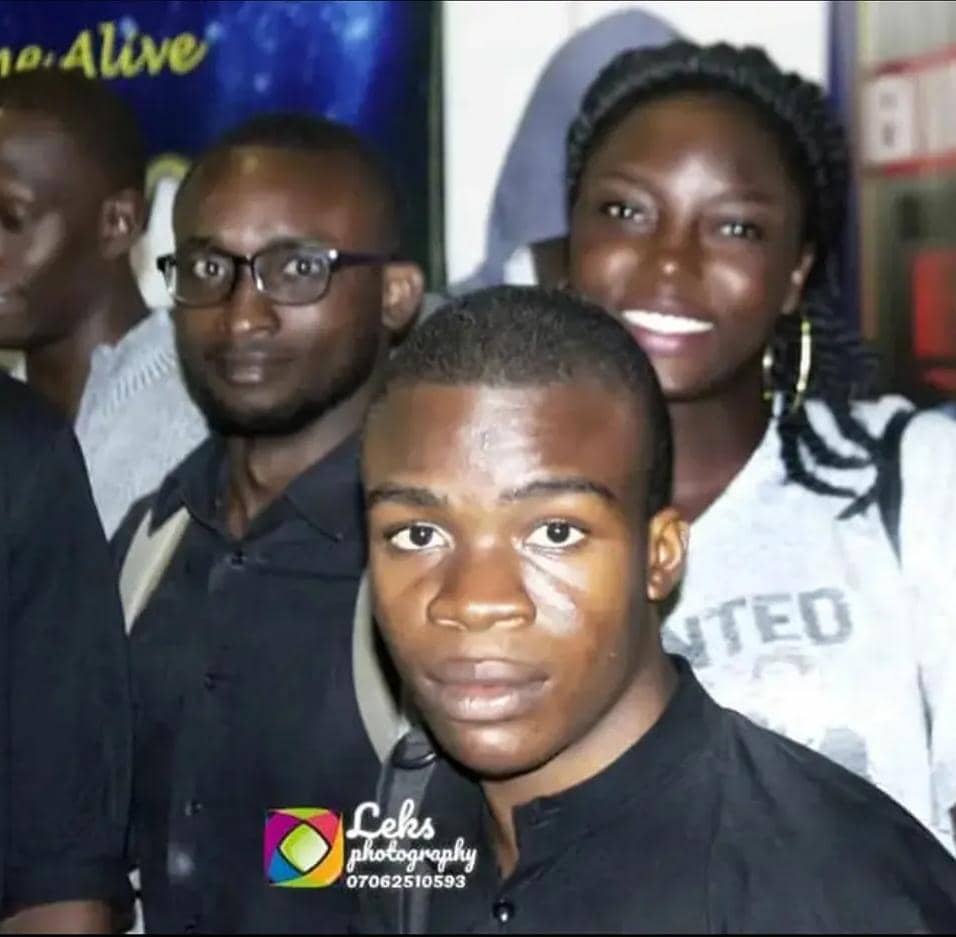
It is when he talks about what he wants, long after AIKU, that Ebenezer reaches for his biggest idea. He borrows a phrase from philosophy, the unmoved mover, to describe the role he hopes to grow into. Not a gatekeeper. Something closer to the centre everything else eventually must pass through, earned through substance rather than control. He is honest that he does not need everyone to know his name. It is enough that the people who matter, inside the industry, know exactly what he has built.
That preference for staying out of the spotlight is deliberate, not incidental. Ebenezer describes it almost like taking a back seat on purpose, because it is only from there that he can properly see the whole picture. Watching the industry from a distance, rather than sitting in the middle of it, gives him what he calls an eagle eye view; a wider, calmer read on where the gaps are, who is being overlooked, and which quiet names deserve to be pushed forward before the rest of the industry notices them. It is less about hiding, he suggests, and more about positioning himself where the view is clearest.
What drives him, in the end, is not size. It is permanence. He wants to be part of something transgenerational, something that outlives him the way today’s comic industry stands on work laid down by people most fans will never name. Beyond AIKU, beyond the tour, what he actually wants is for African comics to have real structure; clear standards, and fair rules around how studios and diaspora partners deal with each other.
Ask him where he wants Afroblot and AIKU in a year, and the answer comes without hesitation: a presence in roughly twelve African countries, with themed events and publications to show for it, alongside Erivic’s next project finding its audience. It is a bold marker to set twelve months out loud. But listening to Eniola Ebenezer, ambition does not sound like a risk to him. It sounds like a job. We Are Erivic. We Are Eternal.
—
This article is based on a direct interview conducted by TheACE with Eniola Ebenezer.
--------------------------------------------------------
--------------------------------------------------------
AI Use at TheACE
TheACE uses artificial intelligence tools to support research, drafting and analysis across Africa’s creative industries. All content is verified, edited and approved by our human editorial team to ensure accuracy, clarity and responsible storytelling. AI assists our work; it does not replace human judgment.