When the village spoke last year, it did not speak kindly. High ticket prices, disorganisation, late starts, and an atmosphere fans called the weakest in the convention’s history followed Lagos Comic Con out of its previous edition, alongside a public admission from organisers that the lapses would be addressed. This year, the village spoke again, and this time it had less to complain about.
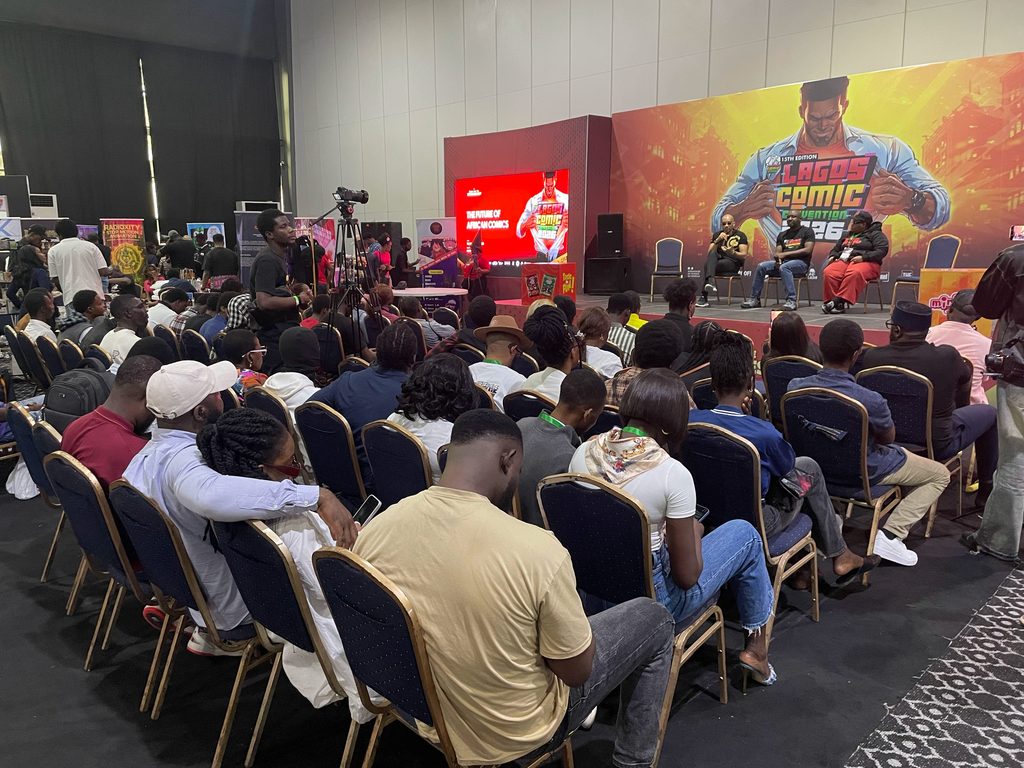
The previous edition had spread across two halls, and the crowd spread with it, thinning an energy that a comic convention lives or dies on. This time, everything happened under one roof. The effect was a room that finally felt full, so full that security had to turn attendees away as others left, a reversal from the sparse, scattered turnout that had drawn complaints twelve months earlier.
At its best, it is the thing that tells thousands of strangers, before a single word is spoken, what kind of event they have walked into, what energy to expect, and what story is being told about them as much as to them. For an event trying to recover credibility after a bruising year, that identity carries even more weight than usual.
“I don’t think I fully understood what a career in animation could look like.”
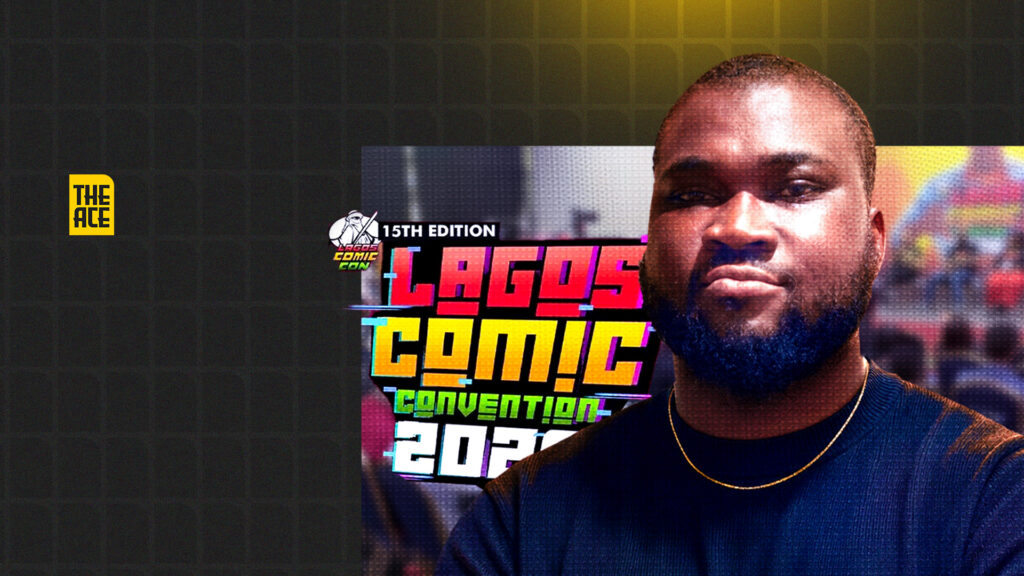
To understand how this year’s identity came together, it helps to go back more than a decade to a young illustrator who wandered into a Comic Panel mentorship workshop with nothing more than an interest in drawing. That illustrator was Osas Akugbe, now Managing Director of Spoof Animation and the creative mind behind this year’s Lagos Comic Con branding. He met Ayodele Elegba at those workshops, and what began as a search for guidance became a career that ran through inking, cleanup, background art, and eventually the top office at the studio Elegba built.
“When you’ve actually worked from the bottom of a production pipeline, you understand how every creative decision affects the next person,” Akugbe said, describing how those early years still shape how he approaches branding today. He does not just ask whether something looks good, he said, but how it will work on a stage, on a screen, on a T-shirt, on a banner, or when someone glimpses it from a distance. That instinct, built in comic pages and cleaning up animation cells, is the same one that shaped the identity attendees walked through this year.
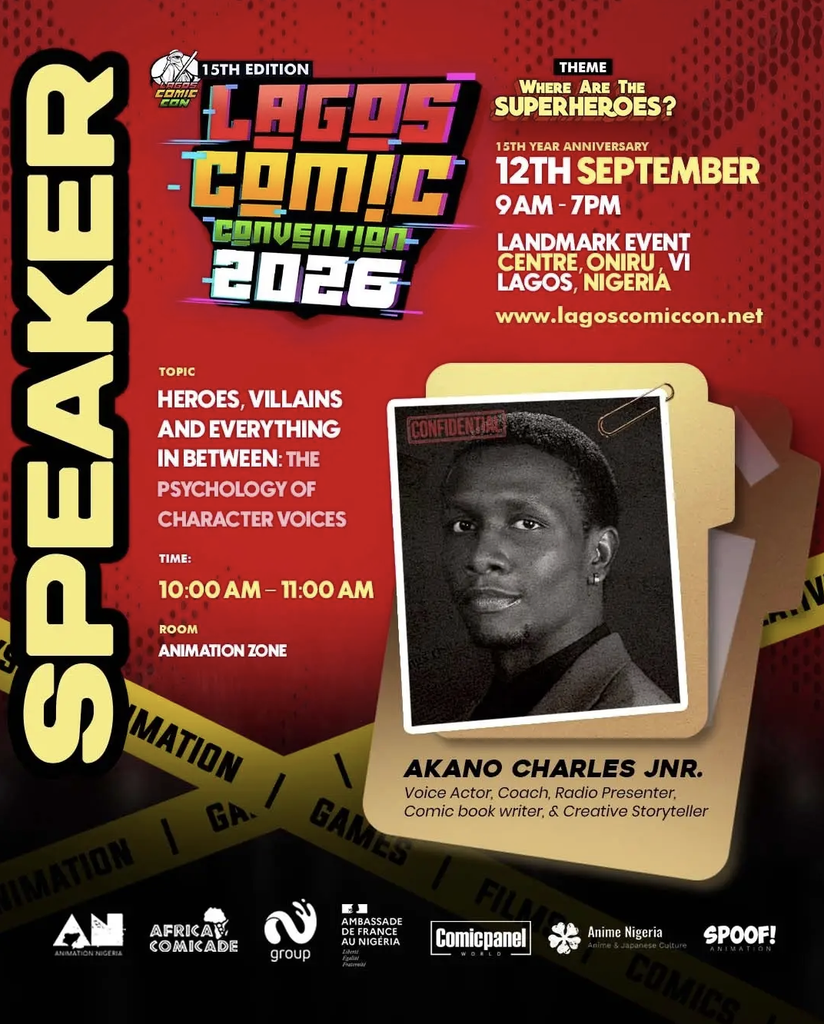
Publicity materials carried a fiery orange-to-red gradient shot through with gold, yellow, and flashes of green, the kind of colour scheme designed to read instantly on a phone screen or a banner from across a hall. The wordmark itself carried a glitch-like, layered treatment, as though the letters were catching light from different angles, which gave even a flat poster a sense of motion. Speaker announcements took on a distinct visual language of their own, styled like confidential case files, complete with a mugshot-style photo pinned inside a manila folder and crime-scene tape running along the edges, a small but deliberate flourish that turned each panellist reveal into its own moment of intrigue. Heavy, blocky lettering, in a display face Akugbe identified as Heavitas, carried the bolder headline moments such as “What’s Happening” and the vertical “Speaker” callouts, giving the identity a weight that could hold its own against the crowded, high-contrast backgrounds.
“You have to think about all the places the identity needs to exist.”
Beyond the palette and typography, the identity’s real test was in how it functioned across the venue itself. Screens on either side of the main stage displayed the title of whatever panel was running, so anyone walking in mid-session knew instantly what they had joined. In the VIP rooms, roll up banners and ground stickers pointed attendees toward whichever space they were looking for, a layer of guidance that simply did not exist the year before.
Akugbe described the thinking behind it as building a system rather than a single design. “Once the core identity is established, you have to build a system around it,” he said. “The stage is different from Instagram. Instagram is different from a T-shirt. A banner is different from a ticket or an accreditation material.” The task, as he put it, was establishing the typography, colours, and layout principles once, then adapting them across every touchpoint without losing consistency, a discipline he says only sharpened once the responsibility of running the studio, and not just designing for it, landed on him.
Behind the visible improvements sat a change in how the year was planned. Ibadan Fan Expo, usually held in July, was postponed so that resources and attention could concentrate fully on Lagos Comic Con. Publicity started months in advance, with an early call for speakers, exhibitors, and vendors and an early bird ticket window that gave the event room to build momentum rather than announce itself at the last minute. It is the kind of trade-off Akugbe describes as central to his role now. “As an MD, you still ask how can we make this as good as possible,” he said, “but you also have to ask, can we actually execute this, how much will it cost, how long will it take, what else is happening. You have to balance ambition with reality.”
“We are superheroes.”
The theme, “Where Are The Superheroes?”, ran through the convention rather than sitting quietly on a poster. Panel sessions carried the language into their own titles and framing, and even sessions that did not lean on it directly found their way in. One panel opened by asking the audience to name ten superheroes, then asking how many of them were African, a question aimed less at trivia than at conscience.
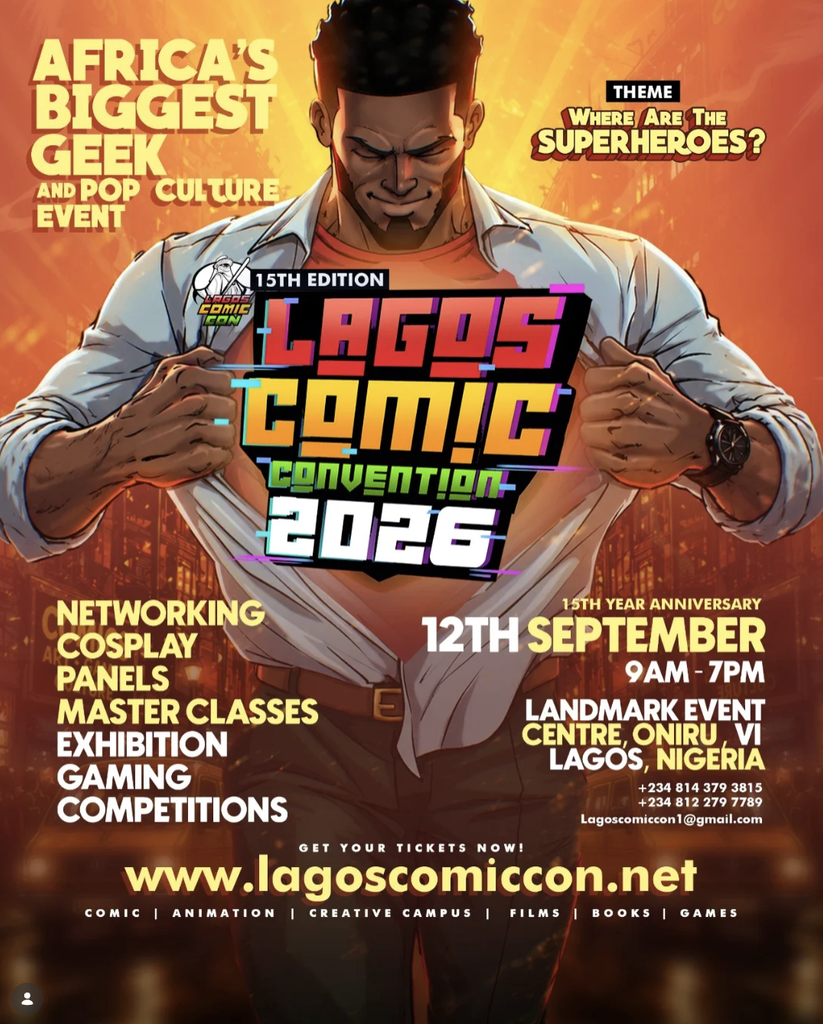
For Akugbe, the theme was never only about capes and fiction. “That question isn’t only about fictional superheroes,” he said. “It’s also about the people around us who create, build, inspire and contribute to society.” The idea shows up most literally in this year’s main poster, where a character stands with his chest open, revealing the official logo underneath. “That represents all of us in the geek space,” Akugbe explained. “We are superheroes.” Alongside it, he built out a separate detective-themed set of promotional branding, an idea he says came to him almost on instinct and which his Chief Convener approved on sight.
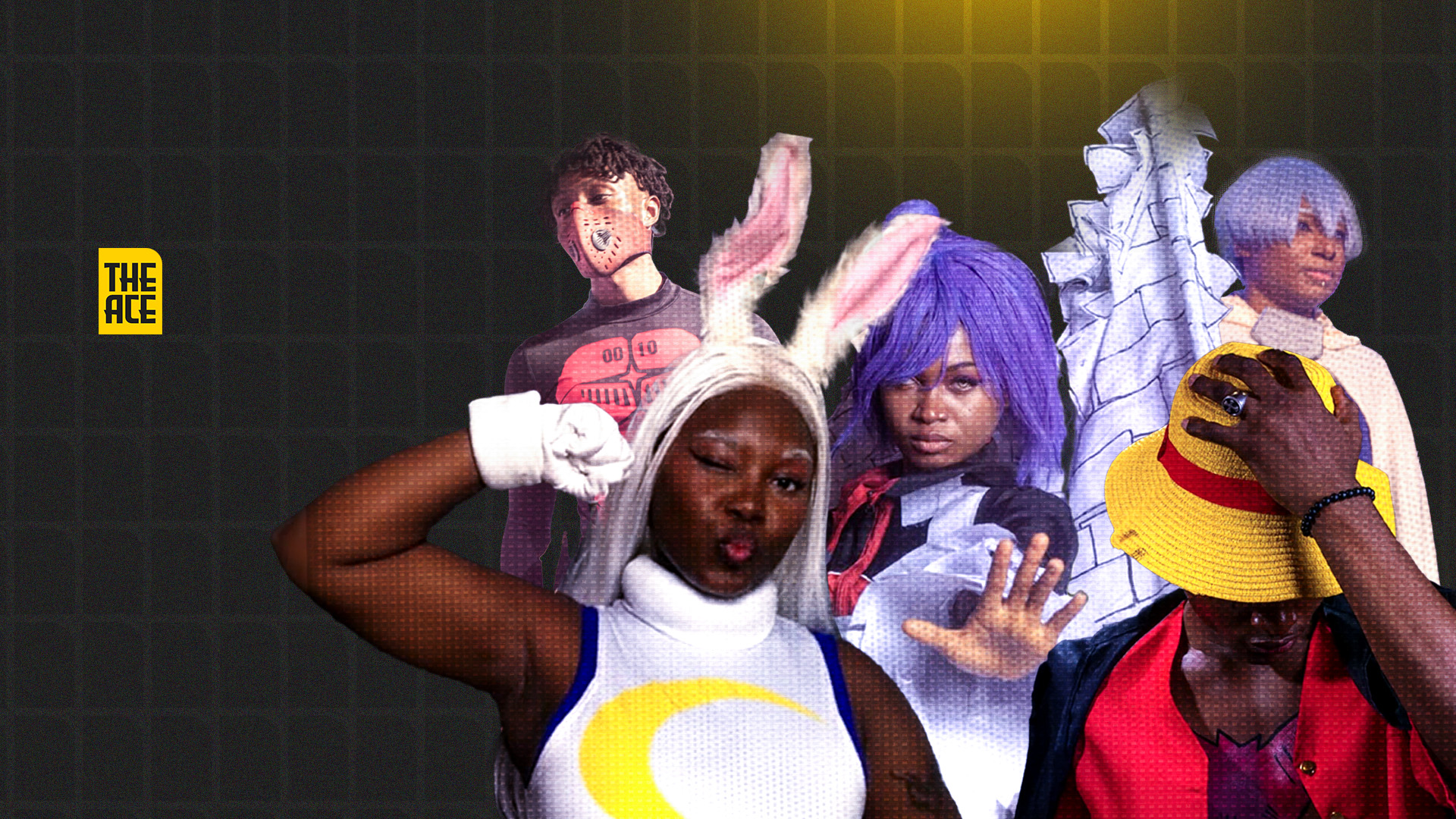
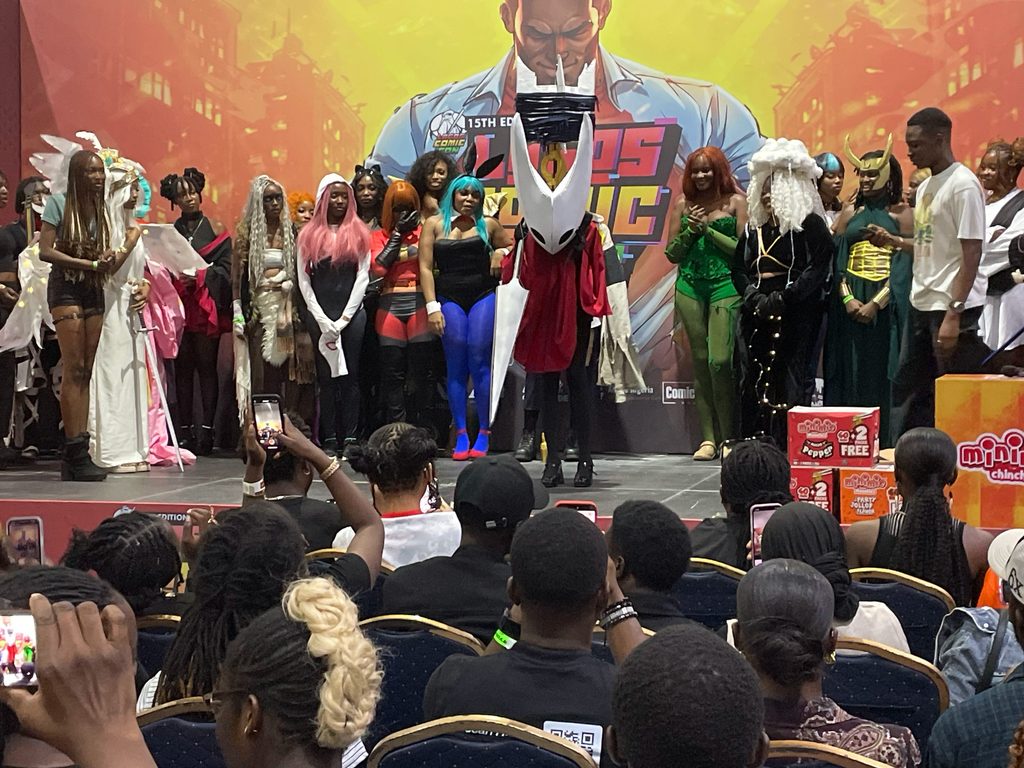
Cosplay remained a highlight, but it was no longer the only one. ComicWox returned to Lagos Comic Con after years away, new studios exhibited for the first time, and a representative from the Lagos State Ministry of Tourism, Arts and Culture was in attendance, a sign of the kind of institutional recognition the convention has long chased and rarely secured.
TheACE was not the only outlet on the ground taking notes. ComicPanel, their own private media platform, covered the convention extensively, and two of its dispatches are worth reading alongside this one. In one, ComicPanel sat in on a main stage discussion between Comic Republic’s Jide Martin, Ayodele Elegba, and Etta Studio’s Olayinka Henrietta Edun, who debated whether the Nigerian comic industry has moved past its early stages or is still building the basic awareness a mainstream audience would need to recognise a local superhero by name. In another, the outlet reported on a Comic Zone panel asking whether superhero comics can survive in Nigeria at all, where Kugali Media’s Toluwalakin Olowofoyeku, Symphonii Studios’ Uzo Chiemelu, and Comic Republic’s Jide Martin traded views on funding, international pitching, and the role artificial intelligence should and should not play in the creative process. Between the two pieces, a clear thread emerges: this year’s Lagos Comic Con was as much a working industry conference as it was a fan event, a shift the branding and programming both seemed built to support.
One detail from this year’s edition has yet to be fully explained. The event was widely publicised and badged as the fifteenth edition of Lagos Comic Con, a jump from the thirteenth edition covered here last year. No official account of the missing fourteenth has been offered so far, and in its absence, speculation has filled the gap. Among the theories doing the rounds is a familiar superstition, the idea that thirteen carries enough of an unlucky reputation in some circles that organisers, sponsors, or brands might prefer to leapfrog past it entirely. It remains, for now, exactly that: a rumour, unconfirmed and unattributed to anyone at Lagos Comic Con. TheACE has put the question to Osas Akugbe, who said he did not think much about it when he was given the brief, and that there must be a rationale to it.
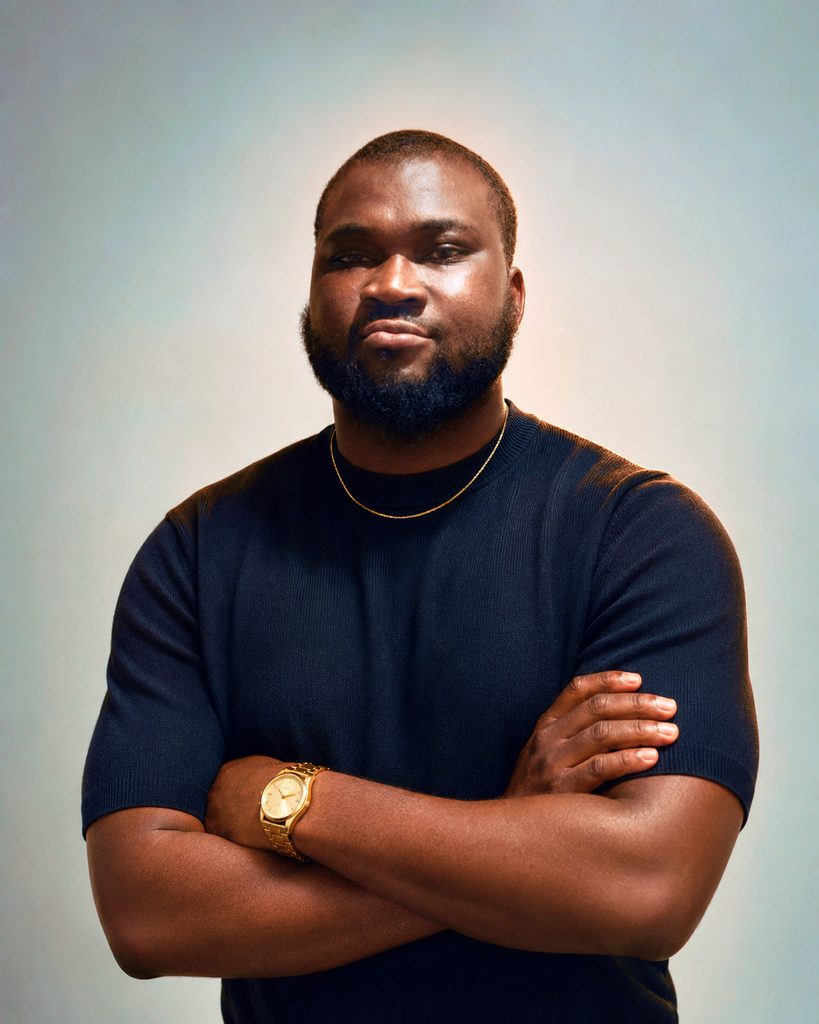
Akugbe is careful not to frame any of this as arrival. He still calls himself hands-on, still someone who has to be told when to step back and let a team execute a vision rather than build every piece of it himself. It is a discipline he traces directly back to Elegba, the mentor who once gave him a foothold with nothing to prove but willingness to learn, and whose seat he now occupies without, in his own words, ever fully leaving the drawing board.
“I want them to understand that where you start doesn’t necessarily determine where you end up,” Akugbe said, reflecting on what he hopes young creatives take from his path. “Take the opportunities in front of you seriously. Learn. Work. Ask questions. Be willing to start from the bottom.” It is advice that could just as easily describe the convention itself, an event that spent a year absorbing hard feedback and returned with a room that, for one weekend, finally felt whole.
Whether it was Lagos Comic Con’s thirteenth or fifteenth edition, one thing was not in dispute. The village that spoke with frustration last year had, this time, very little left to say except that it wanted more.
——————————————————–
——————————————————–
AI Use at TheACE
TheACE uses artificial intelligence tools to support research, drafting and analysis across Africa’s creative industries. All content is verified, edited and approved by our human editorial team to ensure accuracy, clarity and responsible storytelling. AI assists our work; it does not replace human judgment.