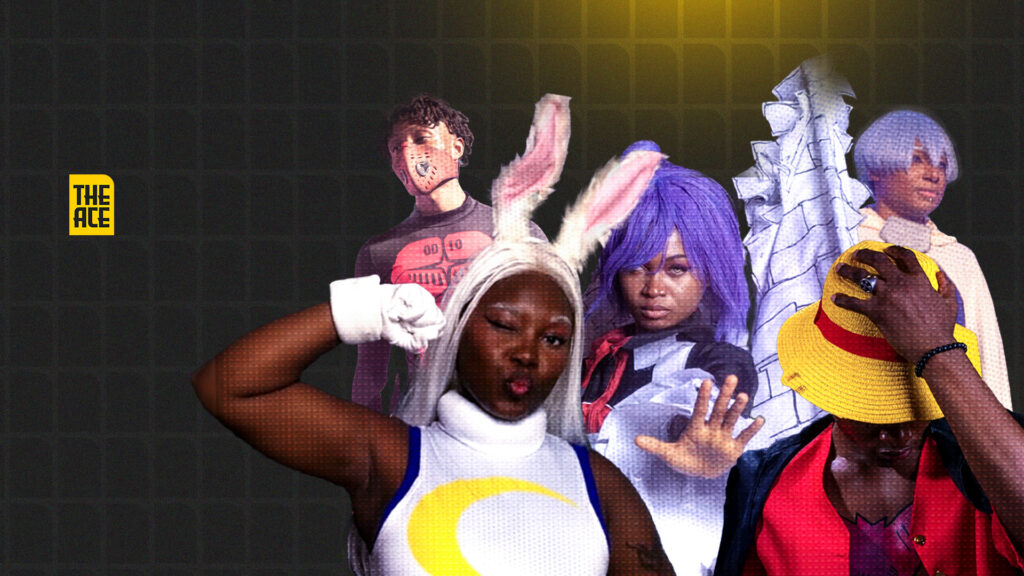
Behind the finished looks at Nigeria’s conventions is a network of makers, friends, imported materials, local improvisation, competition and online culture. Conversations with Nigerian cosplayers show a scene developing standards and community faster than it is developing a reliable way to make a living.
When Onyinyechukwu Onyeka, better known online as Layzeelolita, built the wings for a Konan cosplay from Naruto, she did not buy them. She made them move. The mechanism drew on her training in electronic and computer engineering, the same background that has since pushed her toward mechatronics because she wants to build costumes with more complicated, controlled movement. A Japanese character, a Lagos-based creator, locally available materials and an engineering degree had been folded into a single object that had to survive contact with Nigerian prices, Nigerian bodies, Nigerian event spaces and an audience that may or may not understand the reference.
That object is the reason this is not simply a story about Nigerians dressing up. Cosplay here is not imported fantasy reproduced unchanged. A character designed elsewhere has to be translated. Its shapes rebuilt from whatever the market actually sells. Its proportions redesigned so that a real person can walk, pose and perform inside it. The costume becomes a small engineering and interpretation problem before it becomes a photograph, and the people solving that problem are doing so inside a community with its own standards, informal economies and ways of teaching itself. As Nigerian cosplayers become more visible, the more useful question is no longer whether people here cosplay, but what kind of culture is being built around the costume.
Difficulty finding complete costumes locally had pushed Layzeelolita toward making more of what she needed herself, eventually adding sewing, wig-making, makeup, carpentry and prop construction to the skills she brings to cosplay. It would be easy to tell this as a story about one unusually resourceful creator, particularly now that a BBC Africa profile has brought her wider attention. The more revealing interpretation is that her trajectory makes visible what Nigerian cosplay has been becoming for years, and what that process actually costs.
Built From What Is Available
The practical demands become clearer when the numbers are attached. Osas Esangbedo, a Nigerian cosplayer and content creator known online as Osas Creates or Osassinate, estimated that his Vergil cosplay from Devil May Cry cost about ₦150,000 by the time the outfit was ready to wear and photograph. He did not buy one complete costume; he assembled it from several parts.
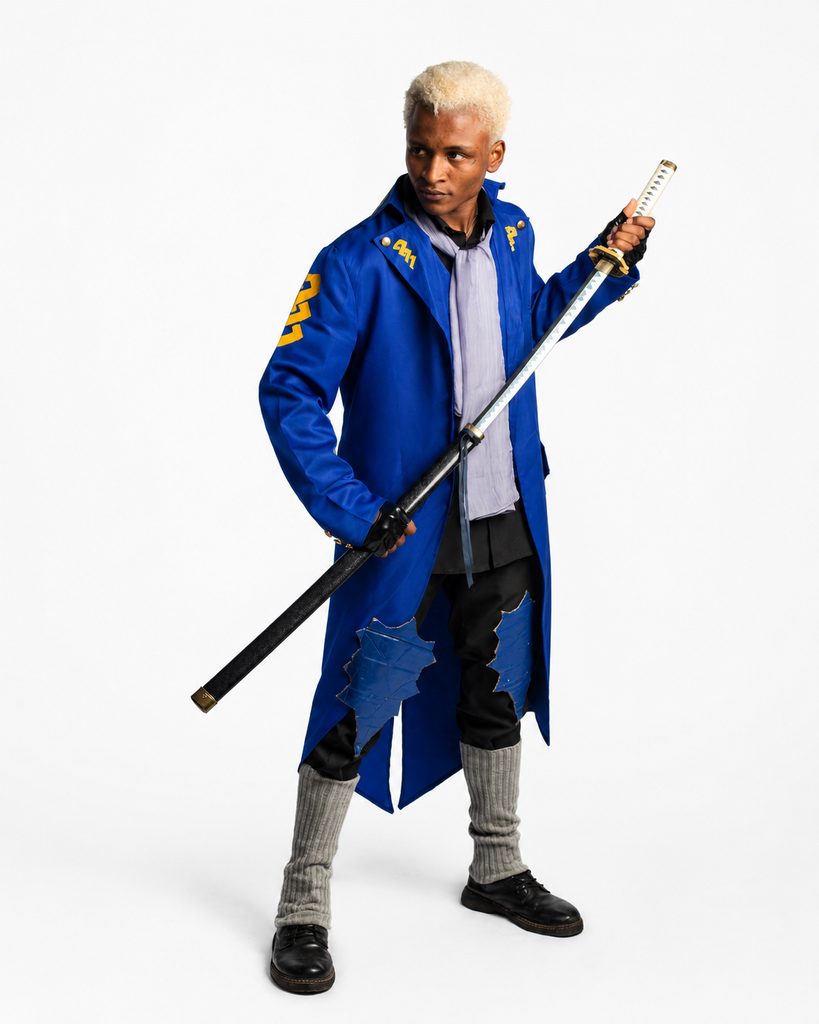
A blue coat cost about ₦22,000, after which he paid roughly ₦15,000 for it to be redesigned and printed to resemble Vergil’s coat. His boots cost around ₦25,000, while socks, gloves and smaller pieces came to roughly ₦10,000. A custom plastic katana added another ₦30,000; he said a steel version could have pushed the sword alone toward ₦100,000. Tinting his hair white cost about ₦15,000, blue contact lenses and solution added roughly ₦10,000, and photography could have cost another ₦10,000 without friends helping him keep that expense down.
The result looked cohesive enough that, according to Esangbedo, people assumed he had bought the outfit as a complete set. In reality, the costume depended on an existing coat, a separate designer, homemade knee pads, armour made with help from a friend and other components gathered from different places. “I try to bring things together,” he told TheACE, describing a process that is less about purchasing one finished object than making unrelated objects agree with one another.
Favour Ayubatari’s (Kammie) Mirko cosplay from My Hero Academia followed a different route but arrived at a similar economic reality. Kammie, who is also a medical doctor, said the white wig cost about ₦45,000 through Temu. The bodysuit, belt and shoes were made locally for roughly ₦45,000 to ₦50,000, while nude tights added another few thousand naira, placing the total around ₦90,000. She photographed and edited the final look herself with her phone, which removed another expense but also meant taking on another role in the production.
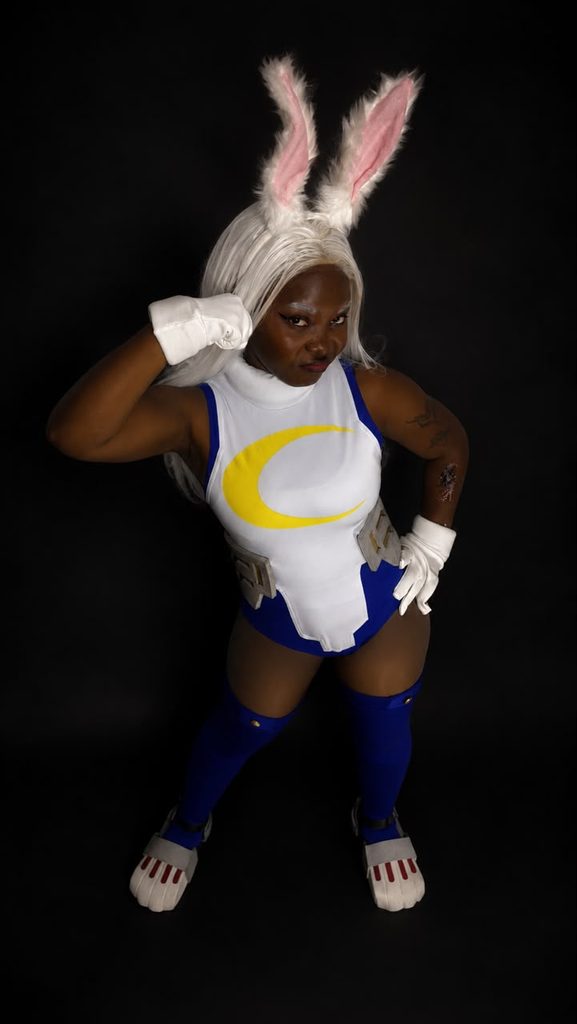
Those figures make the word “costume” sound almost too simple. What appears online as one outfit may distribute money across import platforms, local makers, fabric sellers, prop builders, printers, photographers and hairstylists. Limited access also forces cosplayers to understand how many decisions sit inside a design that viewers might initially read as one object.
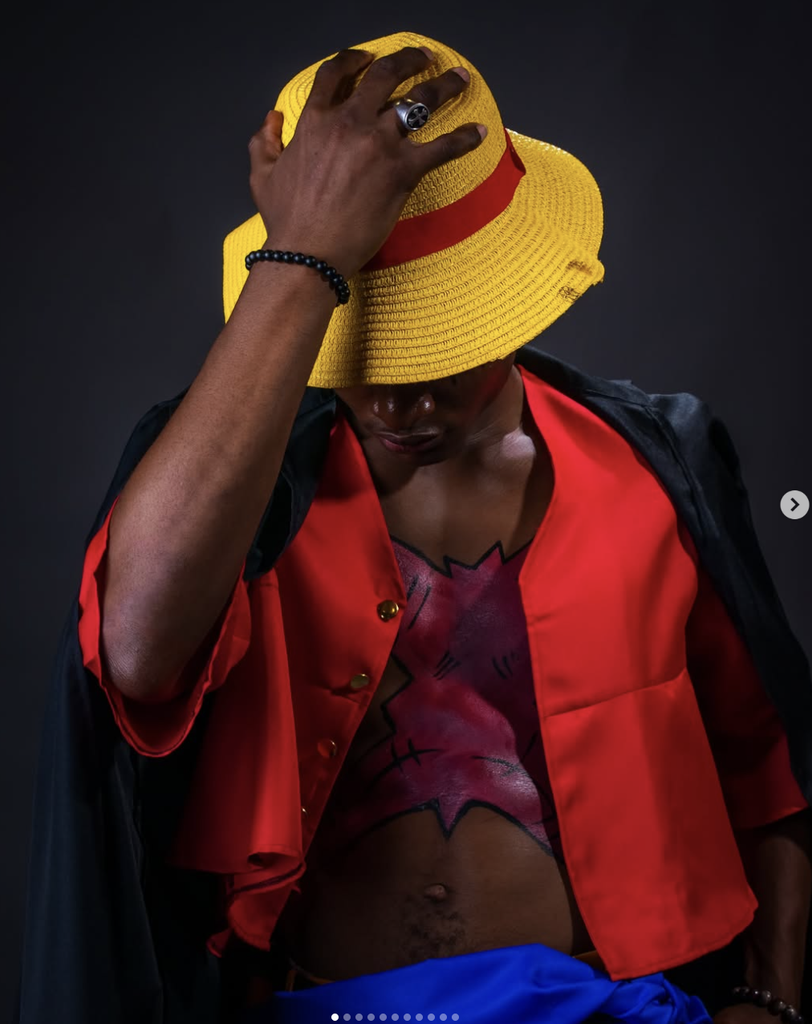
That is where local interpretation begins. Esangbedo has experimented with what he calls “Afro Sanji,” replacing the familiar wig associated with the One Piece character with his own Afro. He sees room for cultural interpretation, but still feels pressure to make the result look deliberate because viewers can be quick to dismiss a weak recreation as a cheap version of the character. For him, changing the narrative is allowed, but the quality still has to persuade the audience that the change was a choice rather than an excuse.
The Competition Is Also a Craft Standard
Conventions turn that pressure into something more formal because a community that competes eventually has to decide what it values. Lagos Comic Con’s published 2026 criteria for its general cosplay championship included costume quality, creativity, accuracy, stage presence, performance, crowd engagement and character embodiment. Those categories make clear that cosplay is being judged as more than visual resemblance, even if different Nigerian events place different weights on those elements.
Esangbedo has competed across OtakuCon, AniWeCon and Lagos Comic Con, and his experience suggests that there is no single Nigerian judging system. He described OtakuCon as the most varied of the competitions he had attended, with categories that recognised originality, performance, look replication and group work. His Afro Sanji performance won recognition there because he not only dressed as the character; he tried to embody Sanji physically through movement and kicks. At AniWeCon, he said audience response played a larger role, while his impression of Lagos Comic Con was that visual replication and the complexity of the finished look carried significant weight.
The differences show a culture still negotiating what excellence means. One event can reward craftsmanship, another can emphasise performance, and another can make audience reaction more decisive. Those systems influence what cosplayers spend money on, what skills they prioritise, and which characters become attractive competition choices. Kammie described competition and social media as a “double-edged sword.” Comparison can become unpleasant when people use derogatory language, but it can also push a cosplayer to improve. She remembers being compared with other creators early in her journey and deciding to treat the comparison as a challenge rather than a reason to leave. Standards create aspiration, but they can also create hierarchy, which makes the community surrounding the competition as important as the ranking itself.
The People the Camera Does Not Credit
Both Esangbedo and Kammie complicate the idea of cosplay as a solitary craft. Esangbedo may appear alone in the final Vergil image, but a designer altered his coat, and a friend helped with his armour. Kammie’s Mirko look depended on a maker capable of producing the bodysuit, belt and shoes, while she handled the photography and editing herself. The person standing in the frame remains the most visible contributor, but the frame often hides the network that got them there.
The same is true of knowledge. When Esangbedo entered the Nigerian scene, he said established cosplayers added him to group chats and explained how the community worked. One early critic challenged whether his first attempt should even count as cosplay, but other people defended him rather than allowing that criticism to define his entry. Kammie described her own reception as “more welcoming than annoying,” even though she encountered people who delivered criticism as insults instead of advice.
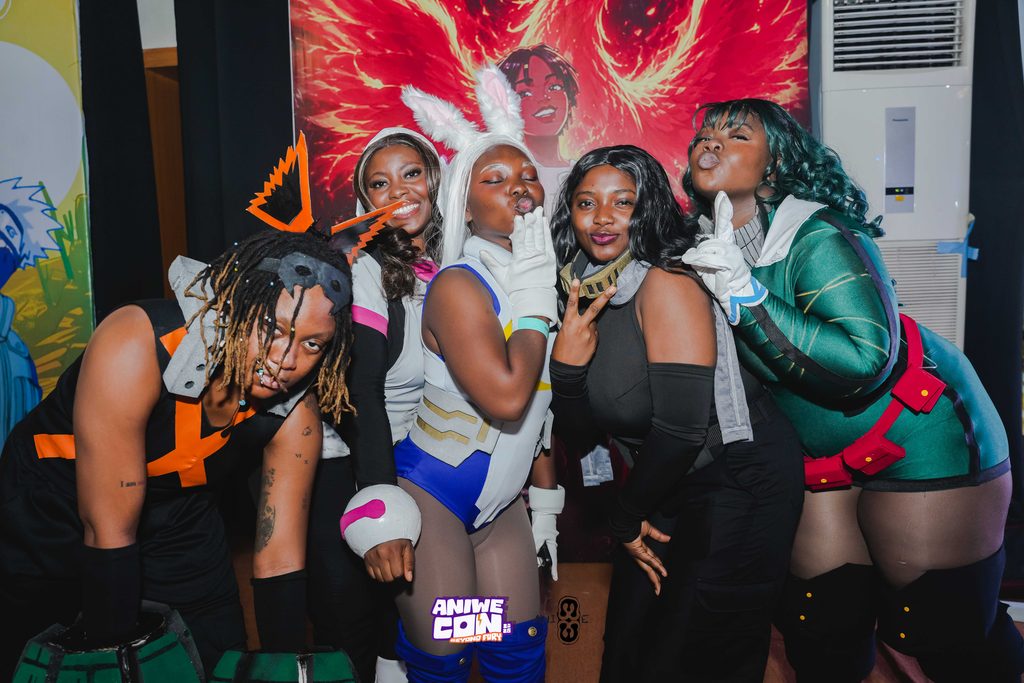
Her first convention makes the community argument clearer. Kammie remembers arriving at Otaku Connect knowing essentially one person. By the end of the event, she says she had around 20 new contacts or messages on her phone, and those connections gradually became “my own communities, my own people.” For someone whose day job is medicine, cosplay also became a boundary between professional responsibility and leisure; she described it as the rare period when she is not thinking about hospital work.
That social function is difficult to measure with attendance figures. A convention can report thousands of guests, but the more meaningful evidence may be whether people leave with relationships that continue after the venue closes. Esangbedo described meetups and collaborations that happen around conventions, while also noting an irony: cosplayers can spend so much of an event hunting for locations, shooting content and finding collaborators that they barely participate as ordinary attendees. The same person who competes against another cosplayer on Saturday may be the one explaining a fabrication technique to them on Monday.
That should affect how organisers think about them. Esangbedo argued that Lagos Comic Con could improve the experience by creating a clearly partitioned area where cosplayers can adjust costumes, wait for competition calls and return between shoots. A dedicated base would not turn cosplay into professional employment, but it would recognise that elaborate costumes require maintenance, storage, communication and privacy.
When the Costume Leaves the Fandom
The meaning of a costume changes depending on who is looking at it. Layzeelolita has recalled being called a “devil worshipper” after cosplaying Yamato from One Piece, whose design includes prominent horns. Within the fandom, the horns are a recognisable feature of a fictional character; outside it, the same image can be read through religious assumptions that have nothing to do with One Piece. Within the fandom, a person dressed as a demon is performing a fictional identity rather than making a declaration about personal belief. Outside it, particularly in a society where representations of demons, horns, magic and occult power can carry strong religious associations, the same symbols are read literally.
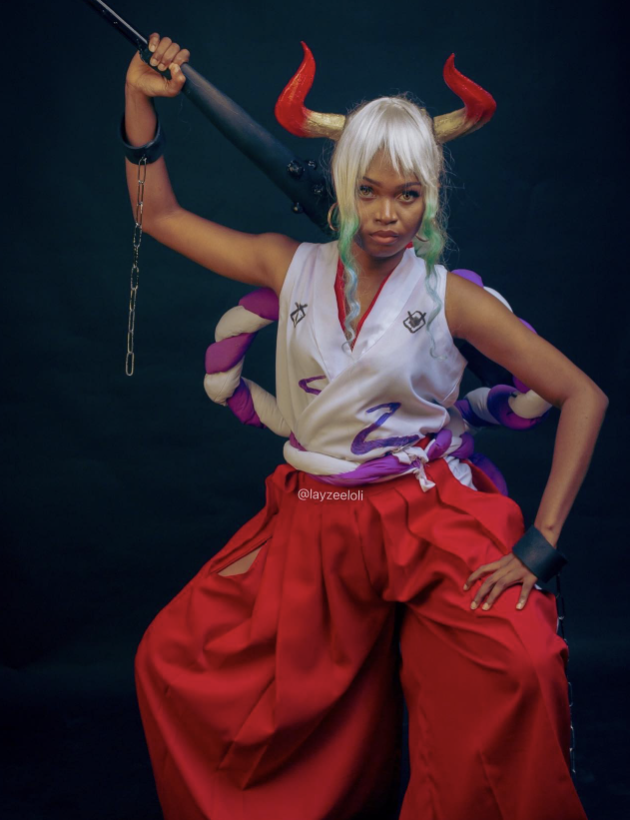
As Nigerian cosplay becomes more visible, its creators are therefore doing more than reproducing characters. They are translating fandom for people outside it, explaining why an adult would spend weeks building a costume, why accuracy matters, and why a hobby built largely around Japanese, American and other foreign popular culture can still produce a distinct Nigerian community. That translation happens in small, deliberate ways as much as in big gestures: in the TikTok posts where a cosplayer talks a curious follower through the process, in the group chats where members rehearse how to answer a relative who thinks the hobby is strange, in the patience of simply wearing the costume in public and answering the same question again. Kammie’s approach to the pressure female cosplayers can receive is one version of this: she said she only chooses characters she is comfortable wearing and does not hide her social media from her parents, refusing to treat the hobby as something that needs to be concealed.
She also drew a clearer boundary around physical access at conventions. In her experience, most people ask before touching or approaching in ways that require permission, but some do not, and an unexpected touch from a stranger will make her pull away. That distinction matters because visibility can create a false sense of availability. A cosplayer may intentionally invite photographs, stage attention and online circulation without consenting to every kind of physical interaction. As Nigerian conventions attract more spectators who are not already immersed in cosplay culture, etiquette becomes part of the infrastructure the community has to teach alongside costume-making.
A Real Economy, With Honest Limits
The financial picture is where enthusiasm has to meet arithmetic. Esangbedo’s Vergil costume cost roughly ₦150,000, while the competition prize he was discussing was ₦100,000. Even if he had won that prize, the costume itself would not have been fully recovered, before accounting for the hours spent researching, sourcing, assembling and creating content around it.
He does not describe that imbalance as evidence that the effort was wasted. Cosplay can return value through recognition, audience growth and the identity built around going further than viewers expect. He noted that his Vergil content performed strongly because Devil May Cry already had an audience interested in the character. That is a real return, but it is not stable income.
Kammie is even more cautious about the career question. Asked whether someone could realistically build a livelihood from cosplay in Nigeria today, her answer was effectively no; she sees the scene as growing but still too limited to promise a dependable career. Esangbedo offered similar advice, saying he would discourage anyone from entering Nigerian cosplay solely because they expect it to pay their bills.
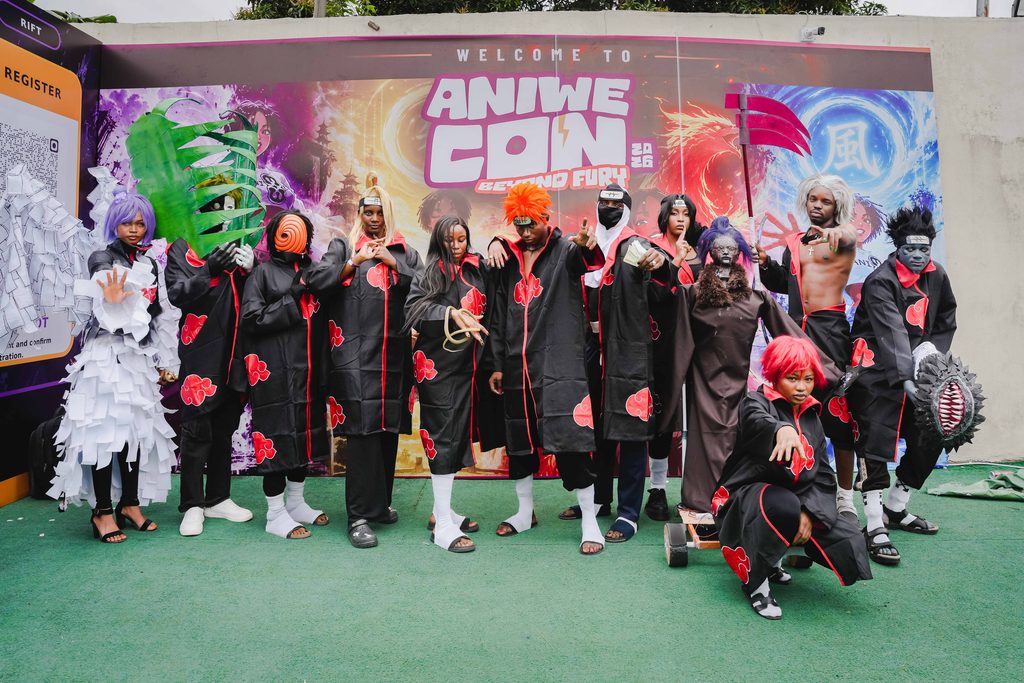
That does not mean there is no economy. Money already moves through costume commissions, wigs, imported materials, props, photography, transport, convention tickets, prizes and the vendors who gather around the same fandom. AniWeCon’s 2026 event, held in Yaba in August, drew more than 2,000 attendees according to its organisers and recognised multiple cosplay categories at the AniWe Awards, where Layzeelolita was named Nigerian Cosplayer of the Year and Best Nigerian Female Cosplayer, Osas Creates won Best Nigerian Male Cosplayer, and Afrocosplayers won Best Nigerian Group Cosplay. Lagos Comic Con, meanwhile, advertised more than 7,000 attendees and now offers dedicated competition access, judging structures and cash prizes as part of its cosplay programme. Those numbers come from organisers and should be read as such. Even so, they show that cosplay is no longer an accidental sideshow attached to Nigerian geek culture: organisers are budgeting for it, selling special competitor tickets and building schedules around it.
The limits are as important as the activity. A scene can become culturally significant before it becomes financially sustainable, and confusing those two stages can produce bad expectations for the people inside it. The current Nigerian cosplay economy appears strongest as a network of spending, commissions, visibility and occasional prizes rather than as a labour market capable of supporting most participants full-time.
Layzeelolita’s interest in costume-making, props, engineering and eventually film or music-video work shows one possible route without becoming a compulsory model for everyone else. Some people will turn cosplay skills into adjacent careers. Others will remain doctors, engineers, students or professionals who spend money on costumes because the community gives them something work does not. Kammie’s description of cosplay as an escape from hospital life is as legitimate a reason to remain in the scene as any plan to monetise it.
What the Costume Is Really Holding Together
The phrase “cosplay community” can sound casual until the activity is broken into the things required to sustain it. A costume may begin with a character created in Japan or elsewhere, but by the time that character appears at a Nigerian convention, it has passed through local makers, exchange rates, imported platforms, friends, group chats, photographers, event rules, social media audiences and cultural assumptions that were never part of the original design.
That process does not make the source character Nigerian, and it does not need to. What becomes Nigerian is the social life that forms around recreating it. Esangbedo’s Afro Sanji, Kammie’s first convention friendships and Layzeelolita’s moving Konan wings belong to different parts of the same process: imported popular culture becoming a reason for local people to make, modify, compete, collaborate and recognise one another. A Naruto character reproduced with locally available materials, photographed in Lagos and discussed by a Nigerian audience enters a different social environment from the one in which the character was originally created. That is where the community’s meaning is decided.
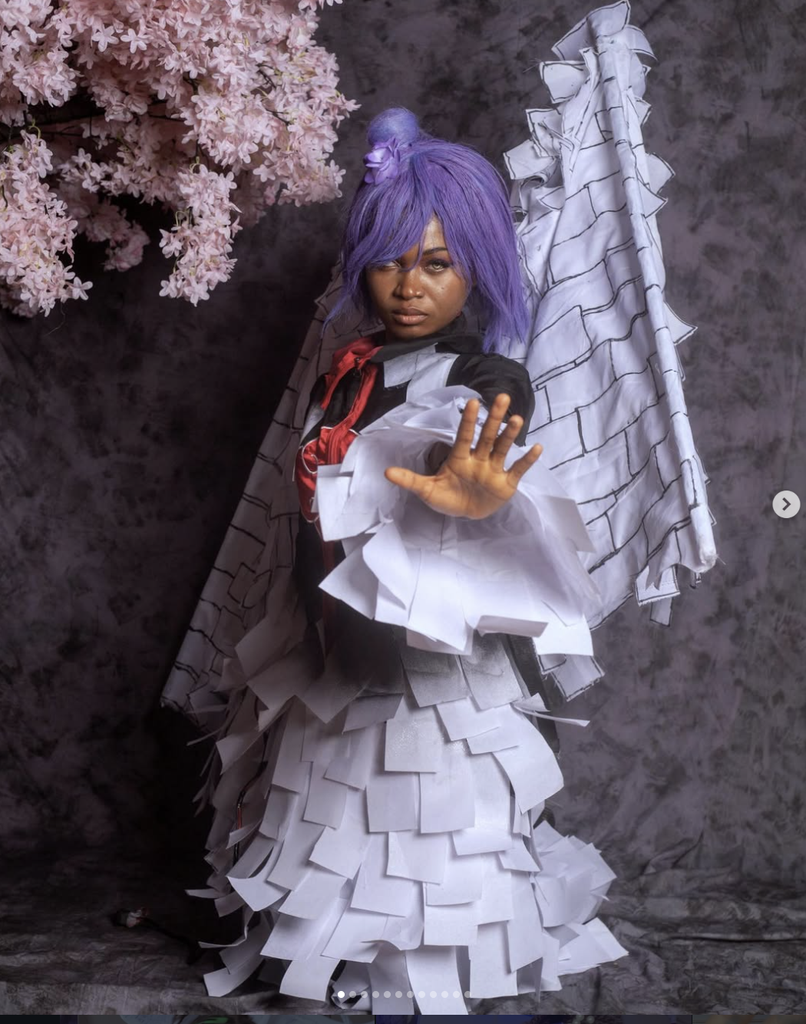
The community is still small enough for its weaknesses to be visible, and one of those weaknesses is attrition. The scene’s most public stories are of people who stayed. Less visible are those who left: the would-be cosplayer who priced out the costume they wanted and quietly stopped, or the one whose first convention ended without the friendships that kept others coming back. Every growth story has a dropout, and a scene that measures success only in attendance and awards will not see them. Costs are high, income is uncertain, criticism can become personal, public understanding is uneven, and event infrastructure does not always match the labour elaborate cosplay demands. Those limitations are precisely why it is more useful to describe the scene as it exists than to inflate it into another prediction about an inevitable creative-industry boom.
What exists already is substantial enough. Nigerian cosplayers are defining standards for one another, distributing work among makers and photographers, turning conventions into meeting points, using social media to make the activity legible to new participants and building relationships that outlast the events where the costumes are first seen. Whatever the scene becomes, it will be built the way its costumes are: from what is available, by people who decided the available thing was not quite good enough and taught themselves to make the rest.
Written by Nehemiah Osarodion and Mujeeb Jummah
——————————————————–
——————————————————–
AI Use at TheACE
TheACE uses artificial intelligence tools to support research, drafting and analysis across Africa’s creative industries. All content is verified, edited and approved by our human editorial team to ensure accuracy, clarity and responsible storytelling. AI assists our work; it does not replace human judgment.