Animation executives from Nigeria, Ethiopia and Morocco asked the Gulf to build projects with them from day one. Their case is strong, but it has a gap in the middle: who pays?
The most revealing detail from the African panels at the Sharjah Animation and Comics Conference was not a forecast. It was where the studios had earned their credibility. Every international tie the African speakers described, from schools and festivals to broadcasters, clients and co-producers, ran through France or the United States. In Sharjah, they asked for something different: an Arab partner at the start of the work, not the end.
Studios from Nigeria, Ethiopia and Morocco made that case on Friday 23 October, according to Gulf Today. They said African stories are ready to travel, but that the industry still needs funding and trained people to put them on global screens. Nigeria supplied three of the seven panellists on the two Friday panels that formed the main programme.
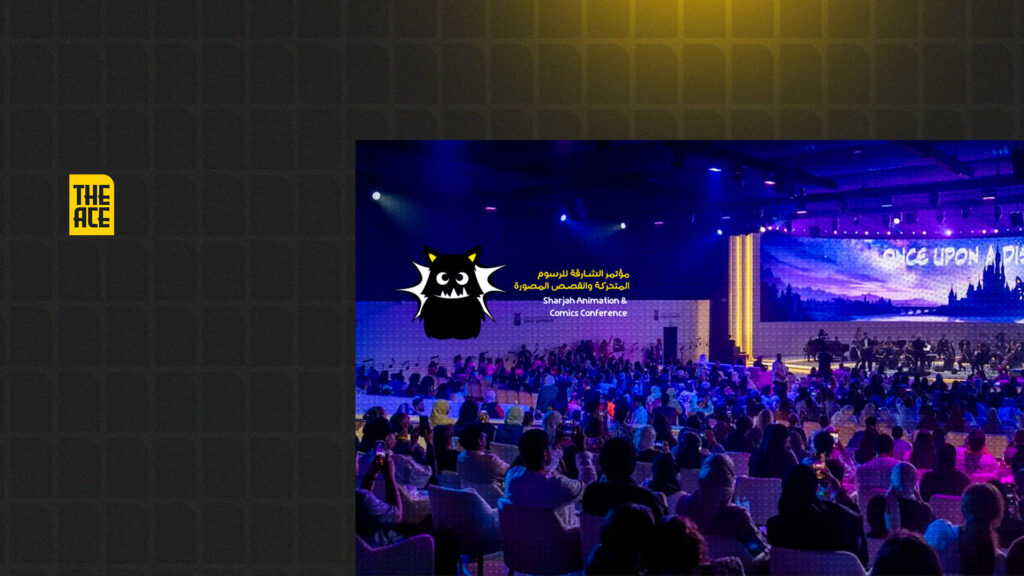
The setting mattered. The conference, organised by the Sharjah Book Authority at Aljada from 22 to 25 October, was the fourth edition and the first to bring comics and animation together. It closed with 8,075 visitors and 70 speakers from 30 countries, the organisers reported, across more than 150 activities.
The women leading the shift
The second Friday panel, Women Leading the Narrative Shift, brought together two Nigerian executives, Mbuotidem Johnson of Basement Animation and Esther Kemi Gbadamosi of Radioxity Media, with Lola Aikins of South Africa’s Tshimologong Precinct and Betelhem Sileshi of G Media Studios, Sharjah24 reported.
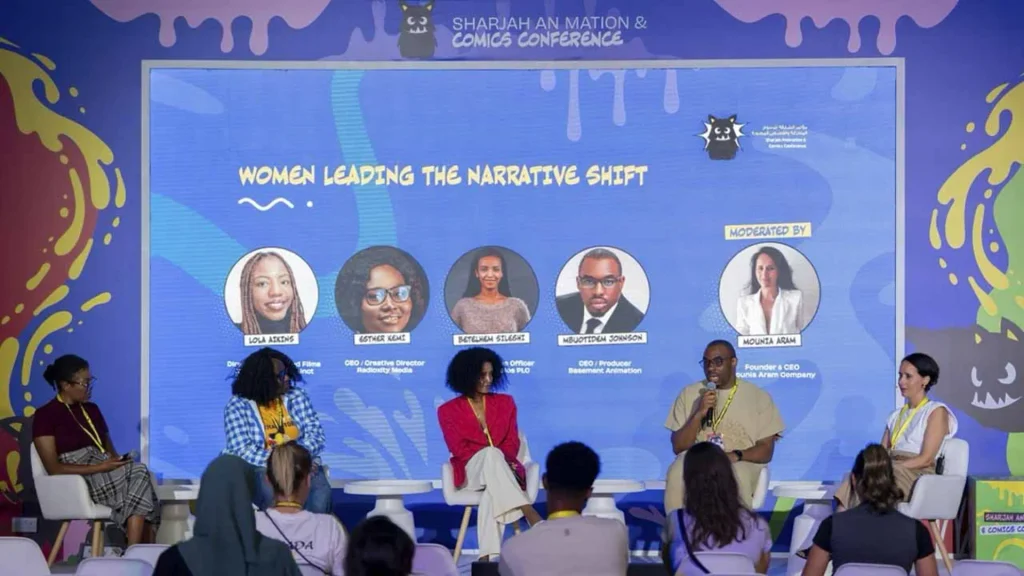
Aikins, who directs animated films at Tshimologong, said she is the only woman on her team and one of only two female animation directors in South Africa. Her internship programme draws about 500 applicants a year, most of them men. Women are well represented as producers, the panel heard, but far less so in directing and supervising, and Aikins said they receive less mentoring than men.
That applicant pool is the most telling number in the discussion. Mentoring assumes women are in the pipeline to be mentored, yet here the skew is visible before anyone is hired, promoted or passed over. The fixes the panel proposed, from mentorship and portfolio development to structured training and supportive workplaces, are sound, but they address a problem that begins upstream, in who sees directing as a career open to them. That is why Sileshi’s point, that hiring one woman encourages others, carries more weight than it first appears: it is a claim about visibility.
Gbadamosi said women are often strong on detail but can lack a defined career goal. Her studio began working with the US stop-motion house Laika about two months ago, with staff building portfolios for review. Sileshi said her studio now has women as creative director and producer; Johnson said women at his studio work across sound design and compositing.
The same split between producing and directing will shape any Africa-Arab co-production. The director’s chair, and the ownership of the idea, decide who controls the story.
In a separate session, Gbadamosi took audiences behind the scenes of stop-motion puppet building, from ball-and-socket joints to the structures that let characters move and express themselves frame by frame, and spoke about young artists choosing hands-on craft in the age of AI, the conference’s Instagram page said. The Laika link shows why that craft matters commercially: it is a route into premium global work through skill rather than scale. Whether it leads to ownership or merely to a better class of subcontracting is the question the rest of the conference circled.
An African-Arab bridge
Where the women’s panel looked inward, the emerging-markets discussion looked outward. Ferdy Adimefe, chief executive of Lagos-based Magic Carpet Studios, said the strongest opening for African animation lies in the Arab world, since 10 of the 22 Arab League states are in Africa. Deals, he said, have to work between producers and between governments, with animation treated as “an asset class”.
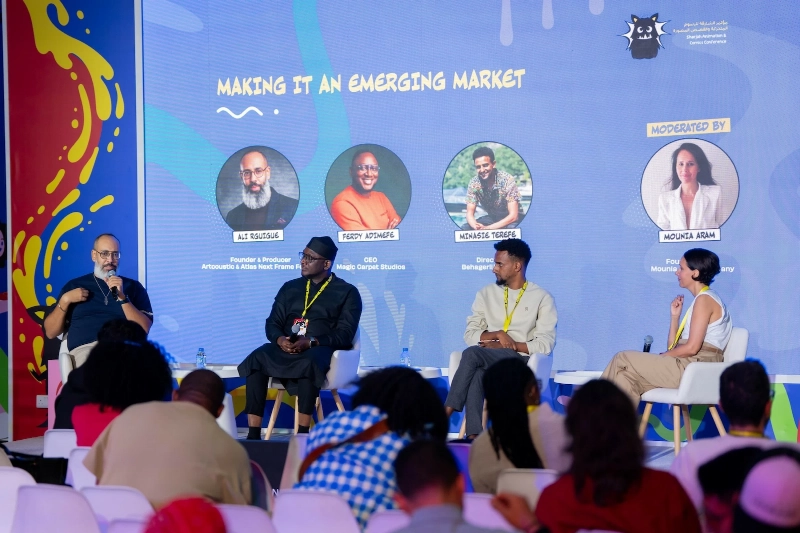
His studio has worked for Cartoon Network, Sesame Street and Microsoft and runs a nine-month fellowship with France’s Gobelins school. Its first feature, The Passport of Mallam Ilia, adapts a novel read across Africa for more than 60 years, a readership Adimefe said helped attract investors. The film is due next year with French and US partners, animated frame by frame in Lagos.
Read together, those facts describe the shift the panel was arguing for: a studio that built its name on other companies’ properties is now financing a story with a ready audience. That move, from commission to ownership, is what treating animation as an asset class means in practice.
Adimefe was blunt about scale. In remarks shared on the conference’s Instagram page, he cautioned that 250 million people at home “doesn’t mean they will all buy your ticket”; a home market too small for a feature is a reason to find a second one.
Minasie Terefe, director at Ethiopia’s Behagerlij Studio, said funding remains the hardest step for African creators. His dialogue-free series Sunday Morning won two prizes at Annecy, including the Disney Television Animation prize; he chose silence so the story could cross languages while keeping its Ethiopian identity. Awards, the conference’s Instagram page said, were for him a way to open doors and build credibility, with the real achievement lying in turning recognition into funded projects. His pitching advice: skip the introductions, open with a hook.
His silence is itself a distribution strategy. Any co-production across the languages of Africa and the Arab world faces a language problem before a financing one, and dispensing with dialogue is one answer to it.
Ali Rguigue, founder of Morocco’s Artcoustic Studios and the Atlas Next Frame Festival, said the continent’s problem is structure, not talent: talent exists everywhere, but pipelines do not. Working with governments, he argued, can help build large African studios without changing their stories. Artcoustic began with government explainers, and its Moroccan series have since been picked up by the French-language broadcaster TV5Monde. In a separate session, Rguigue said his free Flow Motion School receives about 2,000 applications a year for 30 places, and that almost all graduates go straight into jobs, Sharjah24 reported.
That is roughly 67 applicants for every place, an intake of about 1.5%. The demand for training is plainly not the problem; the supply is, and it has been met so far by public money. The school opened in 2021 under a national youth-employability initiative. It is the clearest evidence on offer that the structure Rguigue wants is buildable, and that it was built by institutions rather than by the market.
The panel agreed that the next five years depend on joint African and Arab concepts from the first day, not finished ideas brought to partners late.
The Arab side of the table said much the same. Khoula Al Mujaini, the conference’s executive director, told The National that the Arab world has the artists, audiences and stories, but that talented creators still need access to producers, financiers, publishers and distributors. She wants original projects with regional humour and visual identity rather than imitation of work from elsewhere.
A shared diagnosis, a missing third payer
That is the same diagnosis the African studios gave, delivered from the other shore, and it is both the strongest argument for the partnership and its biggest risk. Two regions that each say they lack financing and distribution cannot simply swap what they are missing. A co-production between them needs a third source of money, and no one on the panels was reported as offering it.
The French and US partners already attached to Mallam Ilia are one such source; whether Arab backers are meant to replace them or stack beside them is a question the panels left open.
The shared bet is that cultural specificity, matched with technique, is an asset rather than a barrier. Terefe’s silent film, Rguigue’s children’s series on Touria Chaoui, who earned her pilot’s licence in 1951, at 15, and the Arab-inspired concepts the organisers want are all versions of it. The open question is whether joint concepts can hold two specific identities at once, or settle into a blander regional middle.
The voices at the margins show what is at stake. Nasser Elsamani, a Sudanese anime artist, told Sharjah24 that nothing like the conference existed where he grew up, and that he learned his craft from online courses. A convening event can show such artists a route. It cannot replace the pipeline Rguigue described.
What to watch
The conference now has a platform and a thesis. To turn them into an industry it needs three things before the next edition, and a viewer should hold all three to a simple standard. None of the accounts of the panels points to a signed deal, and most coverage so far has come from outlets close to the organisers.
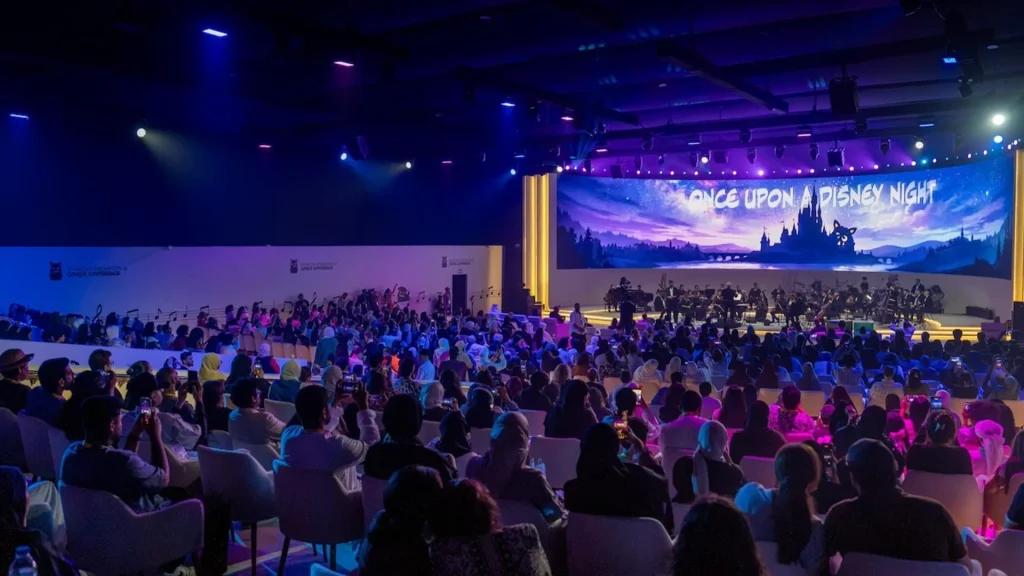
The first is a named project with a financing structure, announced publicly, not another panel. The conference already runs two vehicles that could carry one: Pitch the Project, for children’s series concepts inspired by Arab cultures, and the Book2Screen Challenge for Arab publishers. A category for joint African and Arab concepts in either would test the panel’s call to develop projects together from the start.
The second is an answer to Adimefe’s government-to-government point. If deals have to work at that level, the organisers and the African studios should say what the state layer looks like: a co-production incentive, a fund, a training partnership.
The third is transparency. The closing figures give 70 speakers from 30 countries but do not say how many came from Africa. If the conference wants to be judged as a bridge between two regions, it should publish the numbers that show it.
What the African studios did offer was a coherent diagnosis and a sharper ambition than finding work. They want to own what they make. The Gulf’s response will show whether Sharjah wants to be where that argument is heard, or where it is funded.
——————————————————–
——————————————————–
AI Use at TheACE
TheACE uses artificial intelligence tools to support research, drafting and analysis across Africa’s creative industries. All content is verified, edited and approved by our human editorial team to ensure accuracy, clarity and responsible storytelling. AI assists our work; it does not replace human judgment.