
There is a version of this story that would be easy to tell: a founder, driven by passion, builds a festival from the ground up and watches it grow into one of the region’s most recognised platforms. It is the kind of narrative the creative industry is used to repeating: clean, inspiring, and ultimately predictable.
But that version leaves out the most important detail. The man behind one of Egypt’s most prominent animation festivals does not work in animation. He did not study it, does not practice it professionally, and, by his own admission, does not earn from the festival he runs.
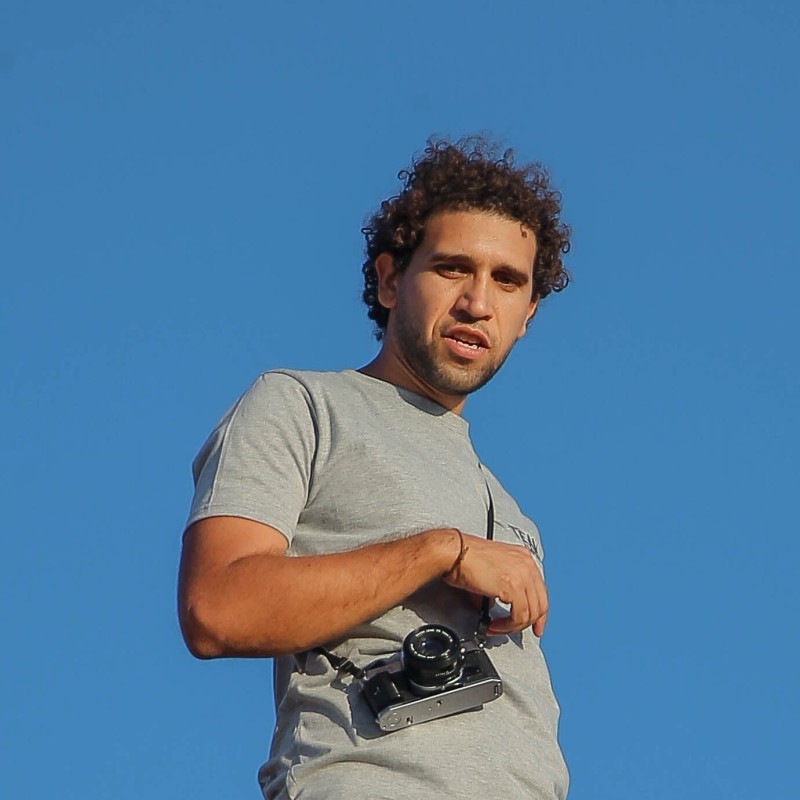
Youhana Nassif’s background is in something far removed, adventure travel, and designing hiking trails. He moves through physical landscapes rather than digital industries. Yet, over the past six years, he has built Animatex into a space that thousands now pass through: filmmakers, students, international guests, and an industry that, until recently, struggled to find a centre.
That contradiction is the story. Animatex did not emerge from within a well-organised animation ecosystem. It emerged in response to the absence of one. As Youhana Nassif describes it, “We have lots of stories. We have lots of talent… lots of technical skills. We have lots of everything, but organisation is a bit lacking.”
Egypt, like much of the continent, had both stories and talent in abundance. What it lacked was structure, systems that could gather practitioners into one place, create visibility, and translate scattered efforts into something legible, both locally and internationally. In that kind of environment, building a festival is not just about programming films or hosting workshops. It is about imposing order on fragmentation. And that is precisely where Nassif’s background as a trail designer became a mechanical advantage.
Just as a hiking trail provides a safe, structured path through unmapped wilderness, Nassif approaches the animation industry as a system to be mapped. Where others see individual films, he sees the gaps between them. Where others see careers, he sees the absence of “connective tissue”.
That also meant Nassif did not enter animation through the conventional route. He had no formal training, no studio background, no gradual climb through industry ranks. His relationship to animation was simpler, and perhaps more telling; he grew up watching it.

“I just like animation… I think it’s an ideal medium to express ideas, to tell stories,” he says, reflecting on an early connection that never translated into a professional pursuit. What stayed with him, however, was a quieter observation: the Egyptian animation he once encountered as a child had, over time, receded from view. That absence became the starting point.
Rather than attempt to produce animation himself, Nassif made a different decision: to create a space where animation could be seen, discussed, and connected. What began in Cairo as a small, community-focused gathering was less an event than an intervention, a deliberate attempt to bring scattered practitioners into proximity with one another.
The early version of Animatex reflected the limitations of its environment. Its first edition operated under the constraints of a global pandemic, with attendance limited to roughly 90 participants and a largely local focus. But even in that form, its purpose was clear. It was not trying to compete with established global festivals. It was trying to make the industry visible to itself. What followed was not simply growth, but consolidation.
In its first edition, Animatex received around 140 submissions. By its sixth, that number had climbed to 2,267, an exponential expansion that signals more than increased interest; it reflects a shift in how the festival is perceived beyond its immediate environment. The scale of programming evolved alongside it. Screenings expanded from just a handful of feature films to approximately 200 short films and 15 features, while workshops grew from six to around thirty, bringing together practitioners across disciplines and regions.
Audience growth followed a similar trajectory. From fewer than a hundred attendees in its earliest iteration, the festival now attracts close to 5,000 participants, spanning students, professionals, and a growing number of international visitors. The presence of guests from across Africa, the Middle East, and Europe has become a defining feature, signalling a gradual shift from a local gathering to a platform with regional and global relevance.
These figures, taken in isolation, suggest success. Taken together, they indicate something more significant: the emergence of a central node in a previously dispersed network.

Animatex began to function not merely as a festival, but as a point of reference. For local creators, it became a place to screen work, find collaborators, and engage with a broader industry. For international observers, it offered a lens through which Egyptian animation could be understood. Over time, this dual role reshaped perception. What started as an independent initiative began to be seen, both locally and externally, as a representative platform for the Egyptian animation space. As Nassif notes, when creators are “looking to screen their film… or looking into collaborations… they think of us.” That transition from event to proxy institution is where the story takes its real shape.
In more established industries, the functions Animatex performs are distributed across multiple entities: studios, guilds, funding bodies, distributors, and formal archives. In Egypt’s animation ecosystem, many of these structures remain underdeveloped or absent. Animatex, by necessity, has moved to occupy parts of that vacuum.
Its activities extend beyond curation. The festival facilitates pitching opportunities, connects creators to international markets, and supports filmmakers in accessing global platforms. It is developing an industry database to track works in development and production, effectively mapping a landscape that has historically been difficult to navigate.
This, perhaps, makes its archival role the most vital infrastructural work. The most recent “90 Years of Egyptian Animation” project was not merely a celebration; it was a notable rescue mission. Its rich history, despite its depth, remains largely fragmented across private collections and independent institutions. And in a region where institutional support for preservation is lacking, Nassif’s team relied on a network of partners and sheer coincidence.
“It’s not only you that doesn’t know about Egyptian animation and its history, most of the people, even here in Egypt, it’s also not known at all,” Nassif noted.
Through these partnerships, they located the last surviving descendant of the country’s first animation creators, who delivered original films and materials to the team. They also collaborated with private organisations that had accidentally acquired the collections of animation pioneers.
In retrospect, this is not typical festival work. It is infrastructural. And it is here that Nassif’s position as an outsider becomes less surprising. Without the constraints of professional identity within the field, he approaches the industry not as a practitioner focused on output, but as an organiser focused on systems. Where others see films, he sees the gaps between them. Where others see individual careers, he sees the absence of connective tissue.
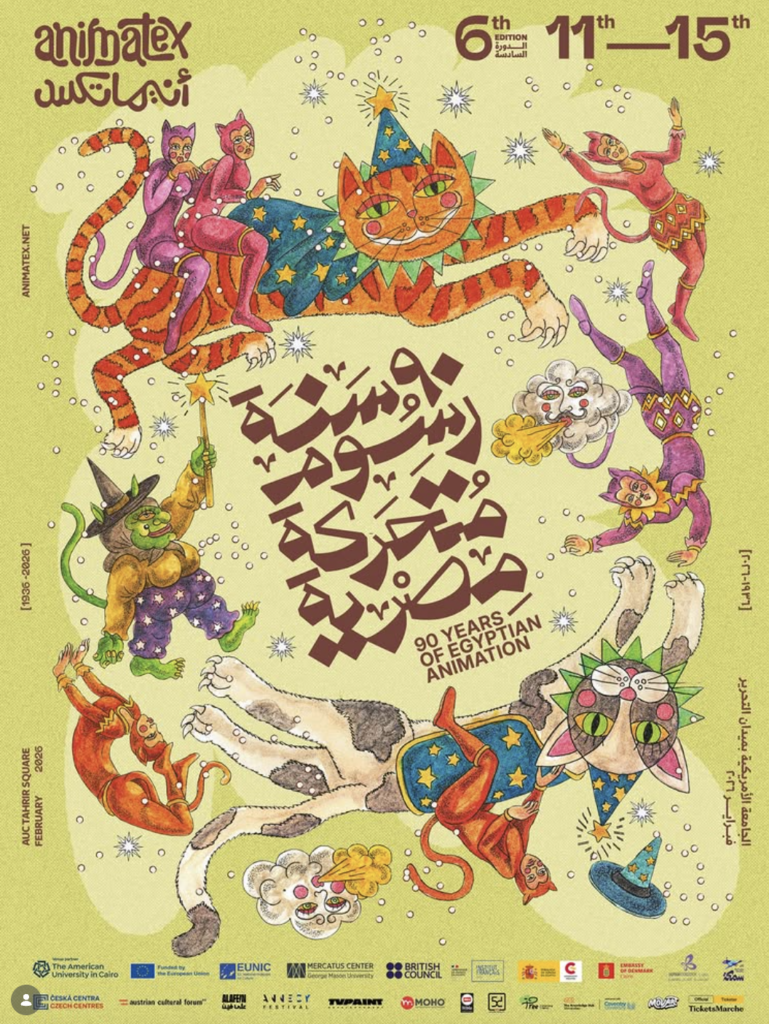
That perspective has allowed Animatex to evolve in ways that extend beyond its initial scope. Yet, the conditions that made it necessary have not fundamentally changed.
As Nassif puts it, funding for animation production remains limited, and institutional support is still developing. Even for the festival itself, sustainability is an ongoing concern. Animatex began as a fully grant-funded initiative; today, grants account for roughly half of its budget, prompting a gradual shift towards ticket sales, sponsorships, and alternative funding models.
There is also the less visible cost: labour. The work of building and sustaining such a platform is continuous, resource-intensive, and, in Nassif’s case, largely detached from personal financial gain. It is driven less by immediate reward than by a sustained commitment to the idea that the industry can, and should, exist in a more organised form.
In that sense, Animatex is not an isolated case. It reflects a broader pattern across creative ecosystems in Africa and the wider Global South. In the absence of fully developed institutional frameworks, individuals and small teams often take on roles that, elsewhere, would be distributed across formal structures. Festivals become markets. Media platforms become archives. Community initiatives become gateways to international visibility. The boundaries between organiser, curator, and institution begin to blur.
This is where the story of Animatex extends beyond Egypt. It speaks to a larger question about how industries take shape, not in theory, but in practice. Talent alone does not build an ecosystem. Neither does visibility, in isolation. What sustains an industry is the presence of systems that connect, support, and amplify its participants. When those systems do not exist, someone must build them. In this case, it was not an animator.
“When you start, there is everything,” Nassif reflects, a statement that captures both the simplicity and the weight of what Animatex represents.
He did not become part of Egypt’s animation industry in the traditional sense. He did something more foundational. He helped construct the framework through which that industry could begin to recognise itself and be recognised by others. The implication is difficult to ignore.
Ergo, in emerging creative economies, the future of an industry may depend less on those working within it and more on those willing to organise it.
--------------------------------------------------------
--------------------------------------------------------
AI Use at TheACE
TheACE uses artificial intelligence tools to support research, drafting and analysis across Africa’s creative industries. All content is verified, edited and approved by our human editorial team to ensure accuracy, clarity and responsible storytelling. AI assists our work; it does not replace human judgment.