Nigeria’s comic book industry is valued at an estimated $106 million. Yet according to Ray Anyasi, Global Director of Bookause International, much of that valuation remains theoretical; a “ghost wealth” sector that has yet to translate into measurable economic output.
Speaking during a recent livestream hosted by Africacomicade, Anyasi described the industry as structurally constrained, not creatively deficient. While the global comics market is valued at roughly $17 billion, Nigeria’s ecosystem lacks the commercial infrastructure required to convert intellectual property into scalable revenue.
Data from the Nigerian Comics Industry Report underscores the imbalance. The least cost of producing a single issue stands at approximately 135,000 Naira, excluding printing and marketing. Meanwhile, 31% of surveyed readers indicated they would not pay above 1,000 Naira per copy. The result is a pricing gulf that makes profitability structurally difficult.

For Anyasi, the missing piece is distribution. He highlighted a startling disconnect between the inherent value of African intellectual property and the absence of formalised distribution networks required to monetise it. He posited that the most significant barrier to success is an “investment hunger” for tangible systems.
Sharing a candid anecdote, he recounted returning 68 million Naira to investors after a proposed pilot scheme for comic-selling kiosks collapsed due to insufficient market data. Without reliable demand metrics, the risk profile proved untenable. The lesson, he argued, is clear: until Nigeria builds formalised retail and distribution systems, the industry will remain trapped in fragmentation.
According to Anyasi, the individual or firm that successfully builds a nationwide distribution pipeline, making a local comic as easy to purchase as a daily newspaper, will essentially command the sector’s commercial gateway for decades. He argued that the business case for Nigerian comics lies in this “land grab” of infrastructure, where “the first person who builds the road,” he suggested, “gets to collect the toll.”
While Anyasi focused on structural reform, the conversation also examined adaptive strategies currently keeping the ecosystem alive.
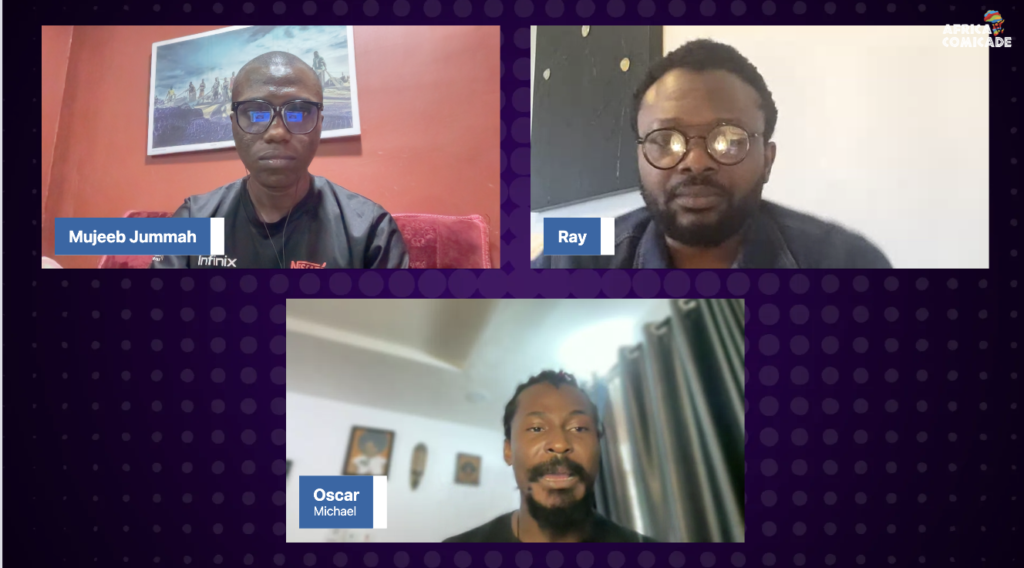
Mujeeb Jummah and host Oscar Michael provided critical context on the creator’s journey. Jummah, co-author of the report and founder of The African Comics and Cinematic Empire (TheACE), argued that creators must compensate for retail weakness with sharper market intelligence. Rather than relying solely on core comic audiences, urging creators to “zag where others zig”, he advocated targeting non-traditional sponsors, including banking, real estate, and corporate institutions, sectors with marketing budgets but limited exposure to comic IP.
Meanwhile, Michael, representing Africacomicade, pointed out the rising trend of “transmedia,” where Nigerian studios like Comic Republic and YouNeek Studios are increasingly leveraging their comic book IPs to secure international partnerships and animation deals, effectively using the cheaper medium of comics as a testbed and proof-of-concept layer for larger franchises.
These strategies, however, are adaptive responses — not structural solutions.
Ultimately, the session served as a clarion call for the industry to move beyond a “passion economy” toward a robust retail model. Anyasi’s spotlight on the structural void was a reminder that talent alone cannot sustain an industry; it requires the cold, hard logic of supply chains and accessible shelf space. By establishing a system where a young artist can simply plug a finished series into a ready-made pipeline and receive royalties, Nigeria could finally unlock its multi-million-dollar fortune.
The broader consensus from the session was unmistakable: Nigeria’s comic industry is not suffering from a deficit of talent. It is constrained by the absence of coordinated infrastructure, data systems, distribution channels, and scalable retail access. The fortune may already be mapped on paper. But until someone lays the tracks, it remains unrealised.
--------------------------------------------------------
--------------------------------------------------------

AI Use at TheACE
TheACE uses artificial intelligence tools to support research, drafting and analysis across Africa’s creative industries. All content is verified, edited and approved by our human editorial team to ensure accuracy, clarity and responsible storytelling. AI assists our work; it does not replace human judgment.