Prologue: The Elephant in the Room
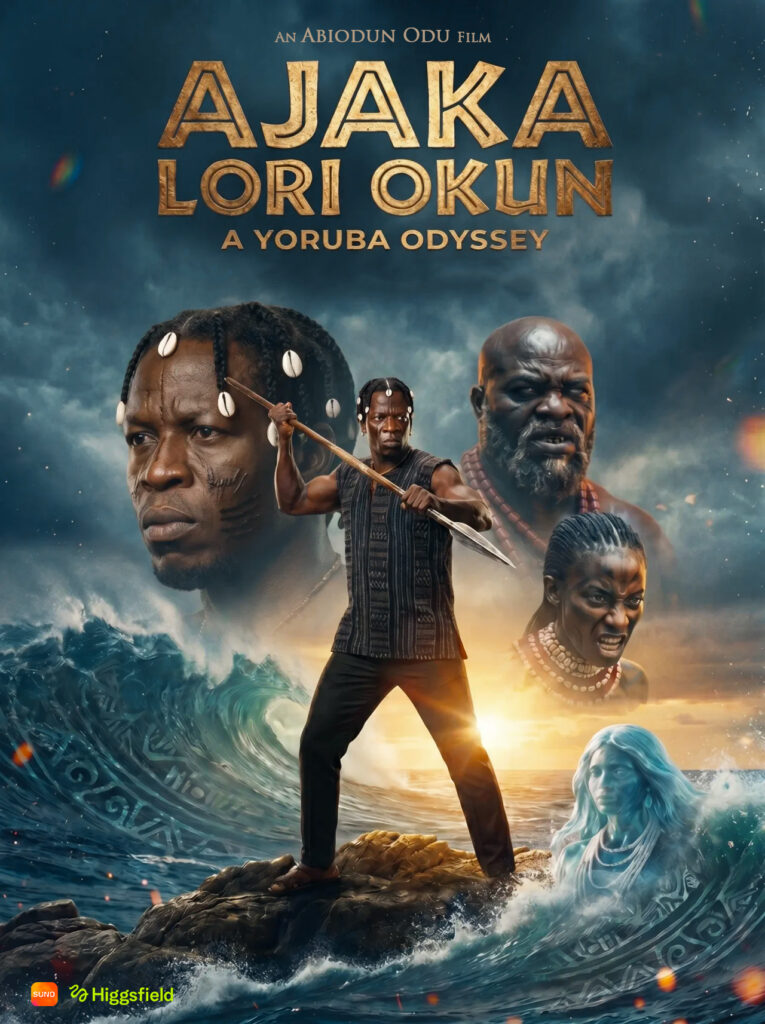
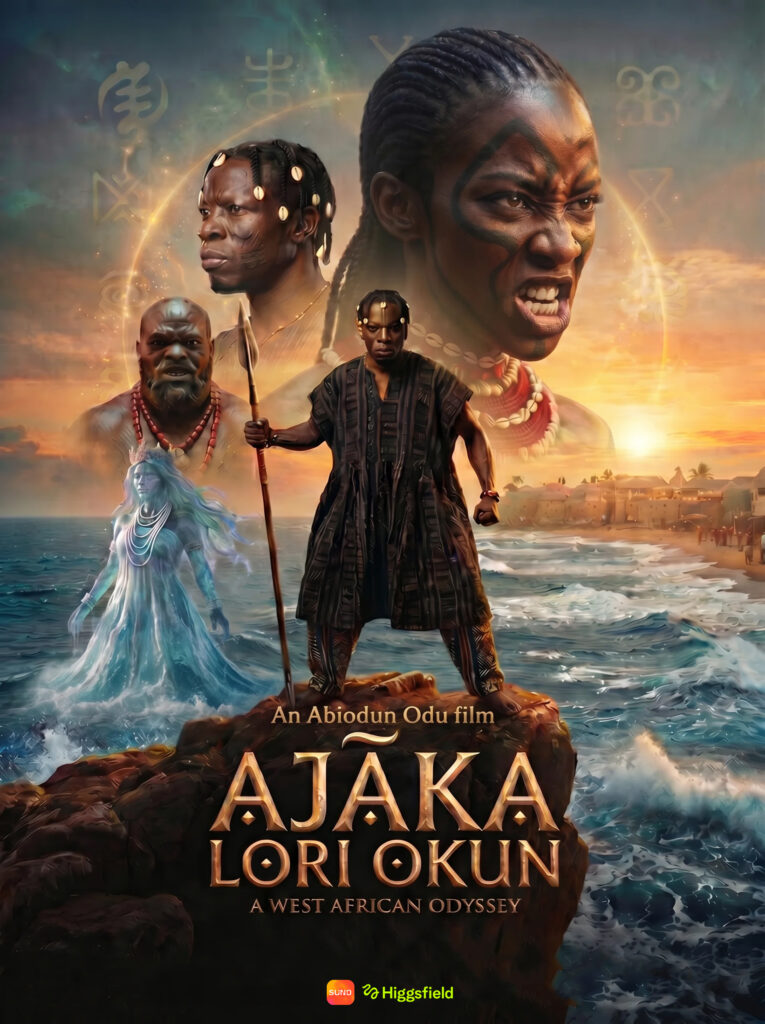
Long before Abiodun Odu released Ajaka Lori Okun, his AI-assisted Yoruba fantasy short film, the creature known as Ajanaku existed in his imagination as an actual elephant. In Yoruba mythology and oral memory, the elephant is not merely an animal; it is weight, terror, presence. But when Abiodun attempted to recreate that vision using generative AI tools, the technology failed at something human: emotion.
“I could not get an elephant to emote,” he tells TheACE during a recent conversation. “I didn’t know what an angry elephant would even properly look like emotionally.”
Eventually, the mythical beast became a towering human embodiment; a compromise that revealed the reality behind Ajaka Lori Okun. Looking behind the spectacle of AI-generated fantasy, there lies an exhausting process of iteration, correction, storytelling instinct, and negotiation between imagination and technological limitation.
For Odu, however, the film itself began years before artificial intelligence became globally accessible. As a trained dentist who graduated from Lagos State University Teaching Hospital with a Bachelor of Dental Surgery degree in 2020, Abiodun spent his creative life moving across photography, graphic design, cinematography, and writing. While nurturing ambitious stories, he simply could not afford to produce them traditionally. And Ajaka was one of them.
Inspired by childhood memories of watching 1997 Armand Assante’s The Odyssey on VCD and shaped by Yoruba oral traditions, the project required an enormous visual effects budget and studio backing rarely accessible to independent Nigerian filmmakers. What AI offered Abiodun was the possibility of finally visualising a world that had previously existed only in fragments of his imagination.
“I wanted to tell a story that I cannot tell currently,” he says. “A story that even with the current resources and technology we have in Nollywood, might still be difficult.”
Scene 1: The Fantasy Film He Could Not Afford
For years, Ajaka Lori Okun existed in fragments; not as a film, but as a pitch. Long before AI entered the equation, Abiodun Odu had already been carrying the story through pitching rooms, film school conversations, and the calculations of what could realistically be funded. At EbonyLife Academy, where he once presented the concept alongside other aspiring filmmakers, the response was familiar: interest, recognition, and then the unspoken budget constraint that governs most ambitious cinema.
“It was one of those projects,” he recalls, “what would you like to do? What are the projects you would like to do? Everybody pitched theirs.”
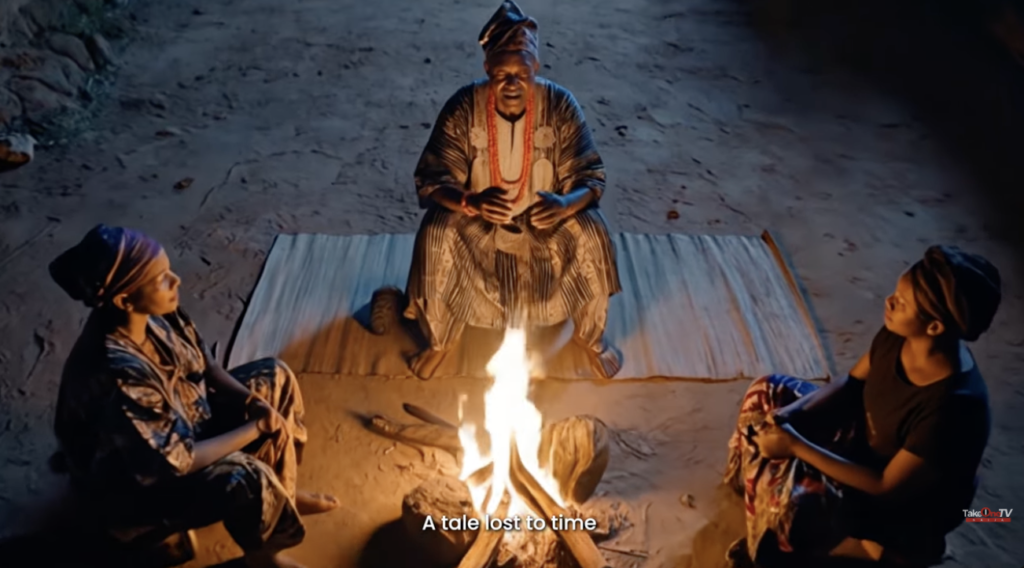
Ajaka Lori Okun did not fit within the economics of its environment at the time. Because even with strong creative intent, films of that scale typically require either institutional backing, large studio financing, or external investment frameworks that come with their own expectations about marketability and cultural framing. So, it remained in the category of “someday cinema”.
It remained suspended. Then the tools changed. By the time generative AI systems became widely accessible through social platforms and creative communities, Abiodun was already experimenting on his smartphone with Remini to upscale old photographs, before moving on to Midjourney for text-to-image generation, and others to generate video assets.
To him, this shift was decisive. What was once locked in an abstract pitch could now be stress-tested on screen. Mythic landscapes and impossible encounters were iterated into rough footage, not finished cinema, but a visual proof of concept at a scale that was previously commercially impossible.
He was not interested in simply “generating a film”. He approached the technology as a director rather than a user. Scenes were pre-visualised mentally, and the shot language was carefully constructed. In that sense, Ajaka did not begin as an AI film. It began as an unaffordable one.
Scene 2: The Myth of “Lazy AI Filmmaking”
There is an assumption that AI-generated creative work reduces authorship to something frictionless, like a prompt, a click, or a finished artefact. But for practitioners like Abiodun Odu, the reality was a labour-intensive cycle of manual correction.
“If you’re trying to make it and just let AI do everything for you, you’ll get AI slop,” he says, bluntly. “It’s not lazy filmmaking.”
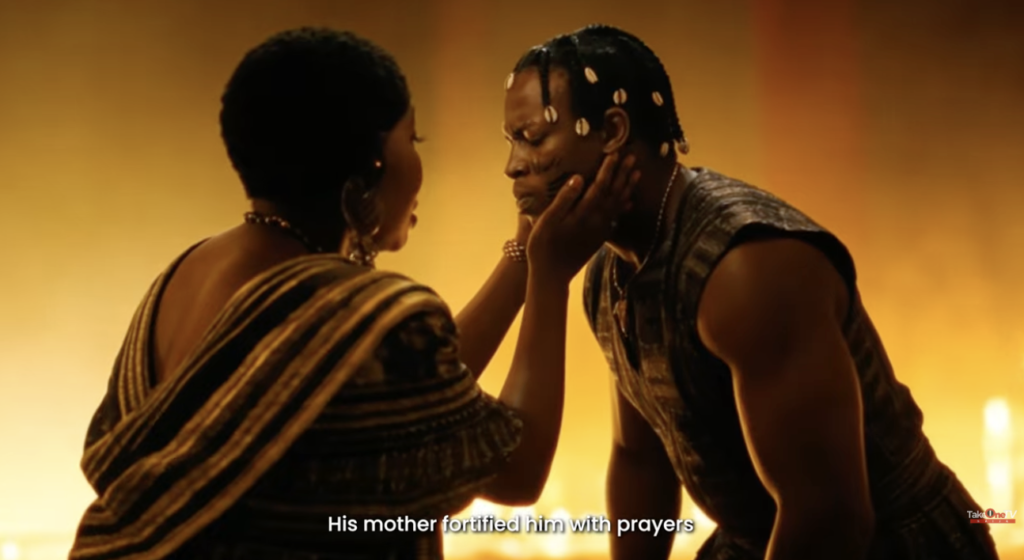
Odu would begin with a precise mental breakdown of each sequence: framing, movement, emotional tone, and camera language, as though he were already on set. Each decision was made before any tool was engaged. Even at that point, the system rarely delivered clean results. A single prompt designed for a 15-second sequence might produce only a few seconds of usable footage. He estimates a success rate of roughly 70%, concealed by constant failures: misinterpreted instructions, shifting character models, awkward motion, or visual anomalies like characters suddenly sprouting six fingers.
Post-production became its own recursive loop. Using editing tools such as Premiere Pro and CapCut, Abiodun would assemble fragments into a working timeline, only to discover gaps where critical moments should exist. Those gaps would then be sent back into AI systems for regeneration, turning the process into a continuous cycle of “shooting”, editing, and reshooting, except the set itself was computational.
For a climactic shot of Ajaka emerging from water, the initial generation produced the character’s face completely dry. The moment, which was meant to communicate struggle and breathless survival, lost its emotional logic. So, he returned to the system, refining the prompt to force emotional logic: wet skin, soaked clothing, laboured breathing.
Sound required an equally hands-on approach. Rather than relying on standard synthetic voiceovers, Abiodun used ElevenLabs to generate base voice models, but manually adjusted the pacing and dramatic pauses in editing to mimic authentic Yoruba theatrical performance.
These micro-corrections defined much of the project. At the core of his process, even AI-assisted feedback was tightly controlled. He would instruct systems not to “flatter” or validate, but to critique harshly, forcing more structural honesty in responses.
Scene 3: Yoruba Mythmaking in the Age of AI
Ajaka Lori Okun had deeper concerns than being computational. Much of the creative friction came from encoding specificity into modern tools. Yoruba cultural markers, traditional facial markings, tonal nuances in speech, movement patterns, and clothing logic, are not documented in ways that AI systems readily understand.
A clear example emerged in his struggle with tribal marks. Odu wanted Ajaka to carry deep, historically grounded facial markings associated with older Yoruba traditions that communicate lineage, identity, and historical weight. Instead, when prompted for traditional Keke or Gombo markings, the AI engines routinely smoothed the skin out or rendered generic scars, missing the depth and geometry of historical scarification.
“The AI doesn’t know it,” he explains. “You have to start describing it again and again.”
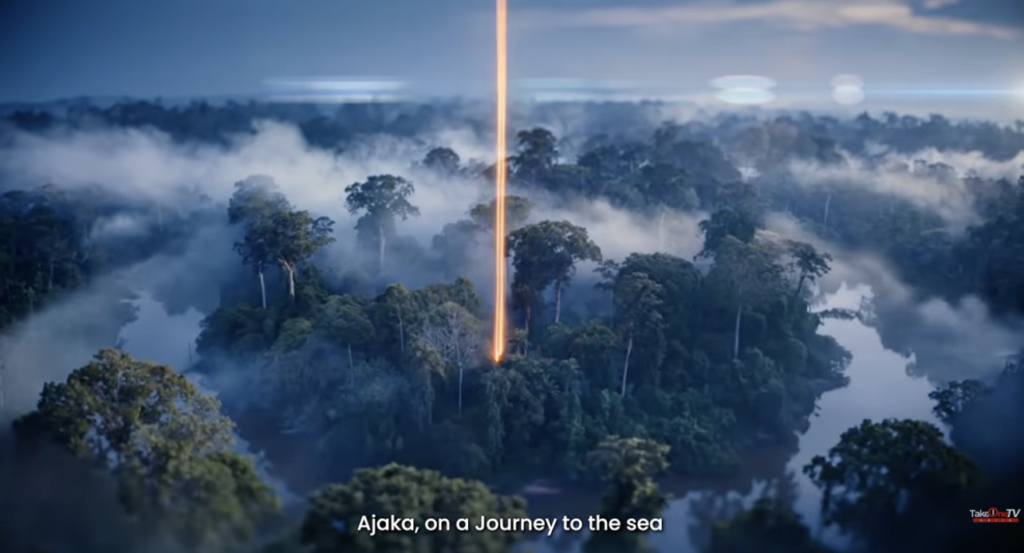
The same challenge extends into language and sound. Yoruba intonation is tonal and meaning-dependent. Even when text-based systems can reproduce Yoruba words, the tonal accuracy often breaks down unless manually reinforced. Without deliberate intervention, AI flattens cultural nuance into surface-level, hollow aesthetics.
This linguistic barrier made Abiodun’s art direction lean into musicality rather than dense dialogue. In traditional Yoruba storytelling, emotion and narrative weight are natively driven by song, chant, and instrumentation. By letting an evocative musical score carry the film’s emotional arc, Abiodun bypassed the sterile cadence of current AI speech, using rhythm as a narrative engine to ensure the short film retained its sonic soul.
“A white man cannot make a Yoruba AI film better than I will,” he says, not as provocation, but as a statement of cultural proximity. The argument is not about exclusivity; it is about depth of reference, lived experience, and instinctive understanding of nuance that cannot be easily inferred from data alone.
Scene 4: The $5 Million Problem
For all its creative ingenuity, Ajaka Lori Okun still collides with a familiar constraint in African filmmaking: scale. Even with the intervention of generative AI, the ambition behind the project does not escape the underlying economics of cinema. For Abiodun Odu, AI did not eliminate this reality; it only changed how early one can confront it.
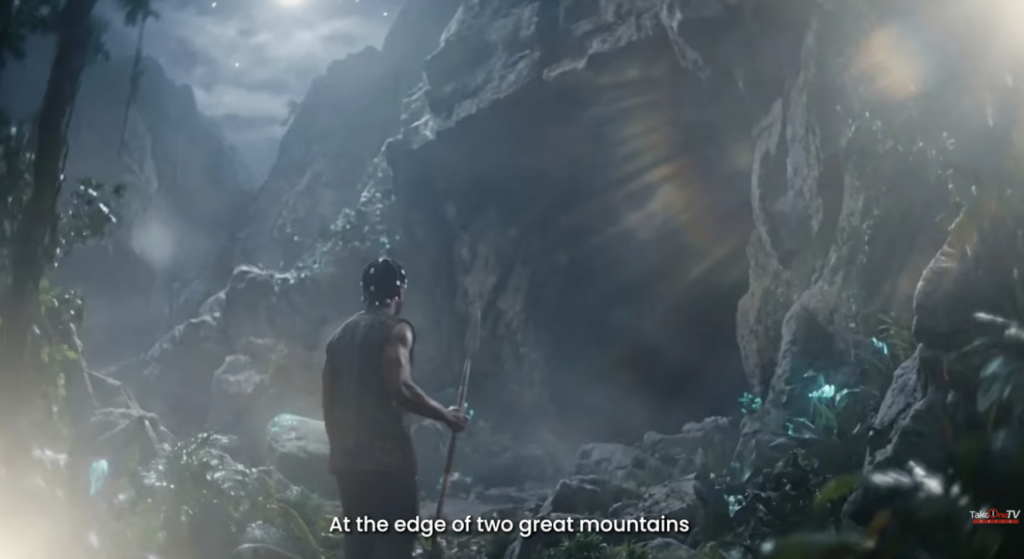
He is blunt about the numbers. A properly realised version of Ajaka, in his estimation, would require at least five million US dollars to execute faithfully. So, while it can dramatically reduce the cost of experimentation, it does not yet remove the need for capital-intensive production. There is also difficulty in its recovery. In Nigeria’s film economy, even strong commercial titles face structural limitations in box office returns, making recoupment highly uncertain.
There is also the question of financing influence. Abiodun is cautious about external investment models that often come with expectations about narrative framing, accessibility, and cultural legibility for global audiences. “The moment Western financing comes in, they will want it to suit their own audience,” he notes.
In that sense, Ajaka sits in a difficult but revealing position, too large for current independent financing structures, too culturally specific to be easily globalised without adaptation, and too technologically experimental to fit neatly into existing production categories.
Abiodun does not see this limbo as a dead end, but as leverage. By using these synthetic proofs of concept to bypass the traditional, expensive gatekeeping of pre-production, his strategy is to present global streaming platforms and venture traditionalists with a fully realised visual bible. If the technology can reduce his initial presentation costs to near-zero, it shifts the power dynamic, allowing an independent Nigerian creator to walk into financing negotiations with a movie that already visibly exists.
Scene 5: AI, Legitimacy, and the Question of Recognition
As AI-assisted films circulate more widely, questions of legitimacy have begun to surface. Should such works be eligible for major awards? If so, under what criteria? And how should authorship itself be defined when parts of the production process are computational?
Abiodun is, however, unconcerned with immediate validation, calling the conversation premature. For him, the medium itself is still in an exploratory phase. The grammar of AI filmmaking is still far too fluid to be neatly boxed into formal award categories.
“It is too early,” he suggests, pointing instead to film festivals as more appropriate early-stage arbiters of quality and experimentation. Festivals, in his view, offer a testing ground where new forms can be observed without the pressure of fully established industry expectations.
At the same time, Odu acknowledges the unease the technology has introduced within the broader film industry. Concerns about job displacement are part of the current reality of technological transition. But he resists framing AI as an immediate replacement. Instead, he situates it within a longer historical pattern of technological shifts in filmmaking, just like from analogue to digital, from practical effects to CGI, and so on. Each transition disrupted labour structures, but also eventually produced new forms of work and expression. AI, he suggests, is still in its unstable phase within that trajectory.
The question of recognition, then, is secondary to the question of understanding: what exactly is this medium becoming, and who gets to define its early language?
Epilogue: The Thin Lines
In the end, Ajaka Lori Okun is a negotiation between imagination, constraint, cultural memory, and computational approximation. The conversation with Abiodun Odu was not a narrative of technological replacement, but of artistic persistence under shifting conditions.
AI, in this framing, is neither a saviour nor a threat, it is but a tool that exposes as much as it enables and reveals the distance between vision and execution. But as the technology advances, Abiodun kept repeating his fundamental point: tools extend intention; they do not originate it.
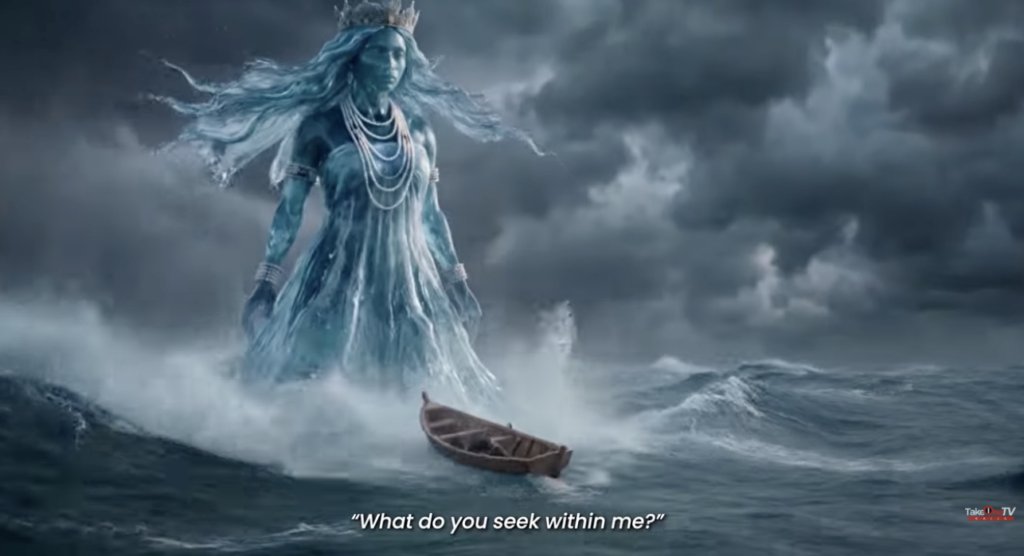
There are moments in the film, and in its making, where AI succeeds in rendering spectacle: storms, figures, motion, mythic suggestion. But there are also limits it repeatedly encounters. So, for all its computational complexity, the project still depends on something irreducibly human: the ability to imagine a world that does not yet exist, and to insist on its form even when the available tools fall short.
“There are movements you cannot prompt,” Odu reflects in the conversation. It is less a criticism of the technology than a reminder of where authorship still resides.
Between AI, imagination, and Yoruba mythmaking, Ajaka Lori Okun occupies a space that is still unsettled; not quite traditional cinema, not quite synthetic output, but something in between. It stands as a prototype of a future language in which African storytellers will define how myth, machine, and memory intersect.
Bloopers: The Raw, Refined Chat
Editor’s Note: The following is an exclusive behind-the-scenes excerpt from TheACE’s conversation with filmmaker Abiodun Odu. We have polished and condensed the transcript to keep the dialogue strictly faithful to the raw tape. The full, unedited conversation will be dropping soon.
Mujeeb (TheACE Founder): University days! I remember meeting you at LASUCOM when we came for a campus competition. You were in the medical line and then decided to cross over into the arts. Could you introduce that transition?
Abiodun Odu: Yes! My name is Abiodun Odu. I graduated from Lagos State University Teaching Hospital in 2020 with a Bachelor of Dental Surgery, so I am a dentist by profession. I have been active in the film space for at least five years, moving across photography, graphic design, cinematography, and writing. My whole life has revolved around storytelling.
Currently, I co-founded Take One Productions Concepts with my close friend and business partner. Under that umbrella, we operate Take One Studios, Take One TV Nigeria, and Take One Talent to build an all-inclusive entertainment ecosystem within the Nigerian film industry.
[CAMERA CUT TO BLACK]
The tape stops here, but the story doesn’t. Watch this space: the full, raw conversation drops soon.
--------------------------------------------------------
--------------------------------------------------------
AI Use at TheACE
TheACE uses artificial intelligence tools to support research, drafting and analysis across Africa’s creative industries. All content is verified, edited and approved by our human editorial team to ensure accuracy, clarity and responsible storytelling. AI assists our work; it does not replace human judgment.