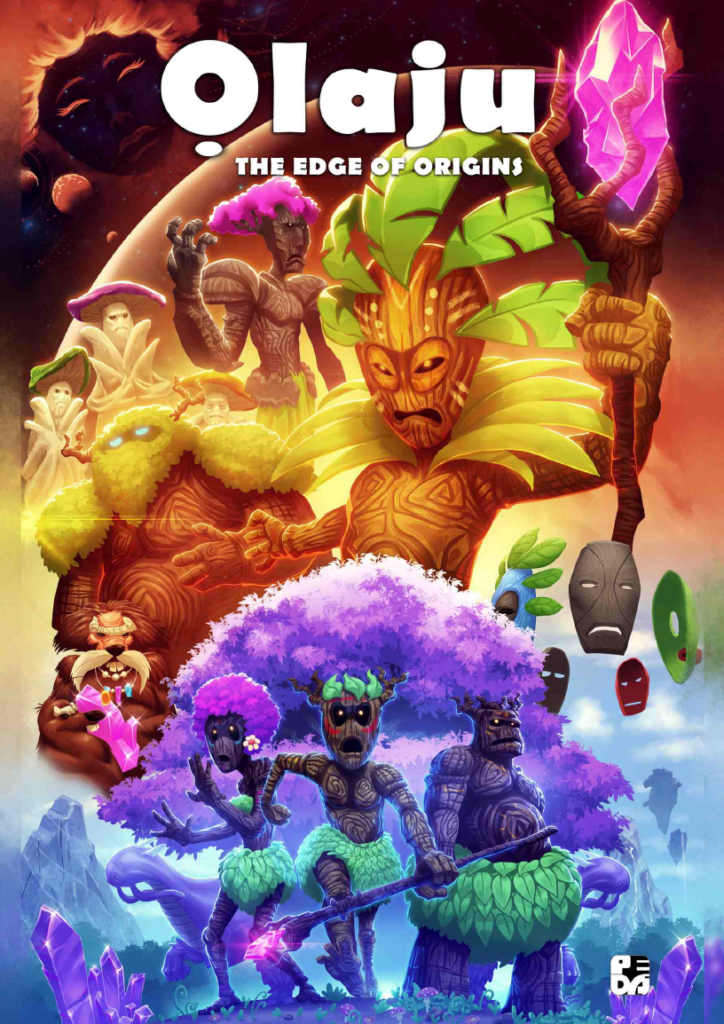
In African comics, origin myths are often treated as a backdrop, a few panels of scripture-like narration before the “real” story begins. Peda Entertainment’s “Olaju: The Edge of Origins“, created by Peter Chizoba Daniel (the mind behind Peda’s earlier “Chronicles of the Newborn“) and illustrated by Alexander Rudewerks Ighoja, takes the opposite approach. The myth is the story. Volume One spends its entire 176 pages inside a pre-human Earth, asking what the planet might say if the trees themselves could speak, and answers with a fully painted, richly imagined fantasy that owes as much to environmental allegory as it does to adventure.
The Narrative Arc: A Summary
The book opens with scripture-like economy on page 7: “In the beginning, before man, there were trees! And they occupied the earth for thousands of years.” Pages 8 and 9 establish the cosmology proper; Ashari, goddess of the material realm, is tasked by an unnamed “Most High Celestial Being” with preparing the planet for mankind, and calls forth the Nkpuru Osisi to do it, a name a footnote translates directly as “tree people… from the Igbo language” to cultivate the land.
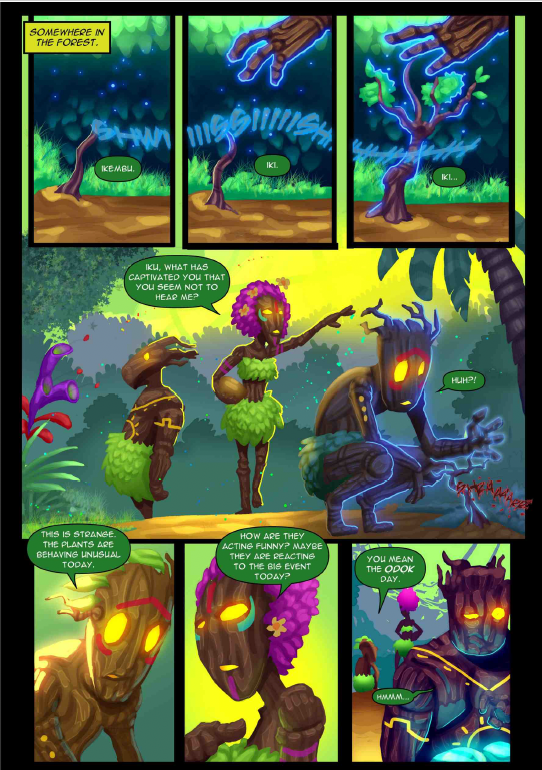
Among them, an eldest elder periodically “ascends” on Odok Day, passing accumulated knowledge into the Oracle of Creation before being replaced by a chosen subordinate, a succession system the book actually dramatises twice: once on pages 11 to 12, where we watch Barkuzu himself rise to the eldership and the Nkpuru Osisi “rejoice… for the work continues, or so it seemed,” and again on pages 13–19, in the present day, where that same Barkuzu uses his own ascension to betray everyone who trusted him.
The story proper begins with three young Nkpuru Osisi, Iku, Bila and Lilo, late for that very ceremony — a warm, comic opening (pages 13–16) that quickly turns dark across pages 17 to 20. Barkuzu, the most senior and trusted elder, ascends and uses the moment to betray his own people, seizing power for himself and casting the Oracle into ruin. In the chaos, a young planter is chosen by the dying essence of Elder Ruzu to become the new custodian of the Orka, a relic tied to the Oracle’s power, and is sent on a quest to reach the ARQU trees and restore what Barkuzu has broken.
What follows is a journey structure, intercut with scenes back at a village descending into chaos and a rival thread following Barkuzu’s loyalists, who are alarmed to learn a new Orka-bearer has emerged. The volume builds to a direct confrontation between the protagonist and Barkuzu, who reveals himself as a self-styled “true, ordained Orka bearer” and teases a far larger threat: the Nkume Ike, a “creation stone” hurtling toward the Earth. The book ends on that image, literally, a full-page splash of the stone blazing through space, with a hard “to be continued.”
The Critical Perspective: A World Painted, Not Drawn
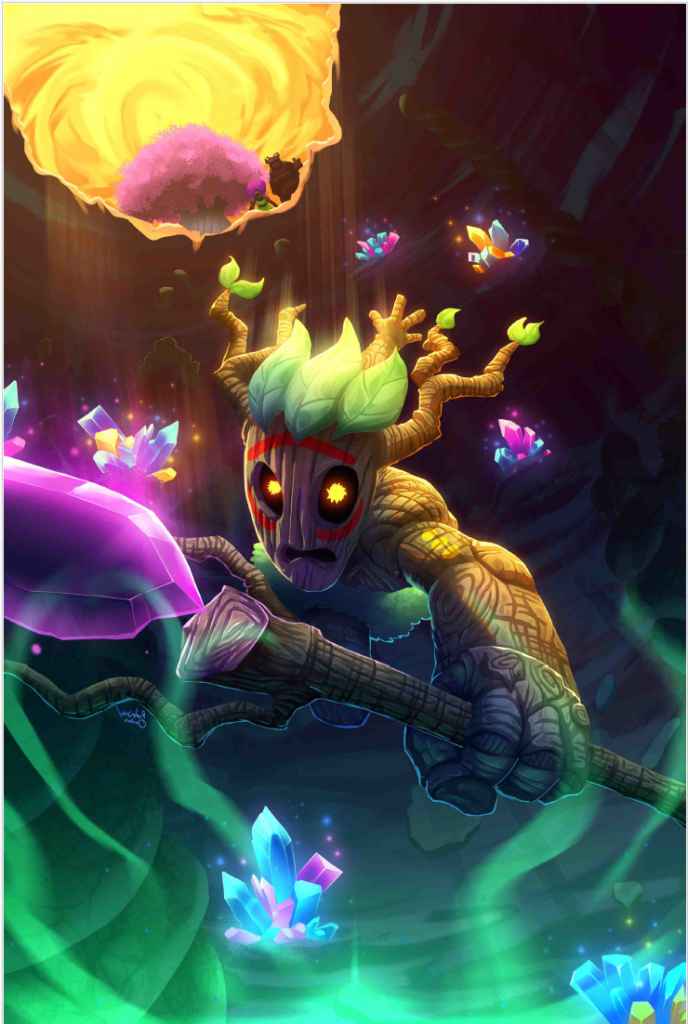
The defining choice of “Olaju” is its commitment to full digital painting over traditional inked comic linework, and across 176 pages, it holds up remarkably well. The cosmic sequence on page 8, Ashari’s hands sweeping light across a sea of stars before “touching” the bare planet into bloom, is genuinely striking, painted with the kind of atmosphere usually reserved for a cover, not an interior page. The book repeats that trust in pure imagery often: page 66 tells an entire passage of village decline in four wordless-but-captioned strip panels (“The cultivation has been halted… The beautiful glade gradually turns into a graveyard of destruction”), and the slow three-panel zoom into Nkatunga the beekeeper’s awakening face on page 69 — from silhouette, to a murmured “Uhh…”, to open eyes — is genuinely well-paced cinematic comics-making, the kind of beat that would work as well in animation as on the page (fittingly, given the team’s stated ambitions for the franchise).
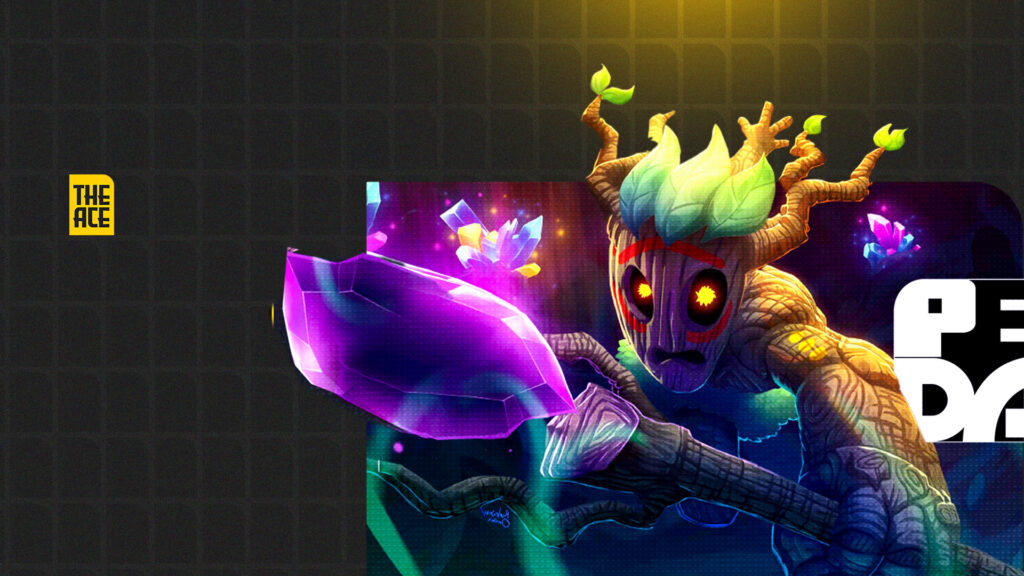
The character design leans into the book’s central metaphor consistently. Each Nkpuru Osisi reads visually as a distinct plant or fungal growth. Barkuzu’s mask-like, fungal-crowned elder form; Tarka’s banana-leaf shoulders; Seronka’s mushroom-cap head, and the cute, sound-effect-driven Kookolkah (a colony of crystal-hoarding mole-rats who communicate mostly in “Bloop,” “Ploop” and “Krak”) are a genuine highlight of creature design, doing real comic and tonal work in pages 52 to 54 after the bleakness of the betrayal sequence.
The included “Characters and Pronunciations” glossary on page 6 is a thoughtful, almost field-guide approach to onboarding readers into a fairly dense ecosystem of named races before the story proper begins, and it pays off; very little of the worldbuilding feels under-explained once the plot is moving. The linguistic choice to root the Nkpuru Osisi in Igbo while naming the book itself “Olaju” (Yoruba for civilisation or enlightenment, per the creator’s closing note) also gives the world a distinctly pan-Nigerian texture rather than a single-culture one.
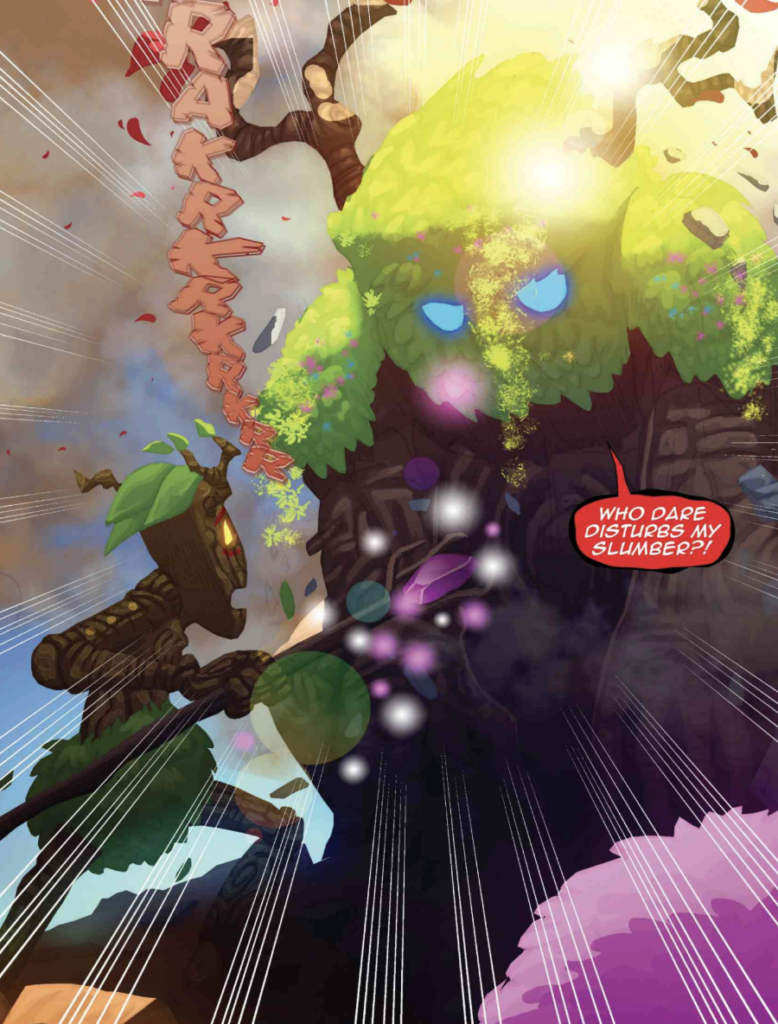
The book’s colour language is doing more structural work than it might first appear. Living Nkpuru Osisi consistently speak in green dialogue balloons; the dead-but-still-speaking Elder Ruzu, communicating from the Oracle, speaks in purple-magenta ones (first on page 26, and consistently after); the Gabookah’s first line — “NO ONE IS ALLOWED HERE!” — arrives in a red balloon that visually separates it from the cast we already trust. It’s a small system, but a reader internalises it within a few pages, and it does useful work distinguishing the living from the spectral from the hostile without extra captions.
Where the book takes its biggest formal risk is in panelling. Daniel and Ighoja favour diagonal splits, panels that bleed past their own borders, and onomatopoeia lettering that physically crosses panel boundaries, like the “KRAKAAKKOOOMMM” that tears across the chaos on page 20, which is a good example of this dynamic approach used effectively.
It is also at its best in high-stakes single moments: the climactic confrontation on page 150, split diagonally between Lilo’s “WHERE AM I?” and Barkuzu’s gloating reveal, uses the slash to put two simultaneous realities on one page without confusing either. It is less successful in the book’s densest action sequences, like on page 140, where a panicking Nkpuru Osisi tries to calm an enraged centipede-creature across six overlapping, irregularly angled panels, which is genuinely difficult to read in the correct order on a first pass, with panel borders crossing and stacking in a way that asks more navigation of the eye than the scene’s actual stakes require.
The book also leans heavily, particularly across its middle third (roughly pages 40–90), on wordless, sound-effect-driven action, a deliberate “show, don’t tell” choice that mostly works. The ambush sequence on page 90, told entirely through “SHWOOMWOOMWOOM,” “SHWHAAABLOOP” and two fallen bodies in the grass, is genuinely clear and well-staged without a single line of dialogue. But stretched across dozens of pages with comparatively few anchoring captions, the quest section occasionally loses narrative legibility even when each individual page is handsome: it is easy to admire the craft of, say, pages 42–44 (the trio falling through a collapsing cave floor) without being entirely certain, scene to scene, what has just been won, lost, or decided.
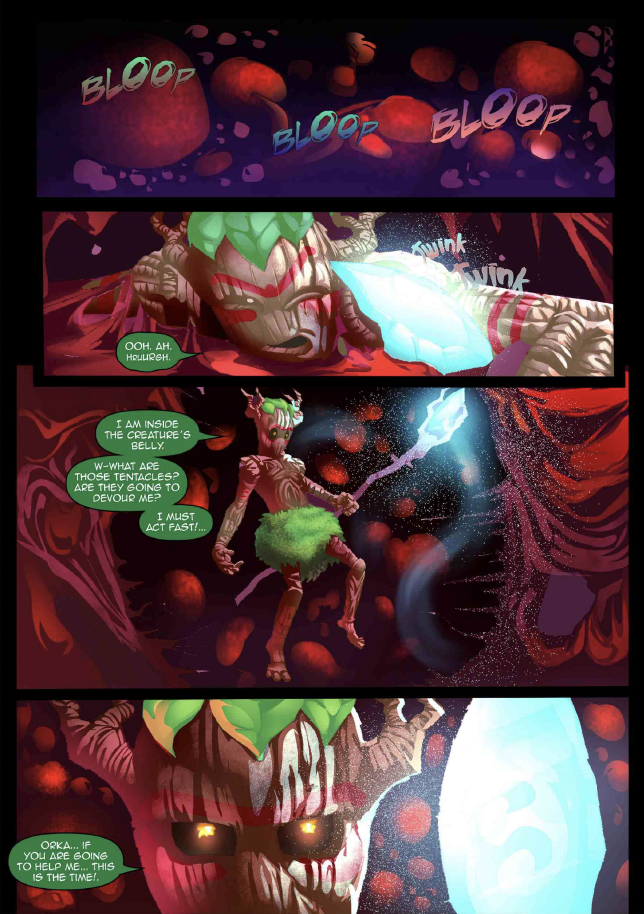
The book’s emotional commitment is its strongest asset. Lilo’s apparent death inside the creature on pages 85 to 87 is genuinely upsetting in the moment, sold by small, specific lines (“Not like this! It can’t be like this. Not Ikembu!”, “We are doomed”) rather than melodrama, and the reveal that Lilo survived two pages later earns its relief rather than cheapening the scare. Barkuzu, too, gets more shading than the average origin-myth villain. His aside on page 34 — “Those barks plot against me. They don’t know the destruction that will befall us if we continue the cultivation” — plants a seed (so to speak) that his betrayal may be rooted in something more than simple hunger for power, which the Nkume Ike reveals late in the volume, seems poised to pay off in Volume Two.
Room for Refinement
The lettering, handled by Bode Joseph, is largely clean and the colour-coded by character type, is a genuine strength, but it is not free of slips. Across 176 pages, the same handful of errors recur often enough to suggest a proofing pass, rather than isolated typos, is what’s needed. “Didn’t” is rendered “DION’T” in at least two separate places (page 38: “THE ELDERS DION’T MENTION THIS!”; page 57: “I DION’T MEAN JUMP!!!”), and “children” loses its D twice in a row across pages 49 and 50 (“RISE… RISE MY CHILOREN!” / “GO NOW, CHILOREN!”). Page 12 renders “subordinate” as “SURBODINATE,” page 17 turns “thanks” into “thnaks,” and page 35 drops a letter from “understand” (“I UDERSTAND”). None of these individually derails a page, but their recurrence suggests these are slipping through a copy-paste lettering workflow rather than being caught and corrected.
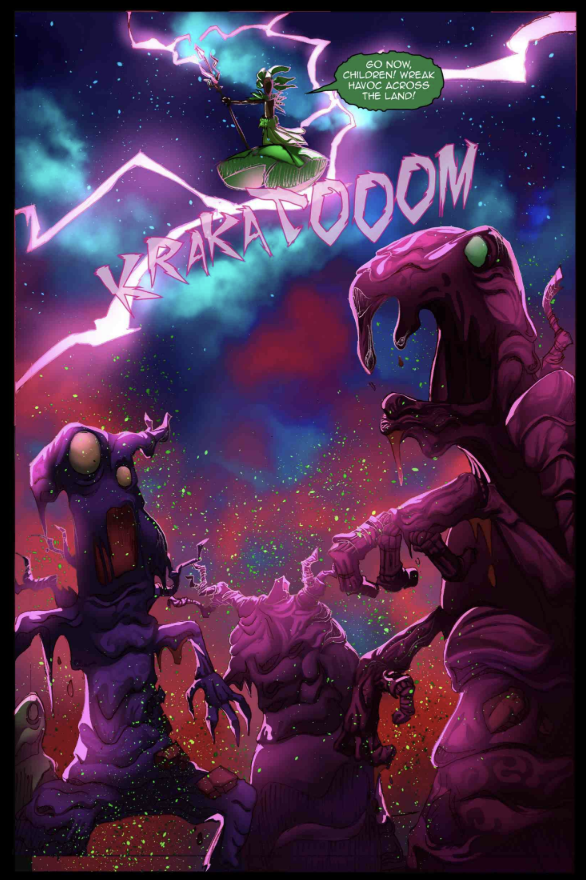
More consequential are two naming inconsistencies that a reader is likely to notice precisely because the book is otherwise so careful about its invented vocabulary. The sacred AKQU tree at the heart of the quest is introduced in the front-of-book glossary (page 6) as the “ARQU tree”, but every single in-story reference afterwards (pages 28, 32, 37, 38, 54, 61, 62, 63, 81 and 89 among others) consistently spells it “AKQU.”
Given how often the word appears, this isn’t a one-off slip but a glossary-versus-script mismatch that should be reconciled in a reprint. Separately, the spirit-mentor who guides Lilo throughout is named “Elder Ruzu” with total consistency across at least nine separate appearances (pages 28, 29, 31, 35, 53, 55, 56, 58 and 84) except once, on page 45, where the same character is referred to as “Elder Puzo.” It reads like a single missed find-and-replace, but on a named character this central to the plot, it is worth catching.
Structurally, the book would benefit from a handful of additional anchor captions through its action-heavy stretches to keep the stakes of the quest legible when dialogue disappears for several pages at a stretch, as it does through much of pages 77 to 89. A reader can follow that Lilo is in danger; it is less consistently clear what is actually gained or lost by the time the action resolves. And while the experimental, border-crossing panel layouts are one of the book’s most distinctive formal choices, a firmer hand on panel hierarchy during its busiest multi-creature pages (page 140 is the clearest example) would let that ambition land without asking readers to hunt for the correct reading order.
One smaller note: the Gabookah’s “NO ONE IS ALLOWED HERE!” exchange on page 40 to 41 ends with the line “I said be gone!!!” followed shortly by a creature elsewhere declaring “You shall not pass!” (page 65), a phrase so closely associated with a specific, very famous piece of fantasy media that it briefly pulls the reader out of an otherwise carefully original mythology. Given how much invented vocabulary the book is willing to commit to elsewhere, swapping this one borrowed line for something rooted in its own world would be a small but worthwhile fix.
Our Verdict
“Olaju: The Edge of Origins” is a confident, visually lush opening chapter to what the creators describe as a decade-long passion project. It reads like one that is unhurried, mythologically dense, and unmistakably rooted in Nigerian language and cosmology rather than borrowed fantasy iconography. Its ambition occasionally outpaces its clarity, especially in its busiest action stretches and a small set of recurring lettering and naming slips that a tighter proofing pass would catch. But the strength of its worldbuilding, the genuine emotional stakes it is willing to sit in, and the sincerity of its environmental framing, civilisation’s origin story told from the trees’ point of view, make it a distinctive and frequently moving entry in African fantasy comics. Volume One closes with real stakes and a striking cliffhanger; the question now is whether Volume Two tightens the storytelling enough to match the scale of the world it has already built.
——————————————————–
——————————————————–
AI Use at TheACE
TheACE uses artificial intelligence tools to support research, drafting and analysis across Africa’s creative industries. All content is verified, edited and approved by our human editorial team to ensure accuracy, clarity and responsible storytelling. AI assists our work; it does not replace human judgment.