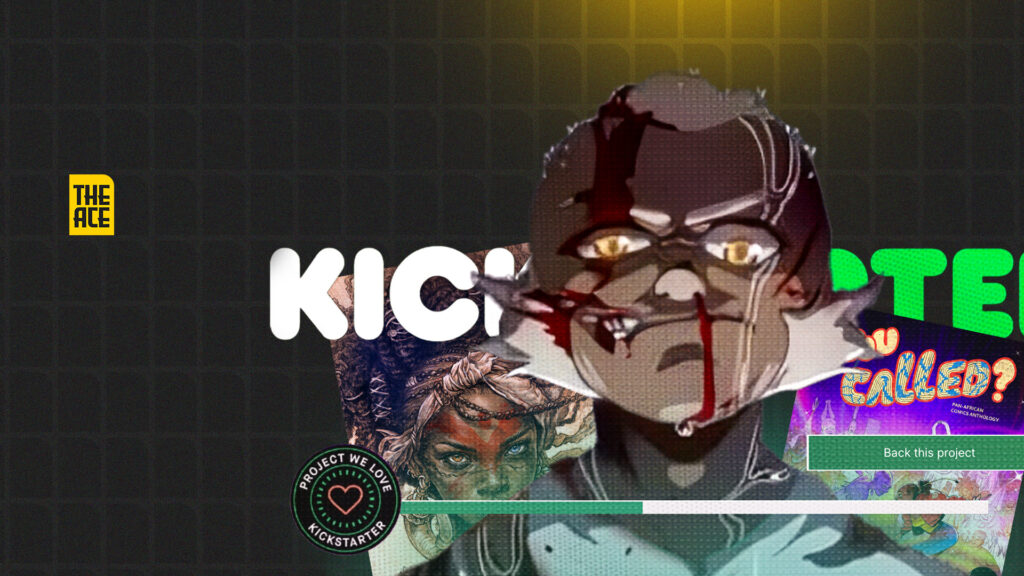
Four crowdfunding campaigns for African-themed comics and animation have together pledged $227,596 on Kickstarter, according to their campaign pages on 12 November. Three have passed their targets, two of them still open. The fourth, an animated pilot adapted from the Zimbabwean manga Mutupo, closed at 44% of its goal and will not be funded, so its $8,847 in pledges will not be collected.
The campaigns were set side by side in a LinkedIn post by Bill Masuku, who says he has spent ten years working in comics and animation. He presented them as four different routes from idea to audience, not as a single formula.
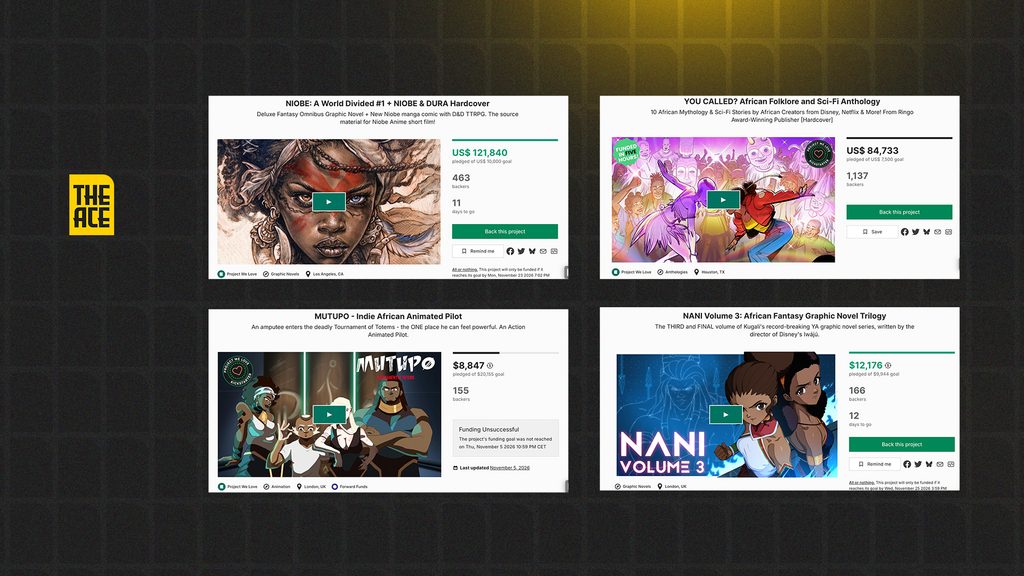
Read together, the four split along two lines. Niobe’s average pledge, calculated from the pledge and backer totals, is about $263, more than three times that of YOU CALLED? (about $75), Nani ($73) and Mutupo ($57). And the three campaigns that passed their goals were run by publishers with track records, while the one that fell short came from a creator who had only just regained control of his work. Four campaigns cannot establish cause, but the creators’ own accounts add some detail.
By far the largest is Niobe: A World Divided #1, from Los Angeles-based Stranger Comics. It has pledged $121,840 from 463 backers against a $10,000 goal, with 11 days left until it closes on 23 November, so the goal has been cleared more than twelve times over. It offers a deluxe omnibus graphic novel and a new manga comic, and its page describes the package as the source material for a Niobe anime short film. Masuku called it a 19-year investment in a franchise that spans comics, animation, tabletop games and merchandise. Niobe alone accounts for more than half of the combined total, and as a US publisher’s project it sits apart from the other three in scale and origin.
The next largest, YOU CALLED?, is a hardcover anthology of ten African mythology and science fiction stories by African creators, published by Houston-based ETAN Comics. It pledged $84,733 from 1,137 backers against a $7,500 goal, and its page carries a badge saying it was funded in five hours. Masuku described ETAN as a Ringo Award-winning publisher and this as its third anthology. The campaign ended on 7 November.
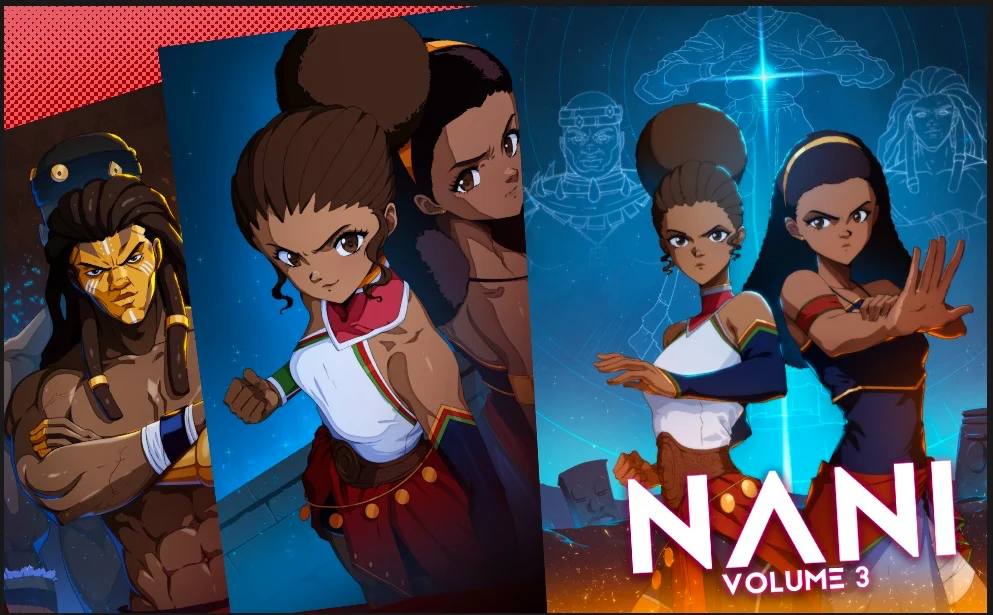
Nani Volume 3, the third and final instalment of Kugali’s young adult graphic novel series, has pledged $12,176 from 166 backers against a goal of $9,944, or 122%, and closes on 25 November. Hamid Ibrahim of Kugali said Nani Volume 2 became the highest-funded African-created comic crowdfunding campaign on any platform when it launched, a record he said Murenga beat two years later. Those campaigns drew mainly on African art communities in the United States, he said, and Kugali went into Volume 3 expecting lower numbers, citing six years since the first campaign and a downturn in indie comics. The goal is a break-even figure covering Kugali’s investment in the book, not the very low target many projects use to fund immediately, and he said the team would be happy with around 150% of it. The page says the volume is written by the director of Disney’s Iwájú, and Ibrahim added that Kickstarter’s attribution tools are too limited to show whether that connection brings in backers. Masuku pointed to young adult and middle-grade readers as a market where African graphic novels still have room to grow.
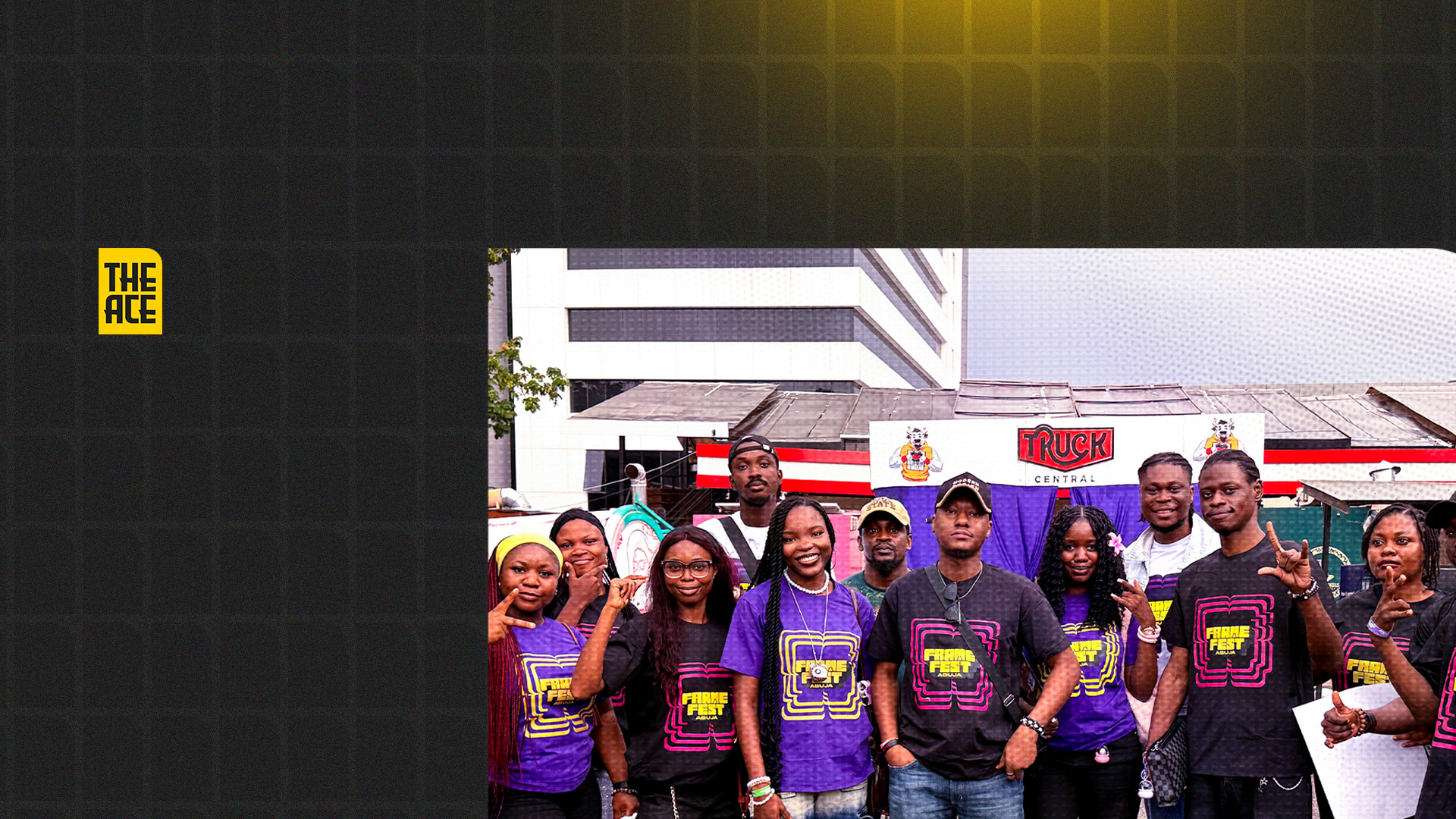
Mutupo, by Kuda Rwizi, is the one that fell short. The manga was first self-published with British Council support, then acquired by the US publisher Noir Caesar. Rwizi said the publisher’s initial rights period was two years, with a possible extension to five. He submitted a written request for the rights to return; the reversion took effect after a 90-day wait, and the process was completed earlier this year. One lesson from the publishing deal, he said, shaped the campaign: “Marketing the IP in online spaces falls on us, the original creators.”
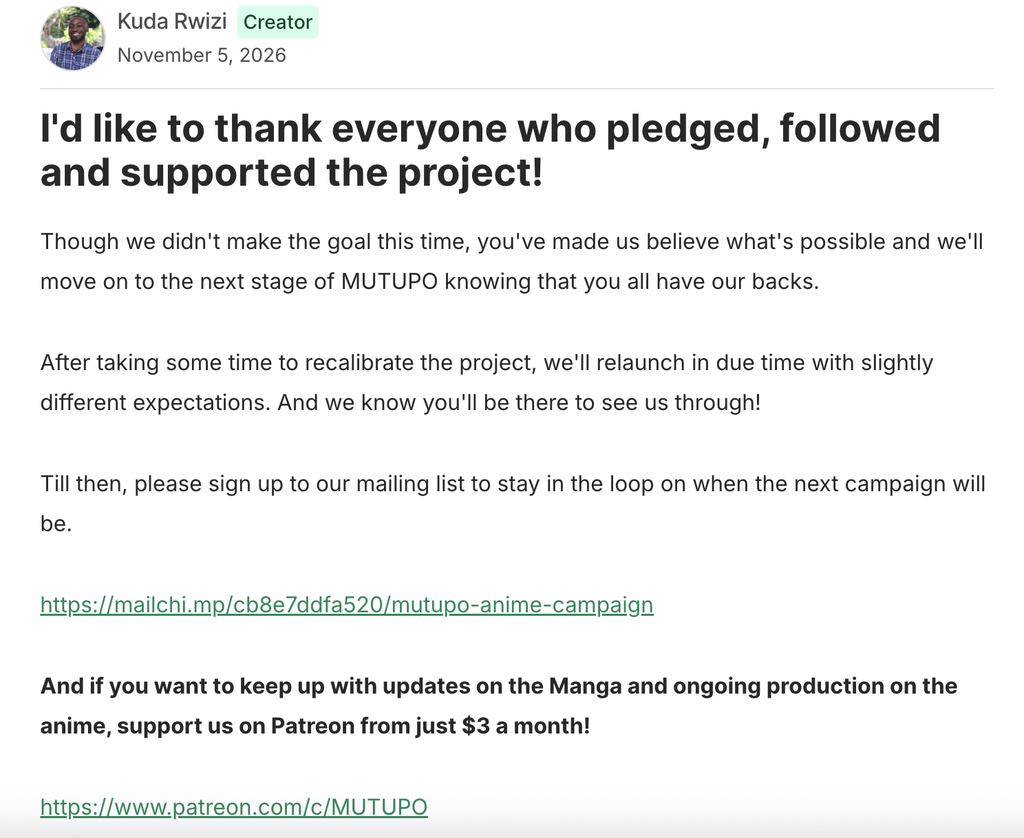
The Kickstarter was for an action animated pilot about an amputee who enters the Tournament of Totems. It sought $20,155 and closed on 5 November with $8,847 from 155 backers, $11,308 short. Rwizi said the goal covered the entire cost of production: pre-production, production and post, plus artists, voice actors, composers, equipment and software. With the goal missed, the team is continuing pre-production at a much slower pace. He said that even three days out, he felt “we could make it through a miracle”.
The goals were not alike in purpose, which limits how far the four can be compared. Mutupo’s covered the entire cost of a pilot and Nani’s is a break-even figure on a book, while Niobe’s $10,000 and YOU CALLED?’s $7,500 were each cleared more than elevenfold.
Rwizi said he and his team have been looking for investors and studios behind the scenes since 2023. He did not specify where they were based. The British Council backed volume one of the manga and a concept trailer in 2022, and he said the manga would still have come out without that support, only more slowly. The animated trailer was different: “I don’t believe we would have done an animated concept trailer were it not for the Scripts and Bars programme.”
None of the four campaign pages lists a base in Africa: Mutupo and Nani list London, YOU CALLED? lists Houston and Niobe lists Los Angeles. Where the money comes from is harder to establish, and the reporting can only partly answer it.
Rwizi gave a rough picture of Mutupo’s backers. More than half were in the United States; the UK and Canada together made up about 15%, and the rest were in Australia, Europe and Africa, which leaves a third or less across those three. Ibrahim was less precise about Nani: a good amount of its core backers are in the United States, with a few in Europe and Africa. ETAN Comics had not responded to requests for comment by publication, and no breakdown for Niobe was available. With no breakdown for two of the four campaigns, the combined total cannot be read cleanly as an African market or an overseas one. It shows demand for African-themed work, but not where that demand sits.
Distribution is part of the picture. Ibrahim said Nani is essentially Kickstarter-exclusive at the moment, and that shipping books printed outside Africa to the continent is “financially untenable”. Kugali has found other routes, and its main sales in Africa have been at conventions and events. It also keeps low-cost digital versions available online so African readers can afford the stories, even though digital-only options are generally seen as harmful on Kickstarter because a cheaper tier can cost a campaign money overall. “We bite that bullet proudly,” he said. Costs like these may help explain why Africa features only lightly in Nani’s backer base.
Ibrahim’s figure on returning backers supports the pattern. He said around 80% of Nani’s backers are returning ones, while Rwizi said most of Mutupo’s funding came from people who first appeared around the time of the campaign. Set beside a 19-year franchise and a third anthology, it suggests that the campaigns that cleared their goals leaned on audiences already built, though only Nani has the figures to show it. Masuku’s post argued that there are several pathways for African intellectual property, and plenty to learn between them.
We asked what would make it easier for African creators to fund and own their intellectual property; Rwizi pointed to more collaboration among creators and stronger business skills in the field. Mutupo, he said, is “one of those projects that needs to see the light of day”.
——————————————————–
——————————————————–
AI Use at TheACE
TheACE uses artificial intelligence tools to support research, drafting and analysis across Africa’s creative industries. All content is verified, edited and approved by our human editorial team to ensure accuracy, clarity and responsible storytelling. AI assists our work; it does not replace human judgment.