Earlier this month, TheACE (The African Comics and Cinematic Empire) reported on what felt like a landmark moment for African comics: Comic Book Canon’s publication of The Greatest African Comics of All Time, a 25-title ranking built from the votes of 29 creators and industry professionals across eight countries. We called it a canon declared from within, not assigned from outside, and we still believe that framing holds.
In the weeks since, that canon has been tested by our own readers, and by the wider industry, in a conversation that played out publicly across Instagram. We asked our community to tell us how representative the list felt, and the results, alongside the broader public reaction, paint a picture that is more complicated than either straightforward celebration or outright dismissal.
This is that picture. And, at the end, an announcement about what TheACE plans to do next.
A Quick Recap
For readers catching up: Comic Book Canon is the work of Mike Mesa, a data-driven project that aggregates “greatest of” lists from around the world into a single meta-ranking. Finding almost nothing for African comics specifically, Mesa built his own survey, modelled on the Sight & Sound poll, and sent it to writers, artists, publishers, letterers and other industry figures across the continent. Twenty-nine responses came back, from Nigeria, Zimbabwe, Senegal, Kenya, South Africa, the Democratic Republic of Congo, Cameroon and Ethiopia.
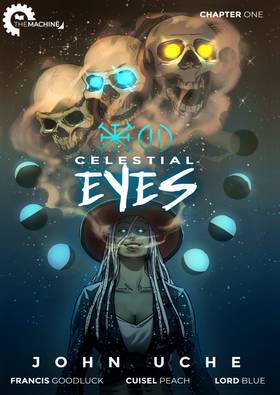
The result was a top 25 led by Celestial Eyes (The Machine Publishing), followed by Malika: Warrior Queen, Supa Strikas, The Might of Guardian Prime and E.X.O.: The Legend of Wale Williams. Our original coverage, with the full ranking and methodology, is available here: Africa’s Comic Book Canon Is Here, and the Industry Built It Themselves.
The Case for the Canon
Before turning to the criticism, it is worth saying plainly: the list is not without merit, and the reaction to it should not obscure that.
The methodology, while modest in scale, was not careless. Mesa reached out to more than 200 individuals and over 30 publishing companies across the continent, and ran the survey in both English and French in an effort to capture Francophone perspectives. Several of the named respondents, among them Murewa Ayodele, Bill Masuku, Dotun Akande and Scourge Comics, are figures whose judgment carries genuine weight in the industry.
Nor are the results themselves controversial in isolation. Celestial Eyes, Malika: Warrior Queen and Iyanu sitting near the top of any serious conversation about African comics would surprise very few people who follow the scene closely. The list, in other words, is not a fabrication or a popularity stunt; it is a snapshot of what a specific, credentialled group of people said when asked a specific question. The debate, as we will see, is really about what that snapshot can and cannot tell us.
What Our Survey Found
In the days following our original story, we invited our readers and the wider industry to share their views through a short survey: The African Comics Canon: Your Say. Ten responses came in, from creators, industry professionals and fans.
Before examining what the responses tell us, an important caveat is required. Ten respondents cannot sustain statistically significant conclusions, and it would be misleading to present them as if they could. The sample is small, self-selecting, and drawn from TheACE’s own readership rather than a neutral, randomised pool. The figures below should therefore be treated as directional signals from engaged community members, not as representative data about the African comics industry as a whole. We share them because they add texture to the conversation, not because they settle it.
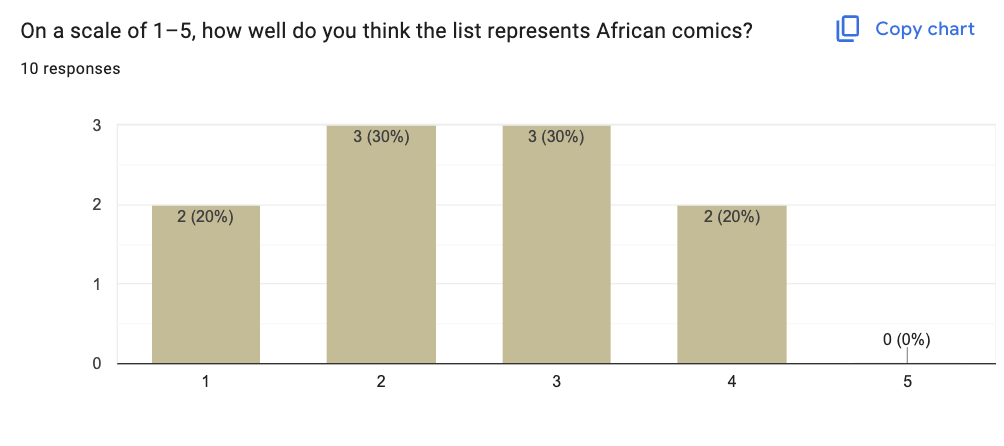
The headline figure is a blunt one. Asked to rate, on a scale of one to five, how well the Comic Book Canon list represents African comics, the average score came back at roughly 2.4 out of 5, lower, on the whole, than the reception the original list received on its own platforms.
The reasons given were varied, but several themes recurred:
- Sample size and methodology. More than one respondent felt that 29 voices, however credentialled, could not support the weight that “greatest of all time” carries. One industry professional argued that the methodology did not justify the conclusions drawn from it, and set out, in detail, an alternative framework involving a curated nomination process, a scoring rubric and multiple voting rounds.
- Geographic concentration. Several respondents, independently of the Instagram debate, flagged that the list felt skewed towards Nigerian titles relative to the rest of the continent.
- Criteria and framing. One respondent, a creator and industry professional, suggested the list represented something real, but that “greatest” was the wrong word for it. “Top-rated” would have been more honest, and a “greatest” framing may be premature for an industry still establishing its baseline.
- Historical depth. A recurring concern was that the list privileged recent, digitally visible titles over comics with genuine historical importance. Ikebe Super was mentioned by name as a notable omission.
On the question of whether TheACE should publish its own version of a “greatest” list, seven of the ten respondents said yes, two were unsure, and one said no, but almost every “yes” came with a caveat. Suggestions included combining survey data with TheACE’s own editorial research, separating reader-driven results from creator-driven ones, organising any future list by genre rather than as a single ranking, and, simply, reaching a far larger and more geographically diverse pool of respondents.
A Finding We Did Not Expect
Here is where things get uncomfortable, in a useful way.
Of the ten responses we received, seven came from Nigeria and three from Cameroon. No other country was represented despite TheACE’s own digital presence across more than 20 African countries.
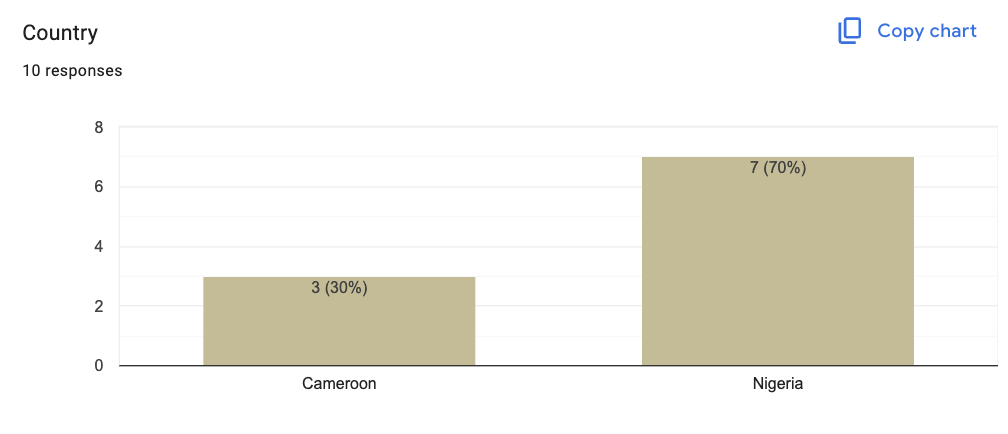
In other words, the same geographic concentration that several of our respondents (and a number of voices on Instagram) identified as a weakness in the original list is also present in our own data. We think this is worth stating openly. It does not invalidate the concerns raised. If anything, it reinforces them. But it is also a reminder that this is not a problem unique to one survey, one organisation, or one list. It is a structural challenge for anyone attempting to take the temperature of an industry this large, this dispersed, and this under-documented.
The Backlash on Instagram
While our survey was open, a parallel conversation was unfolding in the comments on our original post, one that surfaced several issues our survey only partially captured.
The Francophone Question
The most sustained line of criticism came from The Geek Chimp Mag, who argued that the list underrepresented Francophone Africa generally, and Zebra Comics specifically, a platform the commenter described as publishing more frequently and to a larger readership than any title that made the top ten. Titles such as Anaki, Beasts of Tazeti and Sugar Daddy Desires were cited as conspicuous omissions from the upper rankings, with Sugar Daddy Desires in particular described as one of the most-read African romance comics, with a readership in the millions across platforms in both French and English markets.
Comic Book Canon responded directly, noting that every title mentioned had, in fact, placed within the top 40 of the wider ranking, and that the project had specifically run both English- and French-language surveys to capture Francophone voices. The exchange also touched on a sharper accusation, that Nigerian voices dominate conversations about African comics more generally, which another commenter, Godwin Jackson, partly conceded while also noting that the survey’s respondent pool, not any single nationality’s “loudness,” shaped the result.
So where does the truth sit? The Francophone critique has genuine substance. A ranking that aspires to represent an entire continent and leaves out a major linguistic market’s best-known work from its upper tier is incomplete by its own stated ambitions. At the same time, Comic Book Canon’s counterpoint is also fair: placing those titles inside the top 40, and actively surveying in French demonstrates an intention to include that was absent from earlier efforts. The fairest reading is that the project tried to bridge the linguistic gap but did not reach far enough, and that the gap itself, that is, the structural disconnect between Anglophone and Francophone African comics scenes, remains a problem that no single survey will solve. Our own attempt, if any, will need to account for this explicitly in its regional design.
Creators, Not Readers
A separate but related tension emerged around what the list was actually measuring. Godwin Jackson questioned why titles with reportedly millions of readers had not been entered into the survey at all, if their fanbases were as large as claimed. Comic Book Canon clarified that the poll was explicitly a survey of industry creators and professionals, writers, artists, publishers, letterers, and was never intended as a readership or popularity poll. Both framings, of course, are legitimate; the friction arose because the list’s title and presentation did not always make that distinction clear to readers encountering it for the first time.
A Question of Consent: The Peda Entertainment Dispute
Not all of the reaction was about ranking or representation. Peda Entertainment, whose title Chayoma placed at number 12 on the list, issued a public statement objecting to its inclusion, stating that it had not been consulted and calling for its work to be removed from any future lists. The statement framed the inclusion as a potential misuse of the brand without its consent.
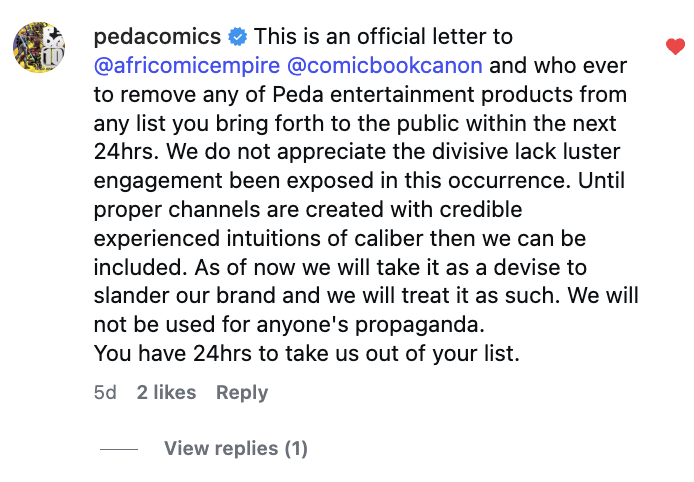
We are reporting this as part of the broader public reaction to the list, and as of publication, the matter has been largely resolved between the parties involved. It is, however, a useful data point in its own right: it suggests that “inclusion” in a list like this is not universally experienced as a celebration, and that any future project, including TheACE’s own, will need a clear process for how creators and studios are credited, contacted and given the opportunity to respond before publication.
The Long Memory
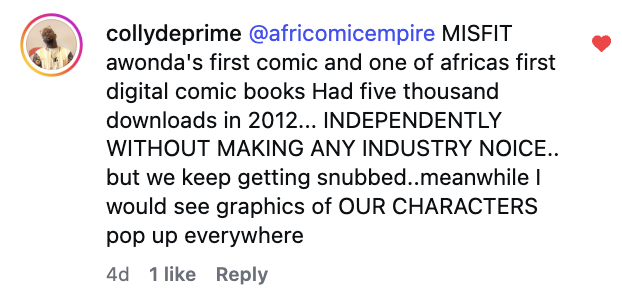
Finally, a thread that echoed one of our own survey findings: the question of historical recognition. Creator Adesugba Adedapo, also known as Collyde Prime, pointed to Misfit: Awonda, one of Africa’s earliest digital comics, which reportedly reached five thousand downloads independently as far back as 2012, long before much of the industry’s current visible infrastructure existed. The point, raised without bitterness but with evident frustration, was that “greatest of all time” lists tend to reward visibility over history, and that work done quietly, early, and independently is easy to leave out simply because it never made noise.
Where We Go from Here: Introducing TheAfrica100
Taken together, our survey and the public reaction point to the same conclusion from two different directions: a “greatest” list — ours or anyone’s — is not the right next step for this conversation right now. Our own respondents rated the existing list’s representativeness even lower than its critics did on social media, and several explicitly cautioned against TheACE producing a competing ranking for the same reasons the original list drew criticism: limited sample sizes, unclear criteria, and the risk of rewarding visibility over substance.
For the sake of transparency, it is worth addressing the sequence of events directly. Our latest idea/solution was not conceived in response to the survey results alone. It had been under preliminary discussion at TheACE prior to the survey being circulated, as part of a broader editorial review of how best to represent the continent’s output. The survey and public backlash sharpened the concept and confirmed the direction, but they did not originate it. We state this to be clear that we are not retroactively claiming our community gave us a mandate we did not already have; rather, the feedback helped us refine an idea already in motion.
So, we are not going to publish a “Greatest African Comics” list of our own. Instead, TheACE will be putting together TheAfrica100 to stand as a celebration, not a competition.
The idea is simple: roughly 20 to 25 notable comics projects from each of Africa’s five regions; West, East, North, Central and Southern Africa, for a total of approximately 100, presented in no particular order. No rankings, no “number one,” no debates about why one title sits above another. Just a wide, regionally balanced view of what is being made across the continent, old and new, widely read and quietly influential alike.
We are still finalising the methodology, and we intend to publish it in full before the project goes live, including how projects can be nominated, who will be involved in regional selection, and what criteria will determine inclusion. In broad terms, we expect it to involve open nominations from creators, publishers and readers within each region; input from collaborators based in or closely connected to each region, so that no single team is making calls about markets it does not know well; and published inclusion criteria, agreed in advance, so that being part of the list is a straightforward acknowledgement rather than a judgement call.
We do not expect TheAfrica100 to be perfect either. But we would rather build something additive, a wider net, cast deliberately, than add another ranking to a conversation that, by its own evidence, is not ready for one yet.
Thank you to everyone who took the time to respond to our survey, and to everyone who engaged, however heatedly, in the conversation on Instagram. This piece was shaped by those contributions, and the next one will be too.
— TheACE
--------------------------------------------------------
--------------------------------------------------------
AI Use at TheACE
TheACE uses artificial intelligence tools to support research, drafting and analysis across Africa’s creative industries. All content is verified, edited and approved by our human editorial team to ensure accuracy, clarity and responsible storytelling. AI assists our work; it does not replace human judgment.