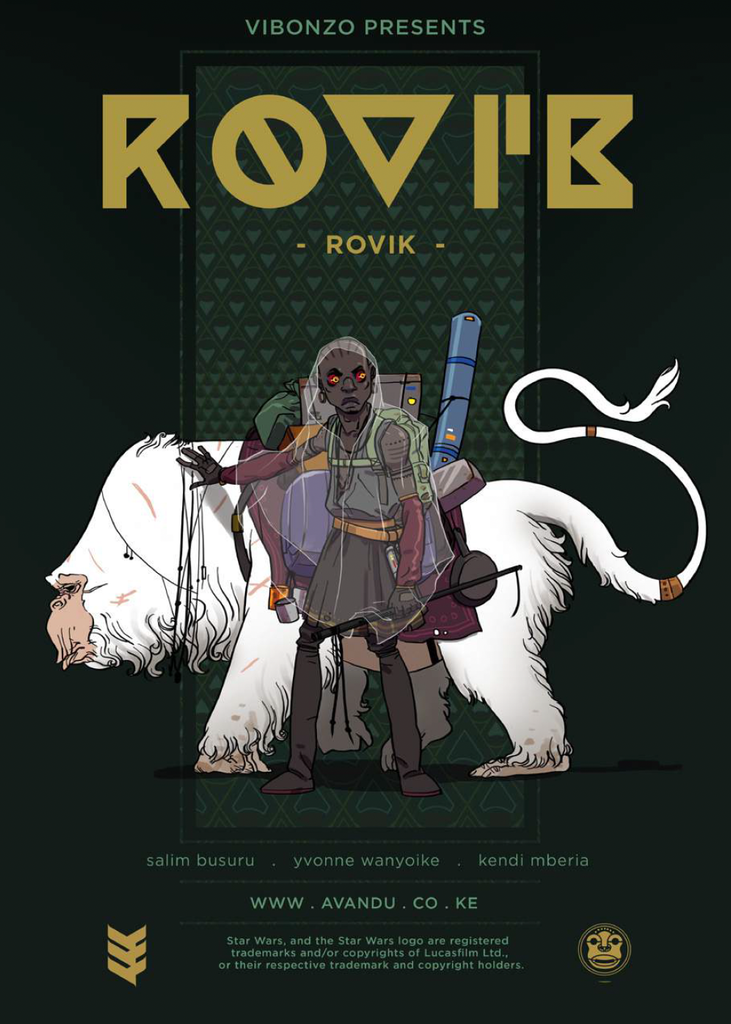
Fan fiction is usually an act of borrowing. A creator takes the surface of an existing universe: its costumes, its vocabulary, its iconography, and uses it to tell a story that could, in theory, exist without the borrowed skin. ROVIK, the 2018 graphic novel from Kenyan studio Vibonzo, does something more deliberate than that. It doesn’t just dress its characters as Jedi and Stormtroopers. It takes the single idea that makes the Star Wars galaxy legible as a political story, an empire that strip-mines conquered worlds to build its own weapon of annihilation, and points that idea directly at the Democratic Republic of Congo.
The comic announces this ambition before a single panel of art appears. Its title page carries a quote from Graça Machel’s real-world report on child soldiers, re-attributed as a “Galactic Report for the Jedi Council.” It is a bold piece of framing, and it tells the reader exactly what kind of fan fiction they are about to read: one using the language of empire quite literally, rather than decoratively.
That literalism extends to form. ROVIK is structured as four numbered prose chapters: “01. The Last Day at Kinshaza,” “02. Of the Planet Dukongo,” “03. The Invasion,” “04. Rumours of Death.” Each opens as short fiction before handing off to sequential art. It reads less like a traditional comic and more like an illustrated novel that occasionally lets the prose step aside so the drawing can finish a scene the words started. That hybrid form is unusual and confident enough to be one of the comic’s defining choices, rather than a stylistic accident.
The Narrative Arc: A Summary
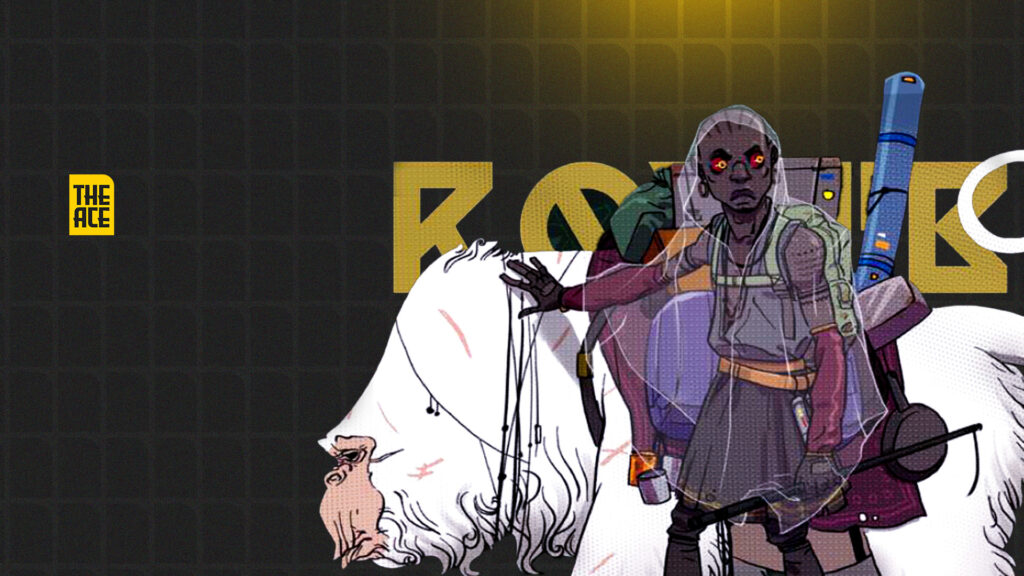
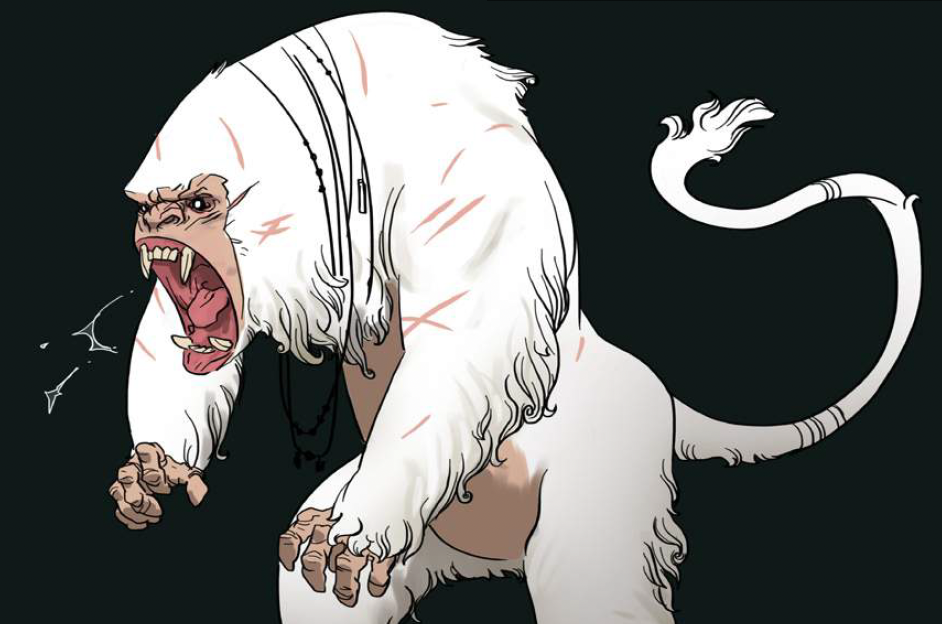
ROVIK opens in disorientation. Its protagonist wakes in total darkness, ribs cracked, hands the only thing visible against the black of the page. “Where am I?” he asks himself (p. 7), before recognising his own spear by touch alone: “I think that’s my spear… yes!” (p. 8). He is soon joined by Pazuzu, an albino “lemari,” a great ape-like beast that functions as his only constant companion, and confronted by three travellers, Okocher, Yekini, and Obafemi, whose motives remain unclear for much of the book. Rovik’s own warning to them is characteristically flat: “You can’t see, and I don’t want to kill you. Let me take you to your animal..” (p. 8). It is the first sign of a protagonist more weary than heroic.
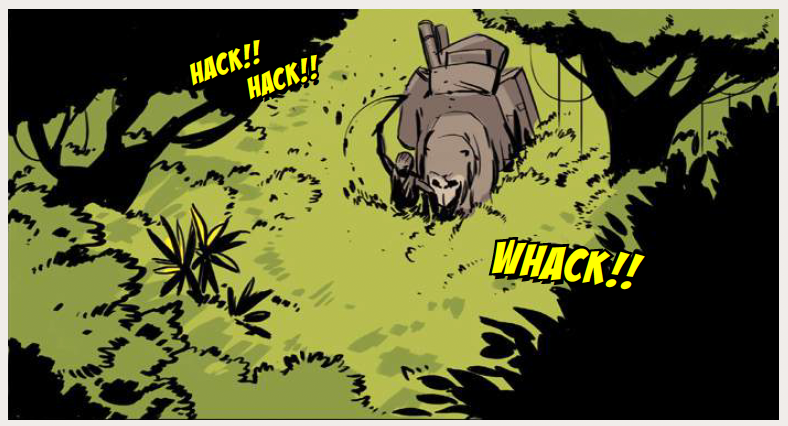
From there the story folds backwards. “A few hours before, in the Glysari jungle” (p. 9), Rovik is working a poaching job, hacking through brush behind a rhino hunt. The narrative then widens into a prose-driven planetary profile (pp. 19–21): the Republic of the Dukongo, an outer-rim world whose Effie-speaking population mines “Agrocite” under the corrupt, referendum-rigging rule of Supreme Chief Sassouman. Its Efkonfane underclass live in conditions the comic does not hesitate to call slavery. The mine, we learn, is feeding the Empire’s construction of the Death Star.
A childhood flashback follows (p. 31): Rovik and his friend Voke, born into the “age set of the red sky,” playing and squabbling under the shadow of an Imperial battleship that has appeared over their village. Young Rovik’s own words carry a bitterness the adult character has clearly inherited: “Jedi don’t come from the Effe people, idiot, or even our planet; we are farmers and miners” (p. 31). The scene ends in a raid. Voke’s fate, delivered later through an old miner’s monologue about digging graves with every spade of Agrocite: “with every spade that penetrates the mine, we are digging our own graves and those of countless others” (p. 33), becomes the engine for Rovik’s arc. It is a revenge plot that carries him and his uneasy mercenary allies through a brutal ambush (p. 50), toward Brazzaville, through a Stormtrooper-guarded gladiatorial pit (p. 65), and into an epilogue that ends on an unmasking: Yekini revealed, blade drawn, resolution withheld. Rovik’s own justification for what comes next is chilling in its plainness: “A life for a life, blood for blood. His allegiance sworn to the red sky” (p. 70).
The Critical Perspective: Visual Language as Allegory
The clearest formal choice in ROVIK is also its most effective. The disorientation sequence that opens the book is rendered as glowing white linework against total black, hands and spear-tip the only forms visible, before the story cuts hard into a fully saturated, sunlit colour palette for the jungle flashback. It is a legitimate piece of visual grammar rather than a stylistic flourish. Waking and memory are given genuinely different optical registers, and the comic trusts the reader to feel the difference before any dialogue explains it.
That confidence extends to the book’s full-page cosmic splashes, a ringed planet in eclipse, used purely as a chapter break with no dialogue at all. These pages function the way a well-placed silent panel does in stronger genre comics: as a place for the reader to exhale between violence.
The most loaded single image in the book arrives on page 65. A gladiatorial pit, a bloodied loser sprawled in the dirt, a baying crowd, and in the foreground, two Stormtroopers flanking a cloaked overseer, weapons held loose rather than raised. They are not the aggressors in this frame. They are simply present, an occupying force so normalised it has become furniture. It is the clearest wide-angle expression of the comic’s thesis: empire does not always need to swing the blade itself once local violence has been made to serve its purposes.
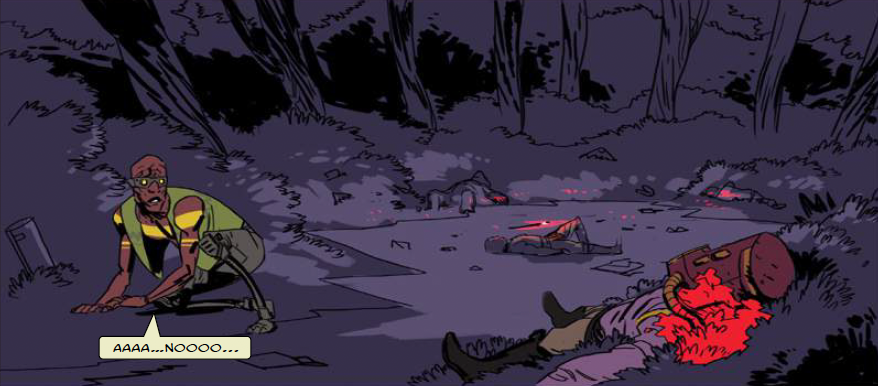
Page 50 makes the same argument at the opposite end of the lens. Where the arena is a public spectacle staged for a crowd, this is a private, unwitnessed killing rendered in tight, urgent panels. The page opens on a bruised-purple night palette, the whole scene lit as if the moon itself had gone the colour of a wound, with a wounded ally crawling toward a body already lost. The panel bleeds to the edge of the page as he cries “AAAA…NOOOO…” Two panels later, a headless corpse in yellow-green fatigues lies beside a helmeted figure whose visor holds two flat green scanner-lights, utterly still amid the spray of red, the only fully saturated colour on the page. Rovik’s own reaction, “…DAMMIT YEKINI!”, is boxed in the same restrained lettering used for every other line of dialogue in the book. It has the effect of flattening panic into procedure, as if grief, too, has become routine on Dukongo. The final tier cuts to a close-up of the killer’s mouth, teeth bared mid-scream, directly beneath a second panel of the same face now flat and blank, asking “…thank goodness,” his weapon’s green targeting lights still glowing beside his cheek. The juxtaposition, feral violence and clinical relief occupying the same face two panels apart, is the most unsettling piece of cartooning in the book. It says more about what this world has done to the people fighting its wars than any line of the planetary-profile text does.
Read together, pages 50 and 65 form the comic’s real visual argument. One shows empire as spectator; the other shows it as a machine that has already got inside the people it rules, turning them into instruments of exactly the violence the Empire benefits from. Neither scene needs a Stormtrooper on-panel to make its point, though page 65 has them and page 50 does not, a contrast worth noting whether or not it was intended.
The script reinforces this register through dialogue that refuses to sand down its texture for a wider audience. “..the Hell, I’ll kill you FOR THIS!!” (p. 35) sits a few pages from “ey manze, me I don’t play like that…” (p. 36) and “eish man! i thought we agreed o..” (p. 30). Words like “bana,” “kwani,” “manze,” and “nkt” sit alongside “smart-comm” and “bitmoney” without apology, letting regional vernacular carry cultural weight rather than explaining it away.
Room for Refinement
ROVIK’s ambition is also where its pacing runs into trouble. The prose-heavy Dukongo “planet profile” page, dense with the kind of exposition Wookieepedia entries are built from, arrives immediately after a strong, wordless cold open. The momentum the comic worked to build is spent absorbing paragraphs of political and economic backstory. The information matters to the allegory, but it is delivered as an artefact rather than dramatised, and the book never quite finds a way to fold it back into the story that follows.
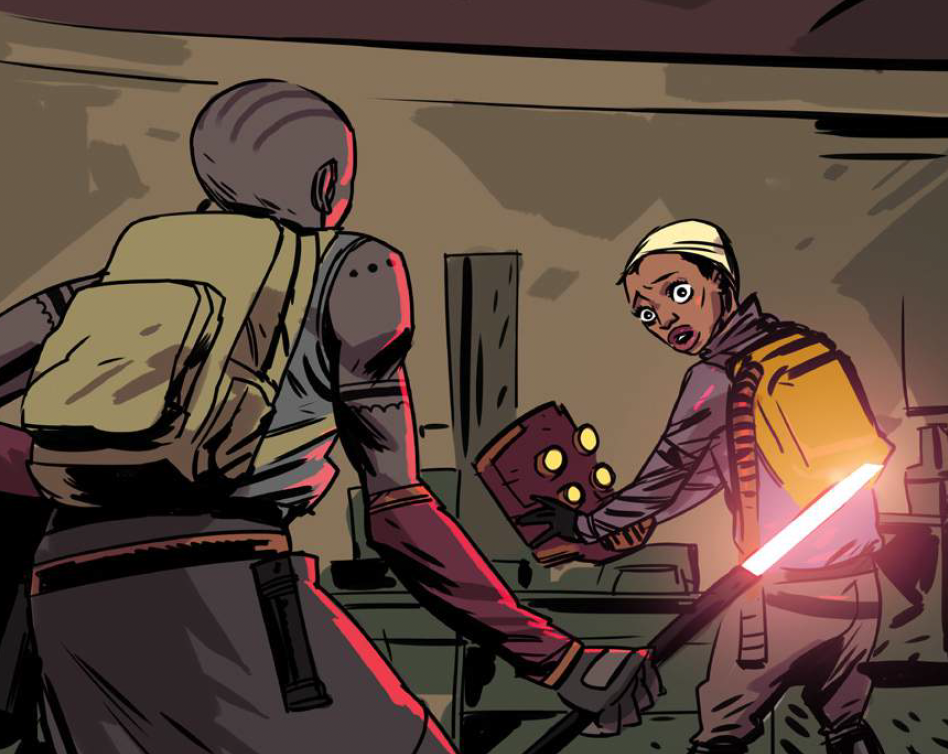
The ending suffers from a related issue. The epilogue cuts on Yekini’s unmasking with no reaction panel and no visual beat to close on. It reads less like a deliberate cliffhanger and more like a story that ran out of pages before it ran out of plot. A single additional panel, holding on Rovik’s face in the instant of recognition, would have given the cut the weight it is clearly reaching for.
There is also an emotional imbalance worth naming. Voke’s death, the entire engine of Rovik’s revenge arc, is delivered in prose, in a single paragraph inside a flashback, rather than dramatised on the page. The political satire around Rovik is vivid and specific; his own grief is comparatively undercooked. The book would be stronger if it trusted its cartooning to carry that loss the way it trusts it to carry Sassouman’s corruption or the Agrocite mines.
The prose-comic hybrid structure, while ambitious, is also inconsistently weighted. The four numbered chapters that open in short fiction (pp. 17, 19, 31, 33) are some of the strongest writing in the book, but because they arrive as unbroken text pages, they ask the reader to disengage from the comic’s own visual rhythm each time the story wants to deepen its worldbuilding. Dramatising even one of these chapter-openers as sequential art, rather than prose, would test whether the hybrid form is a genuine formal strategy or a workaround for scenes the art hadn’t been built for yet.
On the lettering side, the book is legible throughout, but its sound-effect typography swings across at least four distinct display fonts: jagged horror lettering for combat beats like “HACK!!” and “WHACK!!”, a separate bold slab for creature roars, and a softer serif for narrated captions. Individually, each choice is sound. Across ninety pages, though, the shifts start to feel more like font-library sampling than a deliberate register system, and a tighter SFX palette would give the violence more consistent weight.
Our Conclusion
ROVIK‘s real achievement is not its Star Wars cosplay. It is what that cosplay is made to do. By taking the Empire’s core mechanism seriously, an occupying power hollowing out a colonised world to fuel its own weapon, and mapping it directly onto conflict minerals, child soldiering, and dictatorship, Vibonzo’s team accomplishes something rarer than a well-drawn fan comic: a piece of political fiction that uses borrowed iconography to say something the source material never intended to say. The pairing of pages 50 and 65, one intimate and unwitnessed, one public and institutional, shows a creative team thinking in scenes, not just in themes, even when the connective prose chapters around them ask the reader to slow down and read rather than watch.
In his afterword, artist Salim Busuru is candid about why he chose this particular universe. He wanted a story where Africans existed inside a galaxy vast enough to hold them, and he was unwilling to sanitise the child-soldier material the way years of Western war media had quietly desensitised him to it. That candour matters. ROVIK is uneven in its pacing and unresolved in its ending, but it is never uncertain about what it is trying to say, and it says it with a seriousness that few fan comics, African or otherwise, bother to attempt.
As a piece of Kenyan comics history, ROVIK deserves to be remembered less as Star Wars fan art and more as an early, unpolished example of African creators bending someone else’s mythology until it could finally tell a story that was always theirs to tell.
——————————————————–
——————————————————–
AI Use at TheACE
TheACE uses artificial intelligence tools to support research, drafting and analysis across Africa’s creative industries. All content is verified, edited and approved by our human editorial team to ensure accuracy, clarity and responsible storytelling. AI assists our work; it does not replace human judgment.